
America: You Decide.
The Court Wouldn’t Hear It. We Will. Here’s How to Build the Venue They’re Too Afraid to Construct.

This idea is free.
But if you use it and forget my name, I’ll be the first case on your docket.
It’s happening again.
California. June 2, 2026. A primary election. Republican leads in the governor’s race and the Los Angeles mayoral contest begin evaporating as mail ballots arrive over the following days. The U.S. Attorney in Los Angeles, a Trump appointee named Bill Essayli, announces federal election fraud investigations and sends a prosecutor to observe ballot processing at LA County’s counting center. President Trump and his allies publicly allege cheating. California officials call it theater. Legacy media calls it a rerun.
It is a rerun. That’s the point.
We have now watched this movie twice. In 2020 and again right now in 2026, the pattern is identical: Republican leads shrink as mail ballots are counted, allegations of structural fraud are made publicly, cases are filed, and then—quietly, procedurally, without anyone ever seeing the evidence laid out in a courtroom—the cases get dismissed. Standing. Laches. Timing. Jurisdiction. Mootness. The legal vocabulary of we’re not going to look at this.
Over sixty cases after 2020. Dismissed. Not all on the merits. Many on procedure. Many because the plaintiffs waited too long, or because the court decided it had no jurisdiction, or because the candidate himself was ruled to lack standing to challenge the counting of votes cast for him. Which is a sentence that should bother more people than it does.
I’m not a lawyer. I’m a PR guy. I’ve been in communications for thirty years. I ran a firm. I understand how narratives move, how perception operates, how hearts and minds are won and lost. And what I know—what I have known since 2021—is that the people who felt cheated in 2020 made one catastrophic strategic error.
They kept trying to win in the courts.
The courts were never going to give them what they wanted. Not because the judges were all corrupt. Not because the evidence was nonexistent. But because courts are designed to find facts under rules that most of the public doesn’t understand, administered by people the public didn’t elect, producing outcomes the public can’t evaluate. And when those courts dismiss cases on procedural grounds before the evidence is ever heard, the public is left with nothing—no verdict, no hearing, no moment where someone laid it all out and let them decide.
What if someone built that moment instead?
What if—every single time a case got dismissed on standing, on laches, on jurisdiction, on mootness—there was a venue waiting? A place where the aggrieved party could walk in, lay out their case, face genuine opposition, and then hand it directly to the American public with six words:
America. You Decide.
The Concept
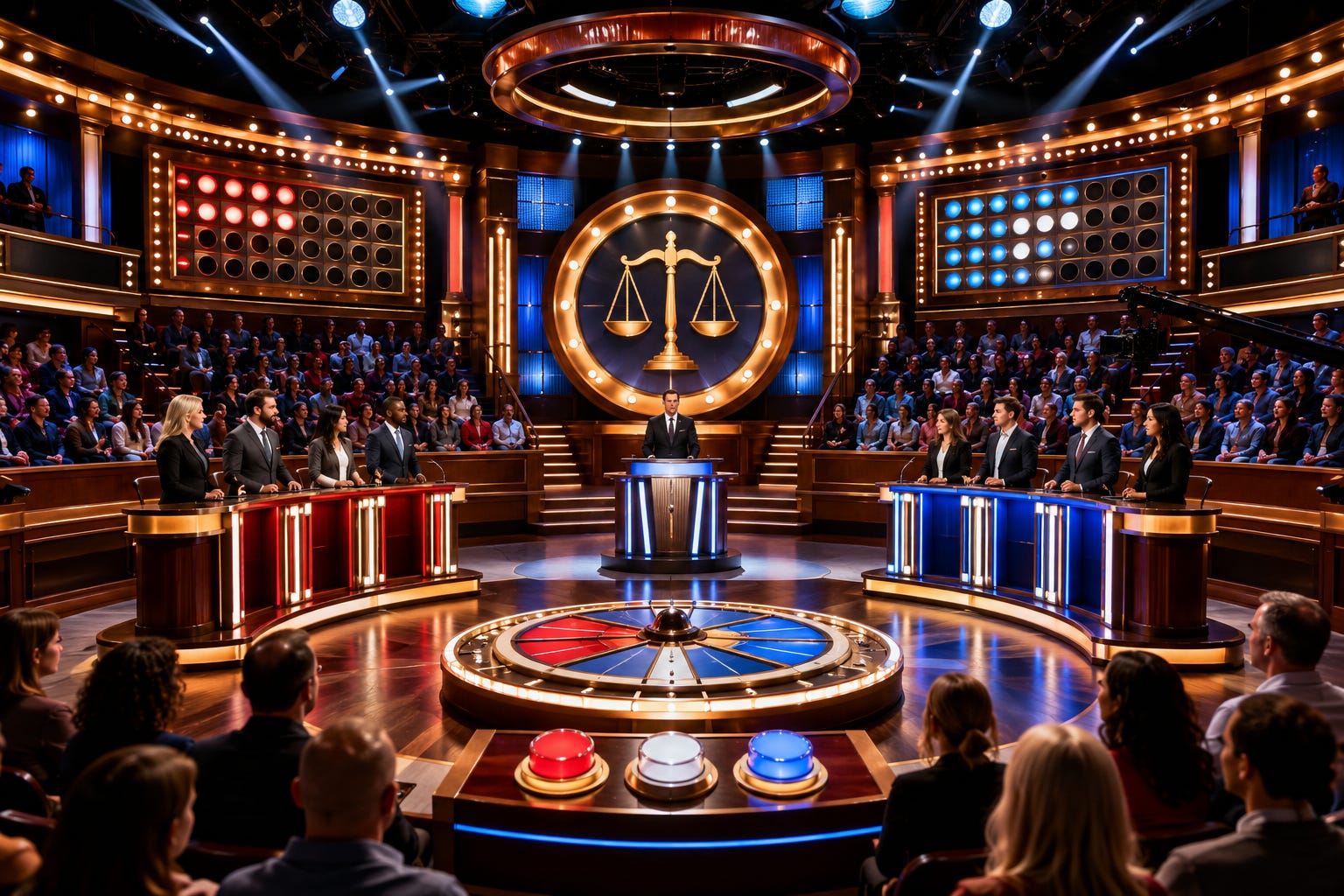
America. You Decide. is a mock tribunal platform—a YouTube channel, a Rumble channel, a podcast feed, and a Substack—where procedurally dismissed legal cases get their day in the only court that has ever actually mattered: public opinion.
It is not a news show. It is not a political talk show. It is not a rally with better production values.
It is a show trial in the best possible sense of that phrase—a structured, procedurally rigorous, genuinely adversarial legal proceeding, performed for an audience, with no verdict except the one the audience renders for themselves.
This is not a MAGA platform. This is not a progressive platform. This is a format. The format has one principle: if you were denied your day in court on procedural grounds—not because your evidence failed, but because the system said it couldn’t even look—you get your day here. That applies to election integrity cases. It applies to deplatforming cases. It applies to vaccine mandate cases. It applies to January 6th individual defendants. It applies to any cause, any grievance, any direction on the political compass, as long as the courthouse door was closed before the evidence was heard.
The J6 committee understood something the political opposition never learned: a legal proceeding performed as television is more powerful than an actual legal proceeding. They hired a TV producer. They did primetime. They controlled the narrative arc. They had graphics, emotional testimony, a beginning, a middle, and an end. The other side watched it happen and built nothing in response.
This is the response. Four years late. But California 2026 means it’s not too late.
Why It Works
The format already exists and people love it.
Court TV. Judge Judy. Making a Murderer. Serial. The People v. O.J. Simpson. Americans are completely fluent in legal proceedings as entertainment. The procedural form is inherently dramatic—opening statements, witness examination, cross-examination, closing arguments. We know how it works. We trust the shape of it. We find it compelling even when we know the outcome.
The dismissal is the story.
Every case that comes through this platform was denied its day in real court. That denial is not a weakness—it’s the entire premise. The framing is not we are claiming fraud. The framing is the system said we couldn’t even ask the question. So we’re asking it here. In front of you. Right now. That is an enormously sympathetic posture that even skeptics have difficulty attacking. You’re not making a claim. You’re performing a process.
You don’t need e-discovery to win hearts and minds.
Real trials run on documentary evidence that takes years to surface. This doesn’t. What you need is a coherent narrative, credible witnesses, compelling advocates, and genuine opposition. In speech and debate—I was on the team, I know—eighty percent of winning is charm. Comfort. Being relaxed. Smiling. Rolling with the punches. Not getting angry when the other side scores a point. The evidence supports the argument; the argument doesn’t carry itself.
Assigned counsel makes it legitimate.
This is the structural masterstroke, and it’s borrowed directly from how law and debate actually work.
The opposition counsel—the defense—does not choose their side. They are assigned it. Exactly like a public defender. Exactly like a moot court competitor. Exactly like a high school debater who draws the con position on a Tuesday and argues it Wednesday. You get what you get, and you argue it with everything you have. That’s the discipline. That’s what makes you good.
This means the defense pool is wide open. Conservative law students, libertarian pre-law undergrads, progressive young lawyers, centrist debate champions—anyone with the skills and the willingness to be assigned a position and perform it rigorously. You cannot call it rigged when the opposition had no choice in their assignment. You cannot call it propaganda when the defense is doing exactly what every public defender and moot court competitor has always done.
And occasionally the assigned defense wins. Which is fine. Which is great. Which is the whole point.
The ending is the whole point.
There is no verdict. No judge renders a decision. No jury announces a count. The host turns to camera and says:
“You’ve heard the case. You’ve heard the opposition. You’ve seen the evidence that the court would not allow through its doors. Now it’s your turn.”
Cut to black.
America. You Decide.
That ending is more powerful than any verdict because it respects the viewer. It says: we trust you. Which is the precise opposite of what every institution has communicated to the American public for the last ten years.
The Format: Rules of Engagement
The Submission Process
Any person, organization, or legal team whose case was dismissed on procedural grounds—standing, laches, mootness, jurisdiction, timing—without a full hearing on the merits may submit their case for consideration.
Submission requirements:
Complete case documentation including original filings and the dismissal ruling
A written summary of the evidence they intended to present
A statement of what remedy they sought
Contact information for the principal party or their legal representative
Editorial standard for acceptance: The case must have been procedurally blocked from a hearing on the merits. The platform takes no position on whether the underlying claim is true. It only requires that the case was denied its day in court for reasons other than the evidence itself.
This standard is completely defensible. You are not endorsing the claim. You are providing a venue for claims the legal system declined to evaluate. Cases come from any direction. The format is the principle, not the politics.
The Prosecution
The prosecution—the party making the allegation—presents their case through a team of advocates. These advocates are not the original lawyers. They are pundits, podcasters, personalities, celebrities, former officeholders, subject matter experts—anyone with platform, credibility, and the ability to perform an argument compellingly.
The prosecution team has wide latitude in how they present. They may call witnesses, present documentary evidence, use graphics and video, be theatrical, emotional, or forensic—whatever serves the argument.
The prosecution gets the charming bastards. That’s not bias. That’s reality. The people who feel wronged are always more compelling than the people defending a process. The format reflects this asymmetry honestly.
The Defense
The defense is always drawn from a standing pool of law students, pre-law undergraduates, young lawyers, and debate champions who have volunteered to participate in the platform’s assigned-counsel system.
They do not choose their cases. They are assigned them—exactly as public defenders are assigned clients, exactly as moot court competitors are assigned positions, exactly as debate teams draw their side the morning of the tournament.
The pool is deliberately ideologically diverse. Conservative, progressive, libertarian, centrist—all are welcome, because none of them are being asked what they believe. They are being asked whether they can argue. Rigorously. On assignment. Under pressure. That is the credential.
The platform has a standing obligation to find the strongest possible assigned defense for every case. A weak defense is propaganda. A strong assigned defense that loses anyway is persuasion. The difference matters enormously.
The Presiding Officer
Every proceeding is presided over by a neutral figure—a retired judge, a law professor without strong public partisan affiliation, or a respected legal commentator who reads as a genuine referee. They rule on objections. They manage time. They maintain decorum. They are not there to be entertaining. They are there to make everyone else’s performance credible.
The presiding officer is the single most important casting decision in the operation. Get this wrong and the whole thing looks like a rally.
The Empty Chair Doctrine
If a party relevant to the case—an election official, a government agency, a private company—declines to participate or does not respond to a formal invitation, the platform invokes the Empty Chair Doctrine:
The invitation is documented and placed on screen
The non-response is noted for the record
A volunteer advocate presents the steelman version of what that party would have argued
The chair where they would have sat remains visibly empty
This is not a trick. 60 Minutes has done this for fifty years. You document the invitation, you note the refusal, and you present the best possible version of the argument they declined to make. You have now been more fair than the original proceeding that dismissed the case without looking at the evidence.
The Chyron
Running continuously at the bottom of every frame, in every episode, at every moment:
“MOCK TRIBUNAL — NO LEGAL AUTHORITY — FOR PUBLIC INFORMATION ONLY”
Rotating with:
“THIS CASE WAS DISMISSED BY [COURT] ON [DATE] — THE MERITS WERE NOT ADJUDICATED”
And:
“THE AUDIENCE SERVES AS JURY — AMERICA. YOU DECIDE.”
These rotate every thirty seconds. They are never removed. They are the premise stated plainly and proudly. They are not a reluctant disclaimer—they are the entire point of the show made visible in every frame.
The Ending
Every episode ends the same way. The host turns to camera. No summary. No editorial.
“The [court name] said this case couldn’t be heard. We heard it. Now you’ve heard it too.”
Pause.
“America. You Decide.”
Black screen. Five seconds. End card with submission information for the next case.
No verdict. No tally. No winner. The public, trusted to figure it out.
The Talent
The prosecution side draws from anyone with platform, passion, and performative ability. The roster is deliberately cross-partisan—the whole operation collapses if it reads as one team dressed up as a court. Some names that suggest the range:
Populist Right
Sidney Watson—sharp, Australian, withering skeptical cross-examination energy. The outsider who sees through American BS.
Brett Cooper—articulate, compelling, makes content shareable across audiences who’d never watch something that felt nakedly partisan.
Shoe0nHead—brings the debate community and the intellectually restless crowd who respect rigorous argument over vibes.
Tim Pool—the skeptical everyman persona plays perfectly in a proceeding format.
Steven Crowder—committed, adversarial, has the debate training and the willingness to go long.
Heterodox Left & Anti-Establishment
Jimmy Dore—heterodox left credibility that makes the operation un-attackable from the pure-partisanship angle.
Russell Brand—chaotic barrister energy, loves performative truth-seeking, crosses into audiences none of the others reach.
Briahna Joy Gray—legally trained, combative, economically left and institutionally skeptical. Former Bernie Sanders press secretary. Argues her assignments with genuine rigor.
Krystal Ball—economic populist left, anti-war instincts, deeply critical of Democratic leadership. Half of Breaking Points.
Ana Kasparian—progressive voice who has increasingly criticized excesses within progressive orthodoxy. Reaches viewers who won’t accept a right-coded messenger.
Bridge & Cross-Partisan
Glenn Greenwald—civil-libertarian, anti-war, hostile to intelligence agency overreach and media orthodoxy. Draws from the old left, libertarian right, and anti-establishment center simultaneously.
Matt Taibbi—investigative populist journalist with credibility across anti-establishment liberals, independents, and the populist right. Best role: “Here are seventeen documents showing that everybody lied.”
Saagar Enjeti—nationalist-populist right, skeptical of libertarian economics and Republican orthodoxy. The other half of Breaking Points. Can disagree with Krystal Ball in the same room without pretending the other is an escaped zoo animal.
Batya Ungar-Sargon—economic populist bridge. Speaks sympathetically about working-class concerns across partisan lines without turning every hearing into red-versus-blue karaoke.
Robby Soave—libertarian connective tissue: civil liberties, due process, free speech, skepticism of both progressive cultural power and right-wing state power.
Center & Presiding Personalities
Megyn Kelly—right-leaning but with significant mainstream-media experience and genuine courtroom fluency from her legal background. Best role: presiding officer or senior prosecutor.
Coleman Hughes—measured, philosophically liberal, unusually disciplined in debate. Best role: reasoned dissent and evidence review.
Piers Morgan—not an American centrist but an excellent moderator for ideological collisions. Television-literate, combative, willing to host figures from opposite extremes. Warning: has a habit of joining the boxing match after ringing the bell.
Jon Stewart—center-left but trusted by many viewers who dislike Democratic consultants, corporate media, and official euphemisms. Can puncture both the right’s theatrical nonsense and the left’s bureaucratic vapor language. Best role: chief satirical examiner or closing monologue.
Bill Maher—liberal, anti-Trump, anti-progressive-orthodoxy, and temperamentally incapable of remaining inside anybody’s coalition tent. Best role: irritable senior juror who keeps asking why everyone has become insane.
This is not an exhaustive list. It demonstrates that the talent pool is enormous, willing, and would show up because this format is genuinely interesting to people who like argument.
The defense is always the assigned pool—smart, earnest, sometimes gangly, definitely nervous, straightening their ties on camera. Genuinely trying to win their assignment. Sometimes winning. The contrast between the passionate prosecution team and the rigorously prepared but outgunned assigned defense is not manufactured—it’s the reality that people with grievances are more compelling than people defending processes. The format reflects the world honestly.
The Platform
YouTube—primary distribution, broadest reach, searchable, shareable, embeddable everywhere
Rumble—redundant distribution ensuring content cannot be deplatformed into nonexistence
Podcast feed—every episode drops as audio simultaneously. The driving audience is enormous and they are exactly the demographic this content serves
Substack—case documents, pre-episode briefings, post-episode analysis, submission calls, community. The intellectual infrastructure and the permanent archive
The combination means the content is essentially indestructible. Pull it from YouTube and it’s on Rumble. Pull the video and the podcast remains. The Substack is the archive that never goes away.
A Note to Whoever Builds This
I am a PR guy in Arlington, Virginia. I have a Substack, a Glock 19, and thirty years of understanding how narratives move people. I do not have the funding, the infrastructure, or the bandwidth to build this myself. My podcast has mouldered for ten weeks. I am not the guy to execute this.
But I designed it. Every rule, every casting instinct, every structural decision in this document came from me. The format, the ending, the empty chair, the chyron, the assigned-counsel defense, the mockumentary texture—mine.
I am publishing this completely. Open source. Take it. Build it. Make it real. You have my blessing and my complete design document.
But if you make money from this and you forget my name, I will be your first case.
Find me. You know how the internet works.
Appendix: The Dungeon Master’s Guide
Everything you need to run this. Pick it up at the front door.
A. Submission Standards and Intake
Qualifying Criteria
A case qualifies if:
It was filed in a federal or state court
It alleged election fraud, procedural irregularity, or constitutional violation in an electoral process
It was dismissed, in whole or significant part, on procedural grounds: lack of standing, laches, mootness, lack of jurisdiction, failure to state a claim, or withdrawal under judicial pressure
The merits of the underlying factual allegations were not fully adjudicated
Disqualifying Factors
The case was heard fully on the merits and evidence was found insufficient
The plaintiff has ongoing active litigation in the same matter
The plaintiff refuses to participate or provide a representative
Required Documentation
Original complaint or petition
Court dismissal order with full text
Docket showing procedural history
Summary of intended evidence
Names and contact for proposed witnesses
Any affidavits, expert reports, or documentary evidence assembled for the original case
Review Process
A small editorial committee—at least one attorney, one journalist, one producer—reviews submissions for completeness and qualifying criteria. They do not evaluate whether the claim is true. They evaluate whether the case was procedurally blocked. This distinction must be maintained absolutely and communicated publicly.
B. Episode Structure
Pre-Episode (one week prior on Substack)
Full case summary in plain language
Links to all public court documents
Statement of what the plaintiff alleges
Statement of what the defense will argue
Identification of all participants
Episode Runtime: 90 Minutes
Opening (10 min)—host introduces case, parties, procedural history; presiding officer states rules; chyron established
Prosecution Opening Statement (10 min)—lead advocate presents narrative; no interruption; documentary evidence permitted
Defense Opening Statement (10 min)—assigned defense lead presents counter-narrative; no interruption
Prosecution Case-in-Chief (25 min)—witnesses called and examined; documents introduced; defense cross-examines
Defense Case (15 min)—defense witnesses and arguments; prosecution cross-examines
Empty Chair Segment if applicable (5 min)—invitation documented; steelman presented; chair labeled and visible
Closing Arguments (10 min)—defense closes first (5 min); prosecution closes last (5 min)
The Ending (5 min)—host to camera; no summary; no editorial; “America. You Decide.”; black
Post-Episode (immediately on Substack)
Full transcript
All evidence documents linked
Submission call for next case
C. The Assigned-Counsel Defense System
The defense pool operates exactly like a public defender’s office crossed with a moot court program.
Building the Pool
Establish relationships with pre-law organizations at universities across the political spectrum
Partner with law school moot court programs
Recruit from national circuit high school speech and debate programs
Connect with young lawyers associations regardless of political affiliation
Assignment Protocol
Cases are assigned to defense teams 14 days before filming
Defense teams receive full prosecution disclosure: all evidence, witness list, planned arguments
Defense teams may request a continuance of up to 7 additional days for complex cases
Defense teams argue their assigned position. Period. This is non-negotiable and is the entire credibility mechanism.
Compensation
Pay honoraria. Treat them with respect. Their performance is what makes everything else credible. A platform that exploits students for free labor to make its star advocates look good is not a platform worth building.
D. The Empty Chair Doctrine: Full Protocol
Send formal written invitation via certified mail and email. Give 14 days to respond.
Publish the full text of the invitation on the Substack, timestamped.
Note publicly that no response was received by the deadline.
Host states on air: “[Party] was invited to participate. They did not respond. We will now present the strongest possible version of the argument they would have made.”
A physical chair, labeled with the party’s name, remains visible in frame.
The steelman advocate presents the absent party’s best argument—genuinely, rigorously, charitably.
The Empty Chair Doctrine is your single most powerful editorial tool. It makes refusal to participate visible and consequential without requiring you to claim anything about why they refused.
E. The Chyron: Exact Language
Rotating lower-third, never removed:
“MOCK TRIBUNAL — NO LEGAL AUTHORITY — FOR PUBLIC INFORMATION ONLY”
“THIS CASE WAS DISMISSED BY [COURT] ON [DATE] — THE MERITS WERE NOT ADJUDICATED”
“THE AUDIENCE SERVES AS JURY — AMERICA. YOU DECIDE.”
F. Platform Integrity Rules
Never declare a winner. The platform renders no verdict. Ever.
Always assign the strongest possible defense. A weak defense is propaganda.
Publish all documents. Every piece of evidence presented is published in full on the Substack.
Correct the record. If a factual error is made in an episode, a correction is published promptly and prominently.
Accept cases from any direction. The format is the principle, not the politics.
The mockumentary rule. Confessional camera segments are permitted and encouraged. Clearly labeled. Not testimony.
No ideological litmus test for defense counsel. Assigned means assigned.
G. The Ending: Exact Script
These are the only scripted words in the entire operation. Everything else is performed. This is fixed.
HOST:
“[Court name] said this case couldn’t be heard.”
“We heard it.”
“You’ve heard it too. The evidence. The opposition. The argument the legal system said it didn’t have time for.”
“We had time.”
“Now so do you.”
[Pause. Three seconds minimum.]
“America.”
[Pause. One second.]
“You Decide.”
[Cut to black. Hold five seconds. End card.]
Chris Abraham is a PR and digital strategy consultant operating through Gerris Corp in Arlington, Virginia. He designed this. If you build it and make money and forget his name, he’ll see you in the first episode.
America. You Decide. is an open concept published with full prior art intent on June 8, 2026. The design, structure, rules, format, and editorial framework described in this document are the intellectual work of Chris Abraham.