
Bernstein Core
How Radical Chic Became a Majority Lifestyle

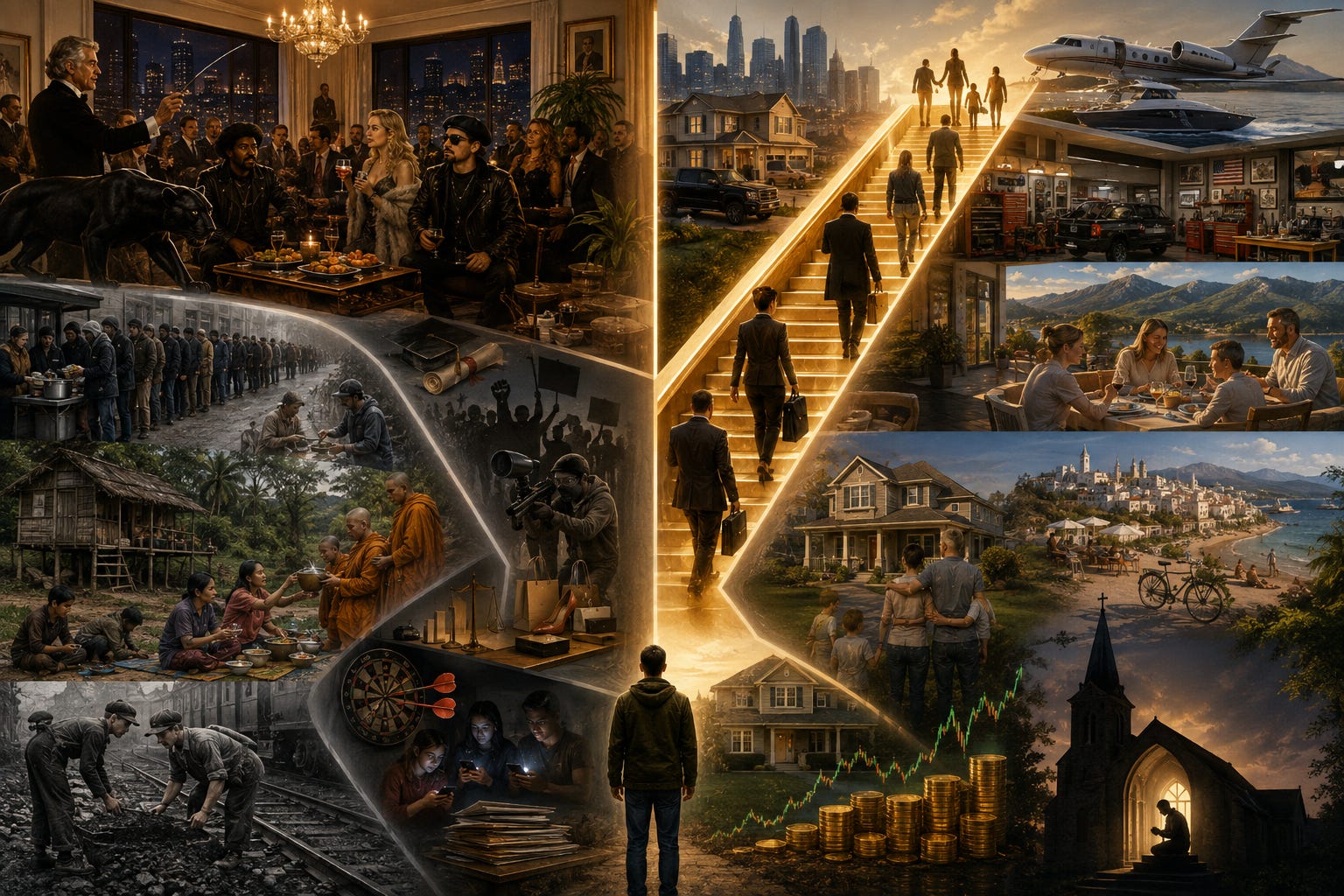
In 1970 the guilty rich who threw parties for revolutionaries were a tiny, strange species. Today roughly half the country lives inside the same contradiction, and that is the real reason socialism cannot get traction in America.
In January 1970, Leonard Bernstein hosted a fundraiser for the Black Panthers in his Park Avenue duplex. Tom Wolfe turned it into "Radical Chic," an essay that has survived fifty years because the type it skewered was so rare and so recognizable: a thin slice of the very rich, performing solidarity with people whose actual lives they would never trade for, three feet from the hors d'oeuvres.
The type didn't disappear. It scaled. Something like half of American households now live comfortably enough, casually enough, to play some version of Bernstein's game, whether or not they'd ever host a fundraiser in a duplex. Call it Bernstein Core: more people than ever feeling proprietary, paternalistic concern for a share of the population that keeps shrinking relative to them. That inversion, more guilt, fewer people left to justify it, is the actual shape of the American economy right now, and it explains why every attempt to import European-style socialism into this country keeps failing to catch.
The K didn't break in half. It broke upward.
The K-shaped economy gets described as a story of collapse, the middle class hollowed out, one leg of the K plunging toward ruin while the other rockets off. That's not quite what happened. The bottom hasn't collapsed so much as failed to keep pace. What actually happened is that an enormous number of Americans got yanked up the right leg of the K into a standard of living that would have been unimaginable to their own grandparents, while a much smaller number stayed roughly where they'd always been.
The numbers back this up more than the popular narrative expects. America now has around twenty four million millionaires, close to forty percent of all the millionaires on Earth, despite having about four percent of the world's population. On billionaires, the U.S. has somewhere around eight hundred, more than China, Germany, and India combined. On the centi-millionaire tier, the hundred-million-and-up crowd, America holds roughly a third of the global total. Last year alone the country minted something like eleven hundred new millionaires a day.
None of that is income. Income and net worth are two different measurements, and the net worth numbers are where the real wall shows up. The Federal Reserve's own data puts the line between the bottom half of American households and the top half at around a hundred ninety two thousand dollars in net worth. Flip that around: something close to half the country already sits above the two hundred thousand dollar line once you count home equity, retirement accounts, and other assets, not salary. That's not a privileged sliver. That's tens of millions of households with something real to protect.
The wall doesn't behave like history's other walls
Every prior socialist upheaval, Russia in 1917, China in 1949, Cuba in 1959, happened against a numerically tiny propertied class sitting on top of an overwhelming, genuinely desperate majority. You could isolate the czar, the landlords, the compradors, because there weren't many of them and everyone else had nothing. That math doesn't exist here anymore. It's structurally closer to trying to overthrow a country where half the population owns the palace.
Watch what the far left actually targets now, and the shift gives it away. A hundred years ago the number of millionaires and the number of billionaires were much closer together, a small class you could plausibly squeeze. Today the activist rhetoric has narrowed almost entirely to billionaires, a few hundred people, because millionaires and what might as well be called hundred-thousandaires have multiplied past the point of being a coherent villain. You can't build a revolution's energy around a class that includes a fifth of the neighborhood.
And the wealth in that broader class doesn't even look like wealth in the way anyone expects. The people this country has spent decades calling white trash, hicks, and flyover rednecks are, by historical standards, richer than they have ever been, just not in ways that register on the usual dashboard. Land paid off decades ago. A garage built specifically to fit the truck collection. A hundred guns and enough ammunition to make competitive shooting as expensive a hobby as golf. None of that reads as money to someone calibrated on Manhattan or the Bay Area, so an entire tier of American wealth stays functionally invisible to the people most convinced they understand who has power.
Even geography backs the same point up further than most people assume. Mississippi, the poorest state in the country, sits close to Germany in GDP per capita and beats the UK, France, Italy, and Spain outright. The honest European competitors to American state-level wealth are places like Switzerland and Norway, not the imagined European utopia invoked in most of these arguments. Rich Americans envy European healthcare and vacation time. Rich Europeans, when you actually sit with the numbers, are less rich than a lot of supposedly poor Americans.
Happiness is not the same instrument as contentment
Push back with the happiness index and Europe wins most years, and that's true, but it's measuring something different than money. I lived in Berlin for three years and in Utrecht and Norwich before that, and what struck me wasn't misery, it was a completely different relationship to more. Tiergarten on a Sunday, a cheap flight to Ibiza, a subsidized beer, a bicycle to the lake, a shared community pool: none of that reads as deprivation. It reads as a culture that settled on a lower ceiling a long time ago and stopped pushing against it. Americans want the upgrade, the fourth star, the extra car, the summer home. Europeans, in my experience, want the walk through the park. Different value systems produce different scores on a happiness survey, and calling the American score worse is a category error. It should be called a contentment index, and contentment is not the same thing as winning.
Pace of life tells the same story sideways. The Netherlands and rural England felt, to me, closer to Alabama than to Massachusetts, an entire continent generally running slower than the American coasts, with obvious exceptions, Paris moves fast, and getting through a German grocery line feels like a Formula One start. But the overall rhythm still lands closer to the American South than to the American hustle.
Even the regional resentments map cleanly onto each other. Everyone outside London insists London isn't England. Everyone outside Paris insists Paris isn't France. And Bavaria has spent decades in actual court, suing over the fiscal transfer payments that send its money to Berlin and the rest of the country, the exact same resentment California voices about subsidizing the rest of America, just with better lawyers and older grievances.
The baseline quietly moved and nobody announced it
Primetime television used to run ads for Hamburger Helper and Tuna Helper, aimed at households that genuinely needed to stretch a pound of ground beef. Nobody runs those ads now, not because the products vanished, but because the median household stopped needing the stretch. "The Jeffersons" moved on up to a deluxe apartment with none of the trimmings anyone would call rich today, no driver, no car collection, no garage built to house one. Seasonal wardrobe rotation used to be an Upper West Side grande dame's affectation. Now it's a Lands' End catalog aimed at everyone.
None of this requires astronomical wealth to explain. It requires ordinary disposable income at a scale that simply didn't exist across the broad middle of the country forty years ago. The viral TikTok complaint about men assuming a date only cost twenty dollars, when she actually spent eight hundred on the dress, five hundred on the hair, two hundred on the nails, doesn't read as evidence of anyone's poverty. It reads as evidence of casual discretionary income, or at minimum enough confidence in future income to leverage against it. Either way it's a world away from anyone actually going without.
Drop the median comfortable American today into 1985 and they'd read as Gordon Gekko.
Dating became a discernment exercise
Once wealth splits this unevenly, figuring out which side of the K someone landed on becomes part of courtship itself, whether anyone admits it or not. I broke on the left half of the K, barely. My friend Mark broke hard on the right side, and it makes some conversations between us genuinely difficult. He'll mention, half as a humblebrag, how much the fusion restaurant cost, how the food was mediocre but his wife insisted, and I have nothing to offer back except silence, because I've never lived inside that particular problem. Oscar Wilde would have had a field day with Mark's exhaustion at his own itinerary, the fatigue of flying to Ibiza and complaining about how tiring Ibiza was. It's not that Mark is a bad person. It's that people raised on social justice vocabulary are having a genuinely hard time metabolizing the fact that they are, by any honest measure, deep on the right side of the same K they grew up being taught to critique.
Skin in the game, or the absence of it
There's a test worth applying to anyone who claims the mantle of the vanguard: would they actually do what the fisherman Peter did, drop the nets, the boat, the whole livelihood, without hesitation, the moment the cause called for it. Most people who talk like revolutionaries would not pass that test. The trust fund kid who dresses down to date someone poorer, keeps the trust fund. The activist who takes a rubber bullet at a protest is furious that it wasn't supposed to hurt. It's the airsoft park version of revolution, all the theater of risk with an assumption that the bullets aren't real.
Ted Kaczynski is the uncomfortable exception worth sitting with, not because what he did afterward wasn't monstrous, it was, but because he actually passed the test everyone else fails. A Harvard-trained mathematician, a genuine bishop of the American secular hierarchy by any social measure, who looked at his own position on the right side of the K and walked away from all of it. Whatever else he was, he wasn't performing.
The scarcity of genuine suffering
I spent ten years volunteering at Miriam's Kitchen in DC, and what I watched over that decade wasn't just an organization drifting toward advocacy work, though it did, pivoting hard from simply serving meals in Foggy Bottom toward policy campaigns and corporate sponsorship. What I watched was something closer to competition. The DMV is thick with people holding degrees in social work, sociology, psychology, more credentialed advocates, by a wide margin, than there are people left to genuinely, catastrophically suffer. He's my homeless client. No, he's my undocumented case. No, she's my domestic violence survivor. There's a version of this that's cynical rather than merely crowded: an institution that runs out of crisis runs out of funding, so the crisis has to be maintained as much as solved.
That's the darker mechanical cousin of Bernstein Core. It's not just that more people than ever feel entitled to speak for the suffering. It's that an entire professional class now depends on the suffering not running out.
What real poverty actually looks like
In 1996 I spent time in a rural community near the Laos border with Thailand, not as a tourist, sleeping on a mat in a raised house, picking rice, getting scabies, unable to communicate because nobody spoke English and my Thai didn't exist. The family there wasn't performing contentment for a photographer. They said, more or less, that they had everything they needed, that the land gave them fish and reptiles and fruit trees planted around rice paddies raised on platforms above the marsh, and that nobody was taking everything from them. Every morning before dawn, families across that region rise to prepare food and carry it to Buddhist monks in a ritual called tak bat, feeding the monastery before feeding themselves, then bringing the leftovers home. It's the same posture as the widow's mite in the Gospels, the woman who gave two coins because that was everything she had, except it's not a singular parable there. It's Tuesday.
Set that against an American culture that treats a mandatory ten percent tithe as an imposition. I'm careful here, because the line between honoring that and romanticizing it is thin, and I don't want to become the free diver who drops down for one deep breath and claims he understands what it's like to live at pressure. I don't. I surfaced. They didn't.
What I don't have any hesitation about is naming the actual scale of the shift within a single American lifetime. My own father, born in 1939 in a Hungarian immigrant community in New Jersey, talked about neighbors stuffing newspaper into their jackets for warmth and running down the tracks to grab coal that fell off passing trains. That was the American poverty class, not that long ago, before it got renamed the indigent homeless. Somewhere along the way the country stopped being grateful for the distance it had traveled, because normalization always erases the memory of the previous pressure.
A diver on compressed air who spends a month living at a hundred thirty feet normalizes to that depth completely; any fast movement back toward the surface after that tears the body apart, the bends, the embolism, all of it. The free diver who drops down on a single held breath keeps the memory of the surface the whole way down and can pop back up without injury. America, as a whole, has spent decades slowly compressing to a depth of wealth no other society has ever sustained, millionaires, billionaires, centi-millionaires, all deeper and more numerous than history has ever produced anywhere. At that depth, any correction downward feels like the bends, even when the actual floor underneath is still miles above where the rest of the world, and where America itself, used to live.
The part that isn't safe to skip
None of this is an argument that wealth is earned in proportion to virtue, and it isn't an argument that poverty is a moral or spiritual failing. Both of those framings are circulating right now, dressed up in different vocabularies, one claiming the right side of the K got there through raw intelligence, the other borrowing the language of vibration and manifestation to suggest that low net worth is a kind of low frequency waiting to be corrected. Strip the branding off either one and it's the same old story: a spiritual hierarchy invented to explain why some people have and some people don't, when the actual explanation is closer to luck, timing, geography, and inherited position than to merit. Being on the wrong side of the K is not leprosy. Nobody's demons need to be cast out for it.
America's wealth, at the scale it now exists, is not evidence of superior character, and the poverty that persists inside that wealth, real, if statistically smaller than at any point in the country's history, is not evidence of inferior character either. The K-shaped economy is a fact about capital. The moment it gets narrated as a fact about worth is the moment the whole argument curdles into something closer to a caste system with better marketing.
There's a reason Anglican missionaries from Africa are sending clergy to convert Americans now, rather than the other way around. Somewhere in the last half century, the country with the most money in the history of the world quietly became one of the more spiritually impoverished places on Earth, and everyone at every altitude of the K seems to sense it, even if almost nobody can say so without sounding like they're accusing someone of something.