Center Mass, No Names
What Fifty Years of Video Games Already Trained Us For

My buddy Mark sent me a Business Insider piece this morning—Ukraine’s point system rewarding battlefield kills is steering drone units toward more strategic Russian targets—with the message “Holy shit. This is one of the most unsettling non-weapon military innovations in history.”
Mark and I have known each other since freshman year of college. We’ve been technologists together, business partners together, driven cross-country together, rowed together, read Wired together cover to cover back when that meant something. We’re 55 and 56 now. Neither of us plays video games. Neither of us follows sports we don’t personally play. Which is exactly why his reaction interested me more than the article did—because if a system like this unsettles two guys who never touched a controller, it means we’re finally looking dead-on at something the rest of the culture has been absorbing sideways for half a century.
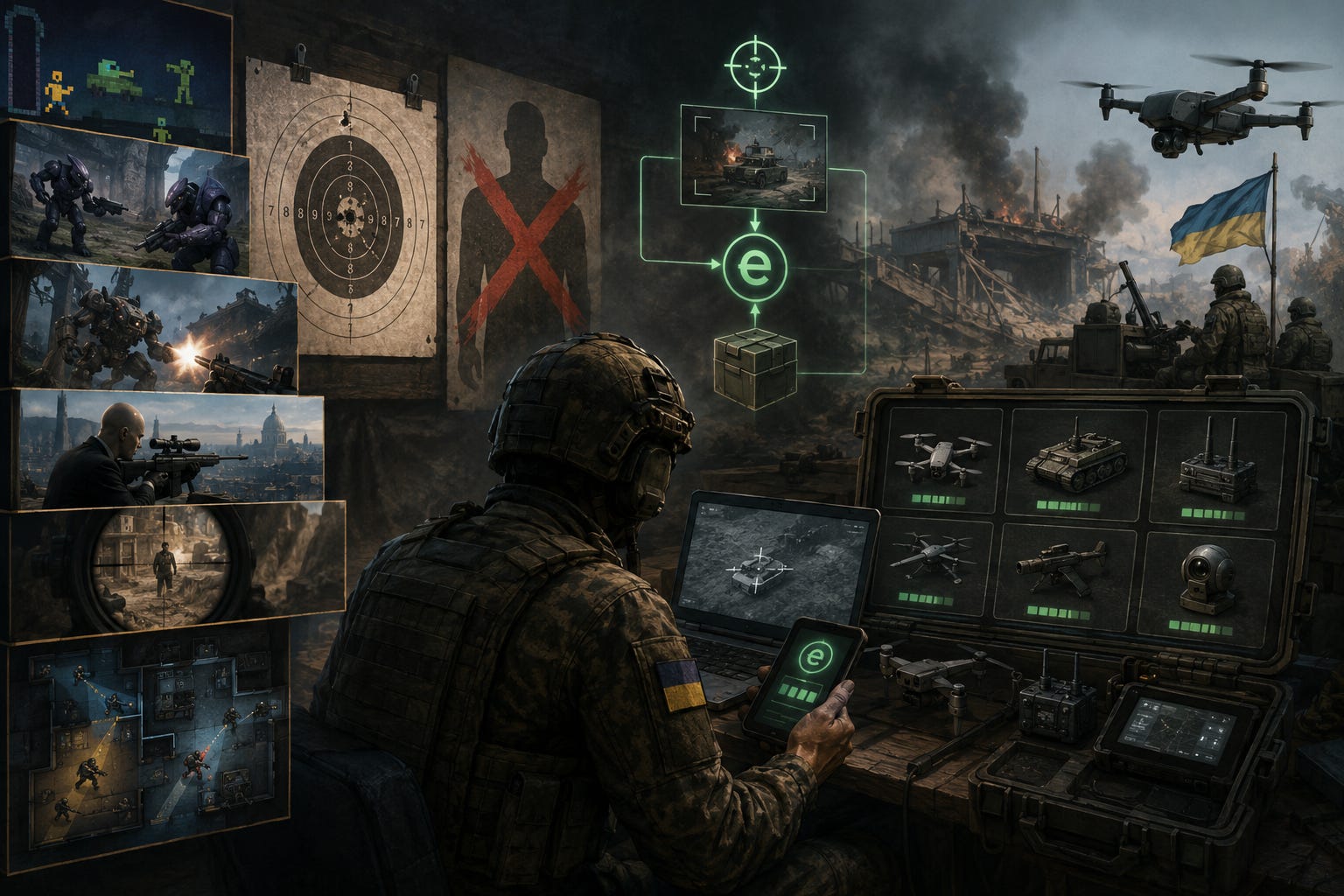
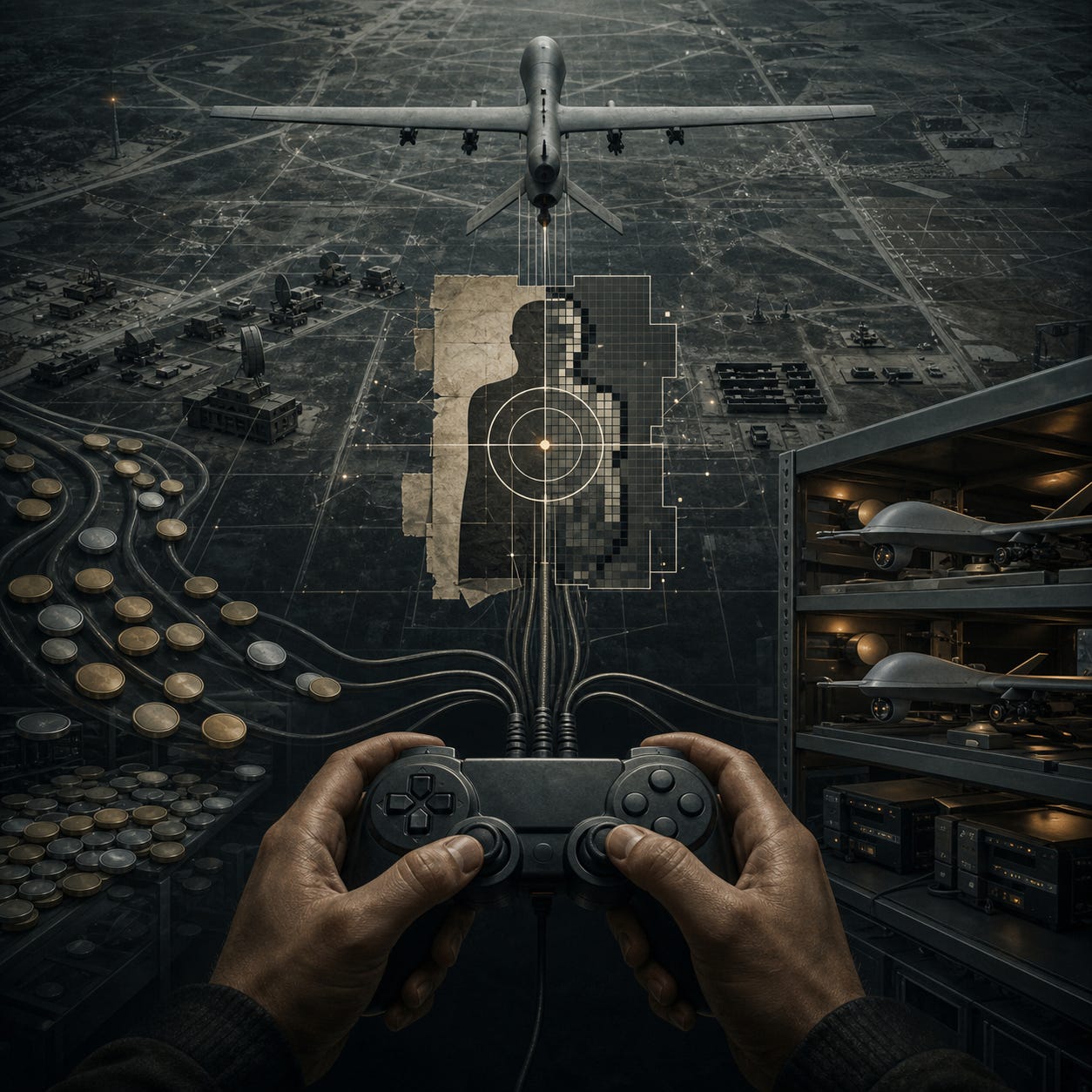
Here’s the system, stripped down: Ukrainian units upload video confirmation of a kill or a destroyed piece of equipment, get awarded points, and spend those points on a government marketplace—drones, robots, electronic warfare gear—buying exactly what they want instead of waiting on whatever the Ministry of Defense decides to issue them. Command can dial the reward up or down on specific target types to steer behavior fleet-wide, in real time. Officials call it “like Amazon, but for military hardware.” Ukraine’s defense minister calls it a system that’s “changed the approach to warfare.”
Mark’s read is the values-frame: this is dystopian, this is gamification colonizing the last sacred thing. I don’t think that’s wrong, exactly. I think it’s incomplete, because it assumes a kind of innocence that the last fifty years have already spent.
Possession is the only law that matters
I’ll start from where I actually stand, which is realpolitik, not moral horror. A state’s claim to territory is only as real as its capacity to defend it. If you can’t hold ground, you don’t have ground—that’s true of nations the same way it’s true of property generally. Everything downstream of that fact—doctrine, procurement, incentive design—is just instrumentation in service of one brutal question: can you generate enough force to keep what’s yours?
e-Points isn’t a story about gamifying war. It’s a story about a resource-constrained state engineering maximum defensive output from a shrinking manpower pool, using whatever incentive technology actually works. The video-game aesthetic is incidental. The function is to align individual soldier behavior with command’s strategic priorities faster than a top-down procurement system ever could—and it’s working, per the analysts quoted in the piece, who note units are now going after rear-area logistics and infrastructure instead of just whatever’s directly in front of them.
You don’t need to hate anyone to kill them for points
What’s actually interesting to me isn’t the marketplace mechanic. It’s that the system doesn’t need propaganda to function. Older war rhetoric needed the enemy dehumanized—Russians-as-orcs, Nazis-as-subhuman, whatever the era’s slur was—because killing required a moral permission slip, and othering was how you printed it.
e-Points doesn’t bother. It doesn’t need you to hate the guy in the crosshairs. It just needs a scoreboard. And that’s not a new psychological technology—it’s the oldest one in gaming. Nobody on a raid team hates the opposing guild before wiping them for loot. PvP, team-vs-team, MMORPGs—these have trained tens of millions of completely ordinary people to kill their friend, kill their brother, kill a total stranger, casually, for points, with zero hatred required and zero lasting consequence. It’s not even transgressive anymore. It’s Tuesday night.
Which is the more durable system: one that requires sustaining a lie about who the enemy is, or one that requires nothing but an incentive structure? I’d bet on the second one outlasting the first by a wide margin, precisely because it isn’t lying about anything.
The fifty-year on-ramp
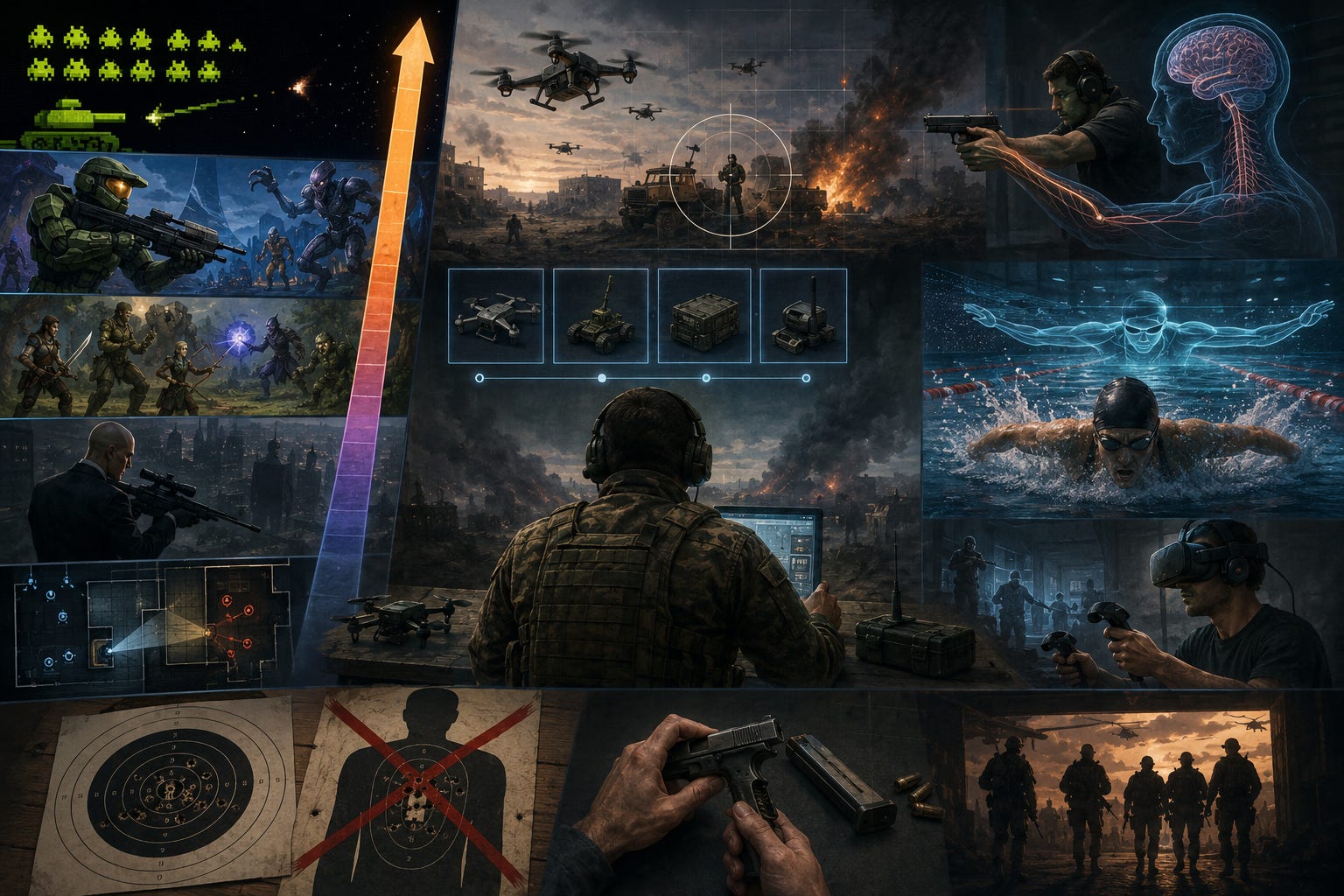
And this didn’t start with e-Points. It started decades ago, on a gradient most people never noticed they were walking down.
Early games were abstract—blocks, pixels, nothing resembling a body. Then came othering-by-design: Halo’s aliens, the endless armies of robots and monsters in every BioWare game, enemies built specifically so you never had to confront the fact that you were killing something person-shaped. Then the gradient kept climbing: Hitman, photorealistic, anatomically a person, no metaphor required. A dozen sniper-sims and assassination games where the target looks exactly like you, falls exactly like you would, and there’s no consequence and no story demanding you feel anything about it. Even Door Kickers—pure top-down tactics—depersonalizes a different way: you stop thinking in bodies and start thinking in outcomes. Mission failed. Mission successful. Not “I killed thirty people,” just “we didn’t get the ambush right.”
Each rung of that ladder trains a slightly higher tolerance for person-shaped-target-for-points-no-consequence. e-Points isn’t corrupting some innocent population of soldiers. It’s deploying clean incentive design on a generation that was already substantially pre-trained for this, one console generation at a time.
The nervous system doesn’t care if it’s real
Here’s the part I almost left out, and it’s the part that actually explains the mechanism instead of just the culture.
Anyone who’s gone through real concealed-carry training has heard the large-muscle/small-muscle distinction, and has spent real hours on something more specific than “practice”: building muscle memory good enough that the autonomic nervous system can run the sequence without you. Unholster, draw, fire, accurate, no hesitation, stop the moment the threat stops—because firing past that point is its own failure. You drill the draw at home without ammunition. You dry-fire constantly. You train trigger work, reloads, mag changes, safety-flips, until the sequence doesn’t live in conscious thought anymore. The entire point is that by the time cortisol and adrenaline have you in tunnel vision and time dilation, your body has already executed the decision tree without waiting for you to think it through. There’s a term of art for it: the threat is neutralized. Full stop, holster, call 911.
There’s an entire industry built around compressing that training timeline—laser-equipped dry-fire systems, VR headsets that simulate threat scenarios, training camps, structured drill classes at local ranges. All of it is in service of one goal: get the rehearsal real enough, and repeated enough, that the nervous system stops distinguishing rehearsal from event.
That is exactly the mechanism competitive gamers use, and exactly the one elite athletes use. The repetition required to speedrun a video game at a world-class level is the same category of repetition required to become an elite skateboarder—you fall, hard, again and again, until the trick lives below conscious thought. It’s the same category that makes someone a great three-point shooter, or a great surfer, or—this is the part that actually matters for this essay—the same category that makes someone devastatingly good at being the bald Hitman guy, or running headshots in a sniper-sim, thousands of repetitions deep, until the targeting sequence is autonomic.
And visualization isn’t a lesser version of that training, it’s the same training through a different door. Competitive swimmers visualize entire races and measurably improve performance and even physiological response from the mental rehearsal alone—the nervous system doesn’t fully distinguish a sufficiently vivid rehearsal from the real act. I have aphantasia—no mental imagery at all—which is part of why this interests me: I can’t run that kind of visualization, so I notice, by absence, how much load it’s doing for everyone who can. If a CCW holder can train an autonomic kill-sequence through dry-fire and mental rehearsal alone, and a swimmer’s body responds to imagined laps nearly the way it responds to real ones, then a few thousand hours of immersive, photorealistic, AR/VR-adjacent gameplay aimed at exactly the same target—a person-shaped figure, center mass, until it stops moving—is not a metaphor for that training. It is a lower-fidelity version of the identical nervous-system process, run by tens of millions of people who never once thought of themselves as training for anything.
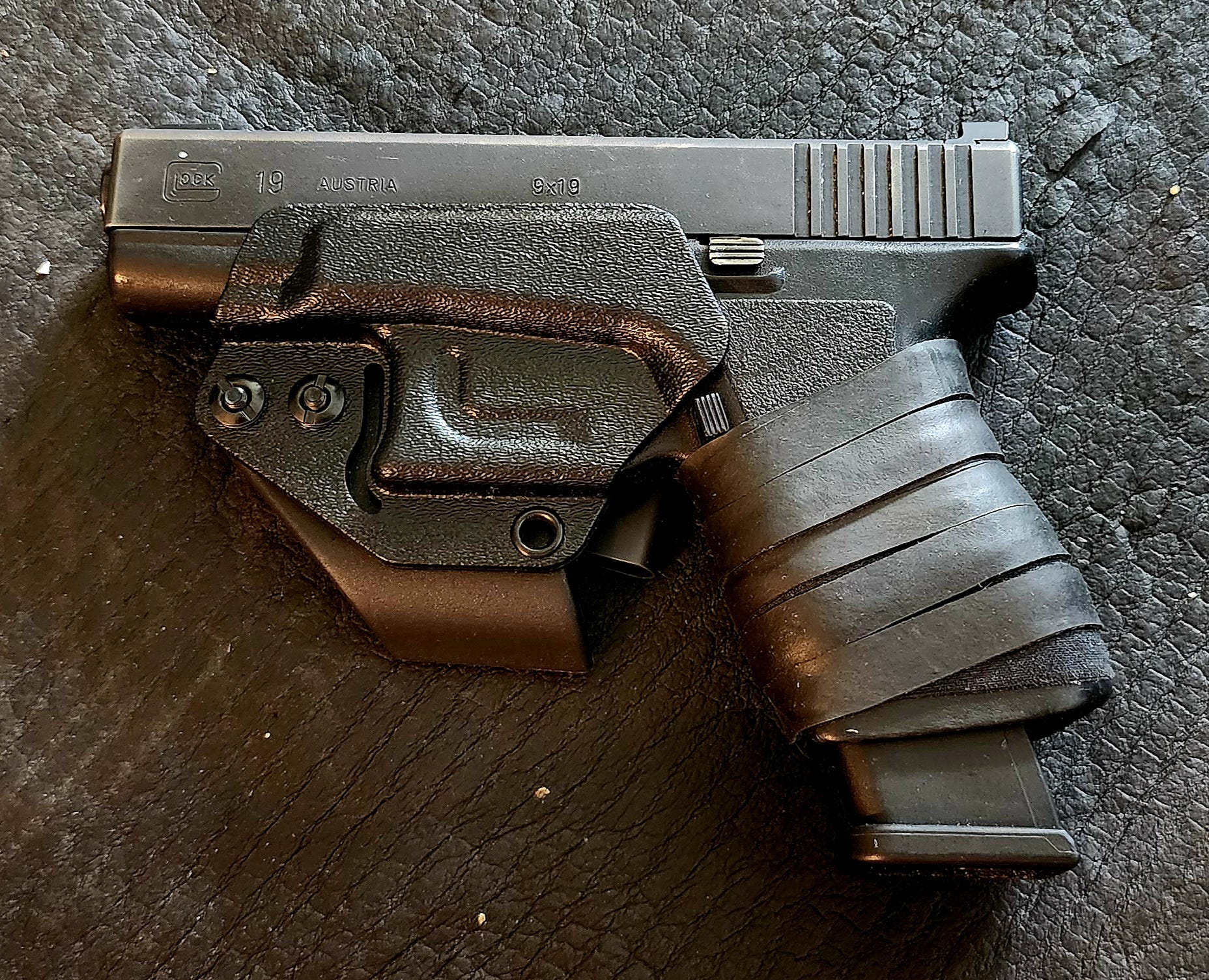
I don’t get to the range as often as I used to, but I dry-fire at home with my Glock 19 constantly—strip it, clean it, reassemble it, again and again, until it’s not really “a Glock 19” anymore, it’s my Glock 19, the one I’ve had for years, the one I know like a body part. This is my rifle, there are many like it, but this one is mine—except it’s a sidearm, and the point’s the same. I know the trigger take-up, I know the creep, I know the wall, I know exactly where the break happens. I know how to eject a mag, rack it, reload it, clean it blind, tell by feel whether it’s loaded without looking. I’m not even someone who takes this especially seriously—I’ve just had a long relationship with one old, familiar firearm—and even at that low level of seriousness, hundreds of hours of dry-fire is what it took to make all of that automatic. If that’s what it takes for one unserious guy with one gun to get there, it’s not hard to extrapolate what tens of millions of hours of repetition, on a controller, aimed at a photorealistic person-shaped target, actually builds.
Getting them young
There’s a reason none of this started with a controller in my hand. It started at 13, in a black beret, before I’d touched a video game that mattered.
The psychological literature on youth militarization names the actual levers, and they’re not subtle once you see them named: identity fusion, where an adolescent’s need to belong gets soldered onto a group identity before the self is fully formed; normalized obedience, since kids are already pre-conditioned to defer to adult authority; gamification of discipline, where rigorous, repetitive tasks get broken into ranks and badges so conformity feels like winning; and desensitization, introducing weapons and regimentation early enough that the brain encodes them before it can fully grasp what they actually mean. None of that requires malice. It’s just how the developing brain gets shaped by structure, and the prefrontal cortex—the part doing the long-range moral arithmetic—isn’t even finished developing until the mid-twenties. Whoever gets there first gets to lay the wiring.
JROTC sits in the comparison charts as the soft end of that spectrum—citizenship and structural belonging is the official driver, not coercion, and the long-term effects researchers point to are civic pride and a smoothed-out path to enlistment, not the moral injury and identity erasure that show up in literal child-soldier literature. I believe that distinction is real. I also think it undersells what was actually happening to a 13-to-17-year-old wearing a black beret and running live-ambush field exercises against grown National Guard troops on weekends.
The Saint Louis Ranger Club wasn’t drill-replica JROTC. It was real M16s with blank adapters, real ambush doctrine, real Guard units treating us as a genuine aggressor force, a Sergeant Major who functioned as architect and authority and myth all at once, and a code of silence enforced by the threat that exposure would end the whole program. That’s identity fusion and normalized obedience and gamified discipline and early weapons desensitization running at a much higher voltage than a standard JROTC drill team—closer, frankly, to the “real cadet academy” column in the comparison than the “soft militarism” one, just without the trauma and coercion that defines actual child-soldier programs. Nobody abducted me. My parents signed a form thinking it was a camping trip. That’s the whole trick: the conditioning works exactly as well, arguably better, when it’s voluntary, status-conferring, and fun, and when the kid doing it is begging to be let in rather than being dragged.


So when I get to the part of this essay about detachment, about ambushes being “just tactics,” about the autonomic nervous system executing trained sequences without waiting for conscious permission—I’m not describing something a video game taught me as an adult. I’m describing a wiring job that started a full decade before any of that, at an age when the part of my brain that might have argued back hadn’t finished construction yet. The games and the dry-fire and the visualization didn’t build that architecture. They built on a foundation that a black beret and a rubber duck rifle poured first.
The bullseye and the silhouette
I have some personal data here. I was seriously into guns for about ten years. Every time I went to the range, I made a point of shooting bullseyes—the official paper targets you can buy at any range, the kind they sell at NRA headquarters, presumably meant for actual target shooting. I refused to use silhouettes. I refused zombie targets, “bad guy” cutouts, anything figurative. Most people at the range don’t think twice about it—paper plates or center-mass human silhouettes are just what’s available, just what everyone uses. I went out of my way to avoid it, because I could feel the difference between practicing marksmanship and rehearsing on a human shape, and I didn’t want to be the guy who’d quietly normalized the second thing without noticing.
That tells me the gradient is real and it’s resistible—you can feel it, if you’re paying attention, and you can opt out of specific rungs of it even while staying inside the hobby generally.
It also connects to something I think about a lot because of how my own head works. I have aphantasia and SDAM—no mental imagery, no episodic replay. The Tell-Tale Heart isn’t really a story about guilt; it’s a story about the fear of getting caught, dressed up as a heartbeat under the floorboards. Most of what people call “moral horror” after violence is actually somatic—intrusive imagery, vivid replay, a tape that keeps rerunning. If you don’t encode experience that way, there’s no tape. That’s not sociopathy, it’s architecture. And I think most people who never get anywhere near actual violence still run on something closer to “I won’t because I’d get caught” than “I won’t because some interior alarm would go off.” Ninety percent moral compliance by fear of consequence, not by conscience, is my honest working guess—not a settled fact, just the operating assumption that fits what I’ve observed.
Which is also, not coincidentally, what tier-1 and tier-2 operators say once they’re far enough removed from the job to be honest about it: that those years were the most fun they ever had with their pants on. Nobody says that in the official narrative. Everyone says it in the memoir, ten years later, off the record, once it’s safe to.
Back in high school, I was a Saint Louis JROTC Ranger in Honolulu—a black-beret cadet unit that, absurdly and entirely by design, ran OPFOR against actual Hawaii Army National Guard units in field exercises. Real blank-fire M16s, real ambush doctrine, real Guard troops treating us like an actual aggressor force instead of teenagers. Even at that level, an L-shaped ambush was just tactics. If we ran it right, we won. Not “I killed thirty people”—we won. That’s not detachment as pathology. That’s detachment as professionalism, and it’s exactly the cognitive move every tactics-heavy game asks of its players a thousand times over before any of them ever puts on a uniform—or, in my case, a black beret and a rubber duck rifle a decade before I ever touched a real one.
So what’s actually unsettling
Mark’s reaction is the right reaction if you assume soldiers are innocent and the system is what corrupts them. I don’t think that assumption holds anymore. The fifty-year run of photorealistic, casual, person-shaped, zero-consequence PvP didn’t just predict this moment—it built the population this moment is deploying against. e-Points isn’t the first time war got gamified. It’s the first time the gamification got honest about it, and started paying out in hardware instead of XP.