
American "For Export Only" Democracy is a Demockery
How We Confused the Packaging for the Product and Called It Freedom.

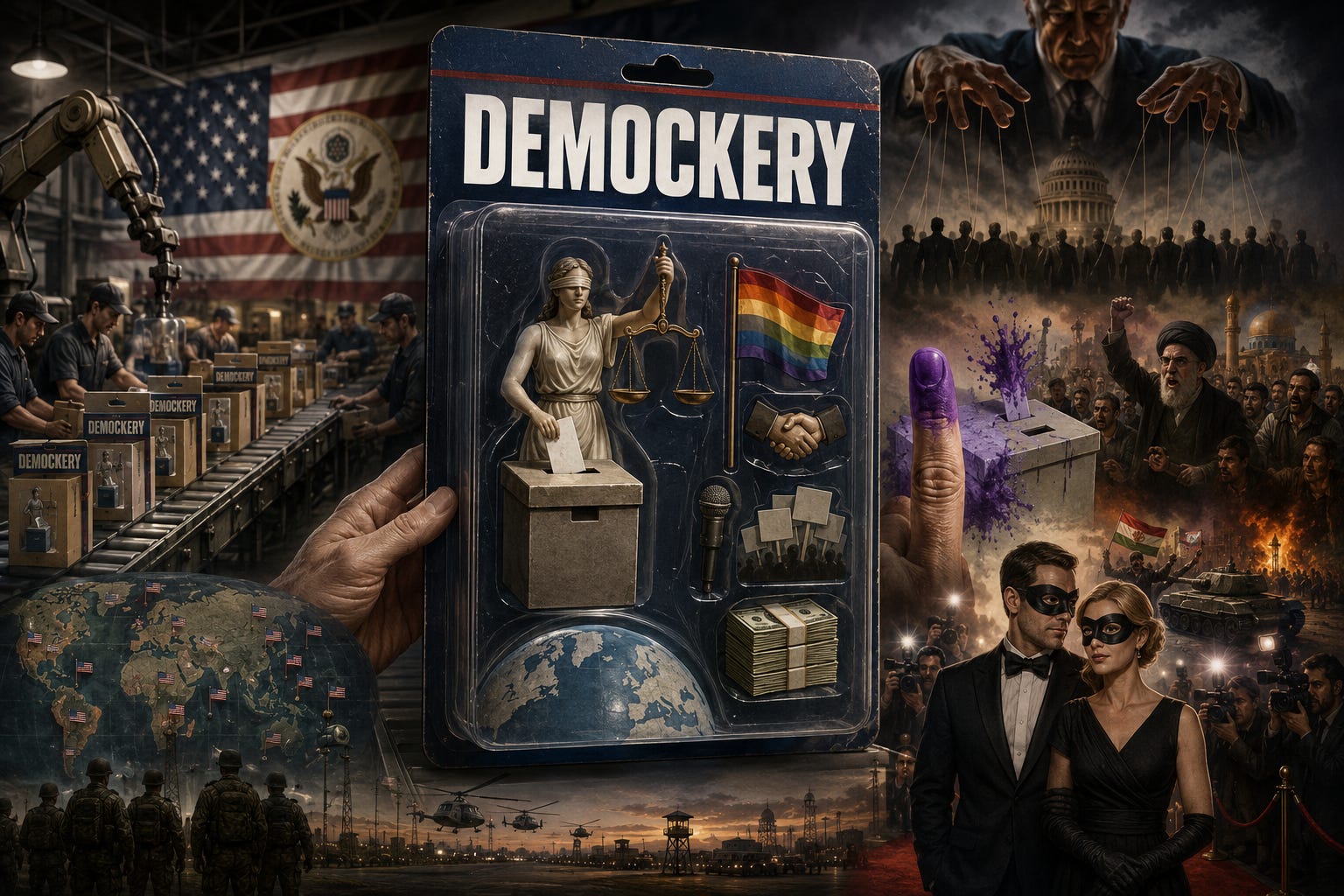
There's a category of beer that exists almost exclusively for export. The domestic market doesn't really drink it. The people who brew it wouldn't order it at their local. It gets made to a foreign specification, bottled with a foreign label, optimized for foreign tastes—a version of something real, engineered for a context that has nothing to do with where it was actually made. The Belgians do this. The Danes do it. The British have been doing it for centuries.
America does it with democracy.
Not the democracy we actually live—the loud, ugly, infuriating pendulum that swings left and right and back again without asking permission. The real thing. The messy thing. The thing that gave us FDR and Reagan and Clinton and Bush and Obama and Trump and will give us something none of us expect next, because that's what pendulums do. The democracy where the people actually decide and sometimes they decide in ways that make everyone uncomfortable and then they get to decide again in four years. That democracy—the one with the chaos built in, the one that requires genuine tolerance for outcomes you hate—we kept that one for ourselves.
What we export is something else entirely. Call it what it is.
Demockery.
The Purple Fingers
Here's how I figured it out.
Every time America liberated an Islamic country and handed it back to its people—gave them the purple fingers, the ink, the ballot box, the whole sacred ritual—they immediately voted in a theocratic mullah. Every single time. Pre-radicalization Kabul was a real place. Pre-radicalization Tehran was a real place. Pre-radicalization Beirut was the Paris of the Middle East. We gave them democracy and they used it to vote in the opposite of everything democracy was supposed to deliver.
The assumption baked into the entire export project was that if you just remove the dictator and hold a free election, people will naturally choose the Western liberal package—secular governance, women in universities, pluralism, openness, the whole label. Because who wouldn't want that? It's obviously correct. History is on its side. The arc bends toward it.
And then the purple fingers happen.
Hamas wins a free and fair election in Gaza. Wrong answer—election voided. Yanukovych wins Ukraine in an election European observers certified. Wrong answer—Maidan, regime change, do-over. Morsi wins Egypt. Wrong answer—military coup, American silence. Iran 1953: Mosaddegh wins democratically, nationalizes oil, wrong answer—CIA installs the Shah. The pattern is not subtle. It is not hidden. It has been running for seventy years.
The tell is always the reaction when democracy produces the wrong result. The machinery cranks up. The election gets relitigated. The coalition gets reshuffled in parliament to keep the wrong people out. Emergency powers get invoked. Candidates get prosecuted. Results get called threats to democracy itself—which is the most exquisite part of the whole operation. Stopping the pendulum is now called saving democracy. Letting it swing is called an existential threat.
The European Remix
You don't have to go to Kabul to see it. You can watch it happen in real time in the countries we call our allies.
France keeps almost electing Le Pen. Every cycle the establishment builds a new emergency coalition—anyone but her, vote for whoever, hold the line—and the line holds, barely, and then four years later it almost doesn't again. Germany watches the AfD rise and the response isn't "let's understand what's driving this"—the response is legal action to ban the party entirely. Hungary elects Orbán repeatedly and the EU threatens to cut off funding until he governs correctly. Poland elects a nationalist government and Brussels works every lever available to reverse it. Canada invokes the Emergencies Act against truckers. Brexit happens and the years that follow are a masterclass in making a democratic result as painful and complicated as possible until enough people wish they could take it back.
The European establishment doesn't call this anti-democratic. They call it defending democratic values. They have convinced themselves—and this is the genius of the whole operation—that the pendulum swinging the wrong way is itself the threat to the pendulum. You have to stop democracy to save democracy. You have to prevent the wrong election to protect elections.
This is demockery. Full operational, institutional, sophisticated demockery.
What We're Actually Exporting
Let's be honest about what's in the bottle.
It isn't communism, though it borrows the aesthetic. It isn't socialism, though it uses the language. It isn't Marxism, though the Frankfurt School fingerprints are on the label. What export-only democracy actually delivers, stripped of the packaging, is soft power maintenance. Imperial compliance dressed as liberation. Be good serfs and pledge allegiance to what America appears to be rather than what America actually is.
America has 900 military bases in roughly 90 countries. That footprint doesn't maintain itself through hard power alone—you can't station troops everywhere forever. It maintains itself through the export product. You get the NGOs and the democracy promotion organizations and the State Department cables and the USAID grants and the color revolutions with the catchy names. You get the ideology that makes your elites want to be aligned with the American project because the American project is on the right side of history and everyone who opposes it is a fascist or a kleptocrat or a threat to liberal values.
The export product is a software update for your political class. Install it and your country's foreign policy becomes compatible with American interests. Reject it and you become Hungary, or Venezuela, or whatever the current designated villain happens to be.
And here's the thing about software updates: they come with terms of service. The terms include a specific package of positions. Anti-racist in a specific way. Pro-LGBTQIA+ in a specific institutional way. Pro-choice in a specific policy way. Pro-multilateral-institution in a specific geopolitical way. These aren't bad positions necessarily—some of them are genuinely good. But they are a package, and the package is non-negotiable, and any country or politician or movement that rejects any part of the package gets labeled and processed accordingly.
The rainbow flag is not incidental to this. It is the flag. It travels with the product. It is how you know which team you're supposed to be on. This is not a criticism of the flag or what it represents—it's an observation about how ideological packages work. When an identity becomes a geopolitical sorting mechanism, it's being used for something beyond itself.
When It Came Home
The operation worked reasonably well for fifty years because the information environment was controllable. You could run demockery at scale when you owned the newspapers and the television networks and the wire services. The narrative about what democracy means and who threatens it and what the correct outcomes are—that narrative was manageable. Expensive, but manageable.
Then social media happened. Then Telegram. Then Discord. Then every dissident information channel that couldn't be deplatformed fast enough before the thing it was saying had already spread to a million phones. The panopticon became a mirror. The machinery that had been invisible for half a century was suddenly visible to anyone who wanted to look.
And the people looked.
The populist revolts that have been shaking Western democracies for the past decade aren't a mystery if you understand what they're reacting to. They're not reacting to democracy. They're reacting to demockery. They've watched the elections get relitigated. They've watched the candidates get prosecuted. They've watched the platforms remove the accounts and the banks close the doors and the emergency powers get invoked against people who drove trucks to a capital city to complain. They've watched democracy produce results that then got managed, delayed, complicated, and reversed. And they've concluded—not incorrectly—that the pendulum is being held in place.
Trump is blowback. Brexit is blowback. Le Pen is blowback. The AfD is blowback. The truckers are blowback. These are not the disease—they are the fever. The disease is the fifty-year project of replacing the messy, genuine, uncomfortable pendulum with a managed process designed to produce correct outcomes.
The Hollywood Couple
Here's the best metaphor for the whole thing.
You know the Hollywood couple—the one that's always photographed together at awards shows, the one with the coordinated outfits and the publicist-managed Instagram and the magazine covers about their love story. The one where everyone in the industry knows the truth but the public gets the performance. The gay man and the lesbian woman who are, publicly, the perfect straight couple. Totally in love. Totally conventional. Totally a product designed for a specific market.
Export-only democracy is that couple. The performance is for the cameras. The reality is a business arrangement that serves specific interests. Everyone at the State Department knows what it actually is. The people in the countries receiving it figure it out soon enough. But the show must go on because the show is the product.
The difference is that social media is now the paparazzo who climbs the fence.
What Real Democracy Looks Like
I grew up in Honolulu. I went to university in Norwich. I've lived in Berlin and Washington and Arlington. I've watched enough different political cultures from the inside to know what a genuine pendulum looks like and what a managed one looks like.
Real democracy is uncomfortable. It produces results you hate. It requires you to sit with the loss, work harder, make a better argument, and try again in four years. It requires you to believe that your opponents aren't evil—just wrong—and that they have the same right to try to persuade the country as you do. It requires humility about the arc of history, because the arc of history has been confidently pointed in the wrong direction many times by very smart people who were absolutely certain they were on the right side.
Demockery can't tolerate any of that. Demockery knows where the arc points. Demockery has already decided the correct outcome and is working backward from there. Demockery calls this defending democracy, protecting institutions, saving the republic. It always does. Every managed system calls itself the legitimate one. Every stopped pendulum calls itself stable.
The purple fingers were the tell. The people voted and they voted wrong and that was the moment the whole project revealed itself—not as democracy promotion, but as outcome management.
We exported the bottle. We kept the beer.
Chris Abraham writes at chrisabraham.substack.com. His previous piece, "A Twelve-Step Program for English-Speaking Democracies," examined the national mythologies Britain and America maintain about themselves. This piece is what happens when one of those mythologies goes abroad.