
Democracy Is DSA Code for Mob Rule
“It’s democracy” and “first principles” do the same job: they let you skip the argument

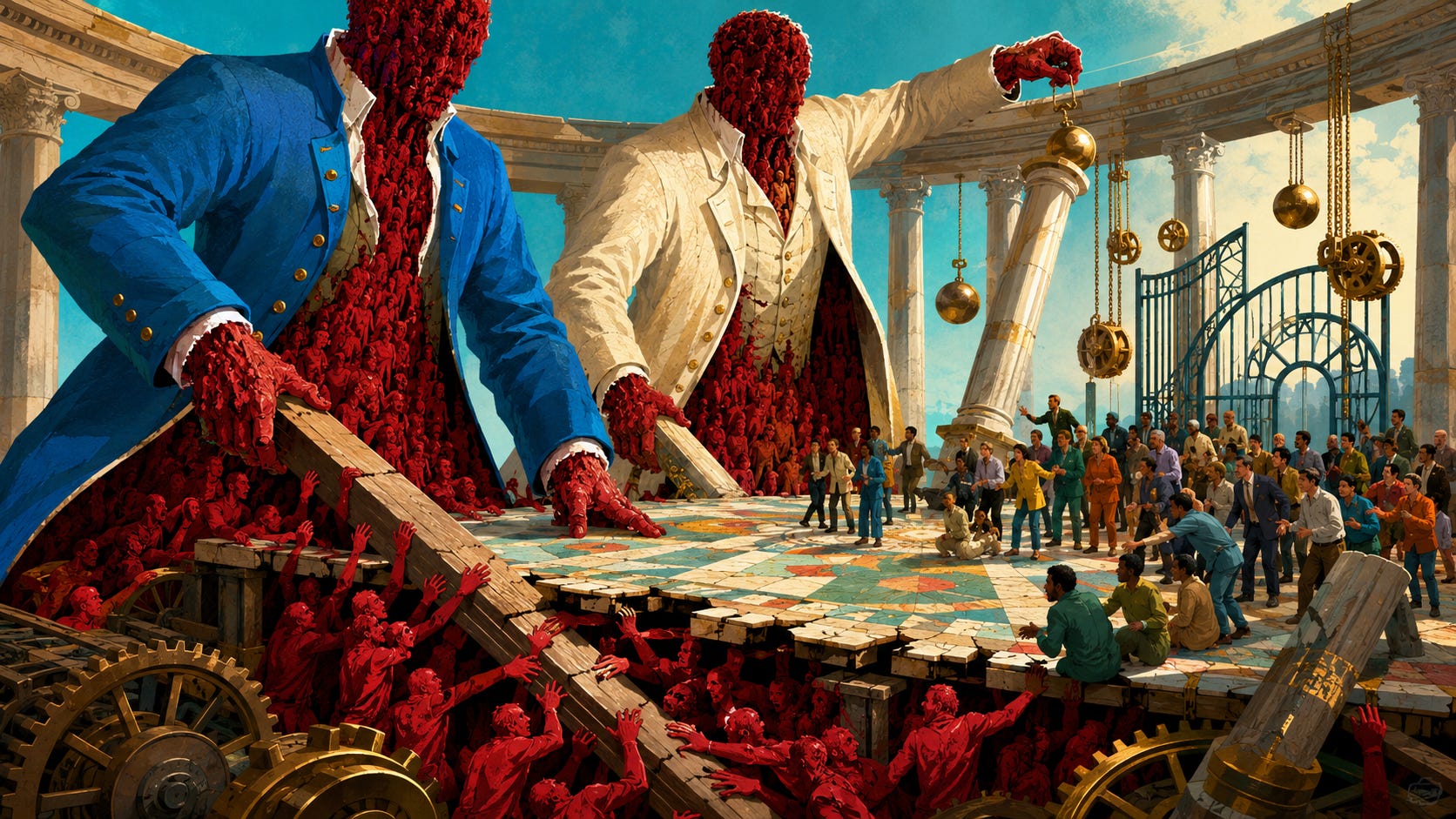
I listened to Megan Romer, national co-chair of the Democratic Socialists of America, explain the DSA to David Remnick on The New Yorker Radio Hour this week, and before the episode was over I’d already posted the whole argument in one line: “I just figured out that ‘democracy’ is #DSA code for ‘mob rule.’”
Romer said the quiet part just as clean a few weeks earlier, defending the DSA’s call to abolish the Senate on Fox News Sunday: “Don’t worry, it’s not too much democracy.” She meant it as reassurance. The founders built the Senate, she explained, so certain landed interests could stop ordinary people from getting anything done, and that’s exactly the problem with it. She called it a sclerotic institution with no purpose beyond protecting bad ideas from popular will.
That’s the standard read of the founding, restated with a shrug. It’s exactly backward.
What the brakes are actually for
The Senate, the courts, bicameralism, supermajority thresholds, the veto, staggered terms—none of it was built to stop democracy. It was built to stop a specific failure mode of democracy: a temporary majority, worked up about something this week, using its numbers to run over everyone who didn’t vote for it. Madison wrote the whole argument out in Federalist 10 before the ink on the Constitution was dry. Left unchecked, he said, a democratic majority doesn’t stay reasonable—it becomes its own faction, and factions don’t self-correct just because they’re big. The republic was designed because the founders had read enough history to know what popular will does when nothing slows it down, not despite popular will.
So when Romer frames the Senate as landed interests versus the people, she’s describing what it prevents, not what it’s for. Take away the brakes and you don’t get more democracy—you get whoever wins Tuesday, doing whatever it wants to whoever lost, until the next Tuesday flips it back the other way. That’s mob rule, and everyone living under it knows their rights last only as long as the current majority does.
The Electoral College is built on the same logic, and it’s next on the DSA’s list. States aren’t just lines on an administrative map. Under the Tenth Amendment they hold everything the Constitution didn’t explicitly hand to Washington, which makes them closer to the semi-sovereign members of the European Union than to the regions of a unitary state like France. The Electoral College is what lets that sovereignty show up on election night: a win built state by state, not one national headcount. Replace it with a straight popular vote and you’ve done to fifty semi-sovereign polities what abolishing the Senate does to political minorities—made a handful of dense population centers dispositive for everyone else.
This isn’t just theoretical. States joined the union under an explicit set of terms, and the Senate and the Electoral College are two of the biggest concessions small and rural states got in exchange for signing on. Texas v. White settled in 1869 that no state can legally walk away over a broken deal, but the ruling didn’t make the underlying disagreement disappear, it just took the exit off the table. Strip away both institutions and you’re testing something bigger than a voting formula: whether fifty states still consider the deal binding once the terms they joined under are gone. The country has already found out once how far that argument can go before it stops being an argument.
The tell is always the same
I’ve written before about how you spot resentment dressed up as principle: watch what gets coded as the villain. When “higher taxes on the wealthy” turns into “wealth itself is the problem,” the target has quietly shifted from a policy outcome to a category of person. The same move is happening here, one level up. When “we lost a vote in an institution designed to slow us down” turns into “that institution is illegitimate and should be abolished,” the target has shifted from a specific defeat to the entire structure that makes defeat survivable. Anything that limits what the current majority can do gets relabeled oligarchy, obstruction, or—Romer’s word—sclerosis. Nothing gets to just be a rule of the game you didn’t like this round.
This is why “it’s democracy” keeps showing up attached to whatever the speaker currently wants and nowhere near a definition of democracy that would also constrain them. Nobody arguing this way is proposing a Senate that could someday be turned against their own coalition. They’re proposing to remove the one thing standing between “the people”—meaning whoever showed up and voted their way—and everyone else.
The other half of the move
“It’s democracy” only clears the floor: it tells you why the objections don’t count. It doesn’t tell you why the demolition is necessary in the first place. That’s what “first principles” is for.
Notice how the DSA platform never argues for abolishing the Senate, the presidency, and the Supreme Court one at a time, on the merits of each. It argues for all of it at once, as a return to first principles—a fresh start, unencumbered by two and a half centuries of precedent that supposedly never had legitimacy to begin with. That’s a rhetorical device, not analysis, and a familiar one: strip an institution of its history, declare that history irrelevant to what the institution really is underneath, and you’ve licensed yourself to tear it down without ever having to argue against what it’s actually done. Nobody reasons from first principles and concludes “keep the thing that’s working.” The appeal to first principles exists to make demolition sound like clarity instead of what it is: a decision made in advance, with the philosophy built afterward to justify it.
Put the two moves side by side and the shape becomes obvious. “It’s democracy” clears the floor—the objections, the dissenters, the minority whose rights are on the table, none of it counts against the will of the majority. “First principles” clears the room—the history, the precedent, the actual argument the founders made for building it this way in the first place, none of it counts either, because we’re starting from zero. Run both moves and there’s nothing left standing except the preference of whoever’s making the argument, whether they call it the people’s will or first principles.
The fence nobody asked about
G.K. Chesterton had a name for this exact move: never tear down a fence until you know why someone put it up. The reformer who can’t explain what the fence is for, he argued, is the last person qualified to remove it. First-principles demolition inverts that burden entirely. It doesn’t ask what problem the Senate solved, what crisis the veto was built to survive, why bicameralism exists in the first place. Not knowing becomes the license instead of the warning sign. “Show me the argument for why this should exist,” the demand goes, as if two and a half centuries of the thing functioning weren’t itself an answer, as if the burden of proof runs toward the fence and not toward whoever showed up holding the axe.
Whose economy, exactly
Economic democracy is the harder version of this argument, and it deserves a straight answer instead of a shrug. The DSA case is that concentrated wealth already runs the country without a vote, and pushing democracy into the workplace and the balance sheet just closes that gap. Fine premise. The trouble is who gets swept up as “concentrated wealth” once you actually go looking for it.
One in ten American households now clears two hundred fifty thousand dollars a year. The upper-middle class, six figures and comfortable, has tripled since 1979 and is now the single largest income tier in the country, thirty-one percent of it. Forty-four percent of households clear six figures, close to half the country, hardly a narrow elite skimming the top. Households making two hundred thousand or more account for nearly sixty percent of consumer spending nationwide, the actual reason a burrito costs eighteen dollars now: the menu is priced for the third of the country that won’t blink, not the median earner.
That’s the crowd “economic democracy” has to run through before it ever reaches the actual concentrated wealth at the top, the tier that even the comfortably rich know they’ll never be invited into. Collapse “the workplace” and “the balance sheet” into a single target and you’re redistributing power away from tens of millions of ordinary upper-middle-class households, not a handful of oligarchs—households who think of themselves as barely keeping up, because the only rung they measure against is the one just above them. The argument needs a villain small enough to be outvoted, and it doesn’t have one. What it has is a third of the country standing exactly where the villain is supposed to be.
Democracy needs a floor, not just a majority
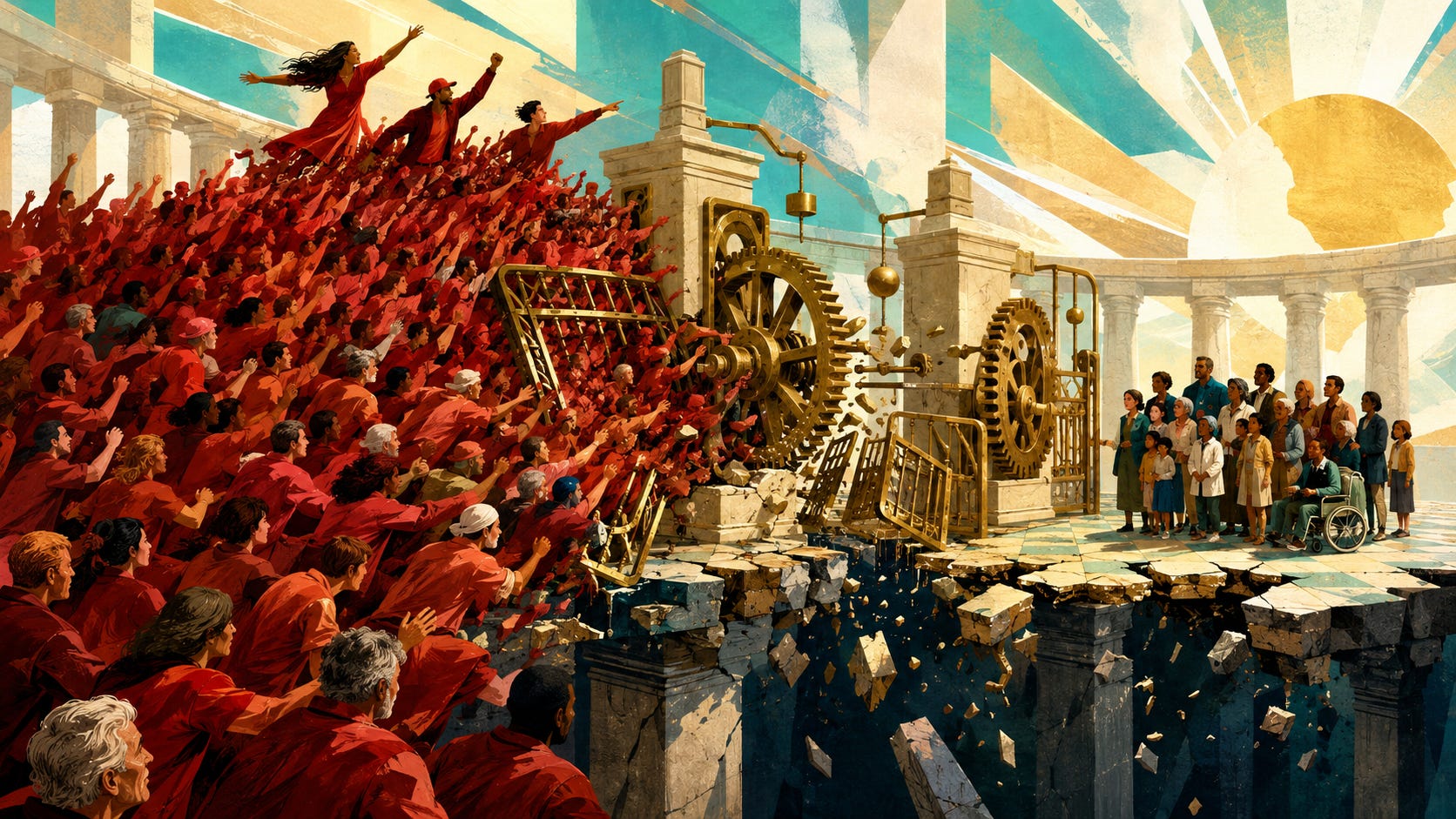
A system where fifty percent plus one can do anything it wants to the other forty-nine isn’t democracy in any meaningful sense, whatever the vote count says. Real self-government requires a floor beneath the vote—rights the majority can’t touch, institutions the majority can’t simply dissolve because it’s inconvenient this cycle. Remove that floor and you haven’t made the system more democratic. You’ve made it majoritarian, which is a different and much older idea, and one the founders went out of their way to design against.
Call it what it is when you hear it. “It’s democracy” and “first principles” aren’t arguments for anything. They’re what people say instead of making one.
Glossary, for anyone who wants the receipts
Federalist 10—Madison’s 1787 essay arguing that pure democracy is uniquely vulnerable to faction and majority tyranny, and that a large, structured republic with built-in checks controls that danger better than direct popular rule.
Tyranny of the majority—the failure mode where a democratic majority uses its numbers to strip rights or resources from a minority, with no institutional check to stop it.
Bicameralism—splitting the legislature into two chambers elected on different terms and constituencies, so a single wave of popular sentiment can’t immediately capture the whole government.
The Senate’s design—six-year staggered terms, two seats per state regardless of population, meant to slow down and cool off whatever the House just passed in the heat of the moment.
The Electoral College—the body of state-appointed electors, allocated by each state’s total congressional representation, that actually elects the president; makes the outcome a state-by-state contest rather than a single national popular vote.
First principles—foundational assumptions treated as self-evident starting points for reasoning. Legitimate as a philosophical method; used rhetorically, it lets someone discard precedent and history as irrelevant baggage before the argument even starts.
Chesterton’s fence—G.K. Chesterton’s principle that a fence should not be removed until the remover understands why it was built; a standard rebuttal to reform-by-demolition arguments that skip straight past a structure’s original purpose.