Don’t Fall for the Fronting
Everybody’s a squish. Everything else is cultural.

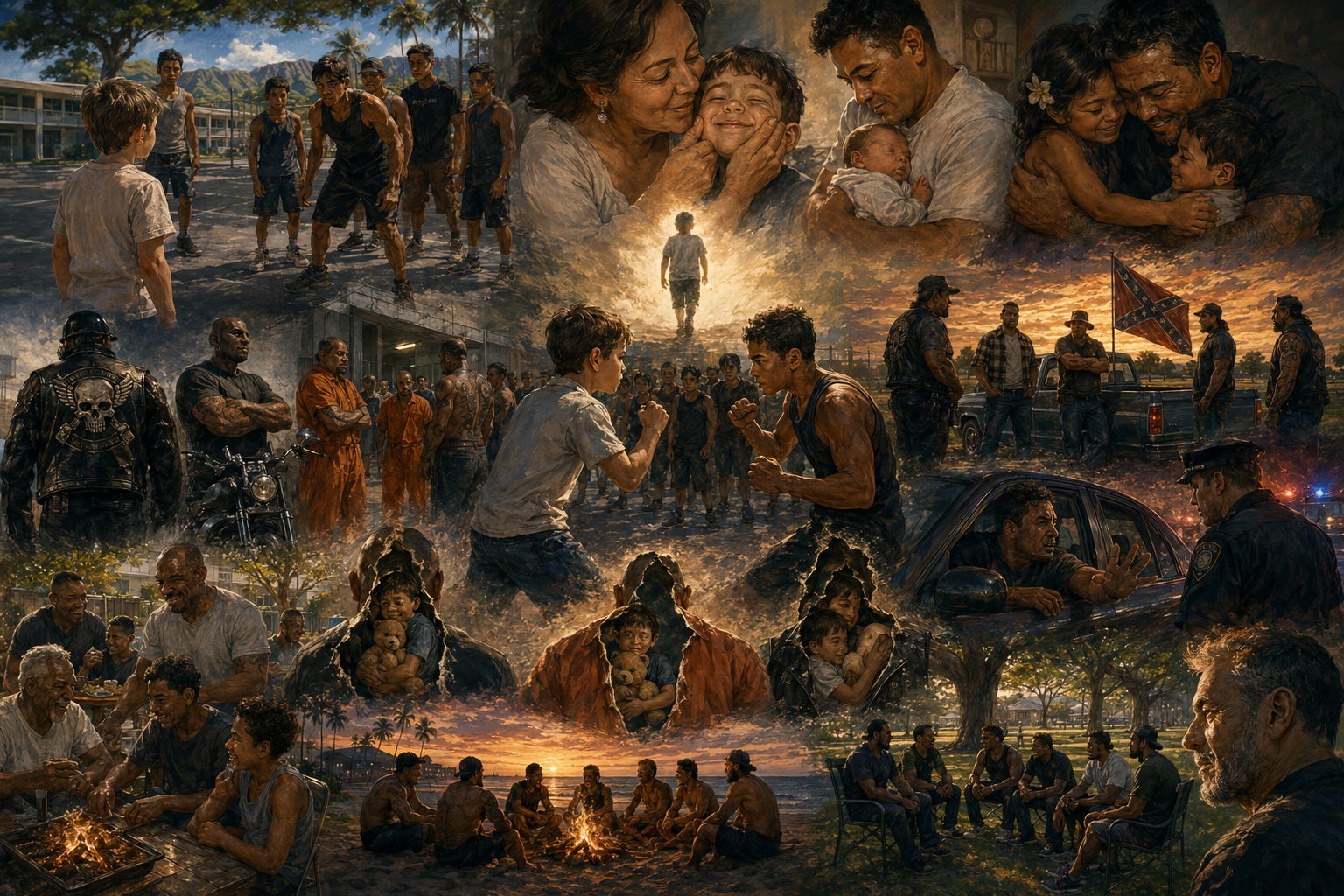
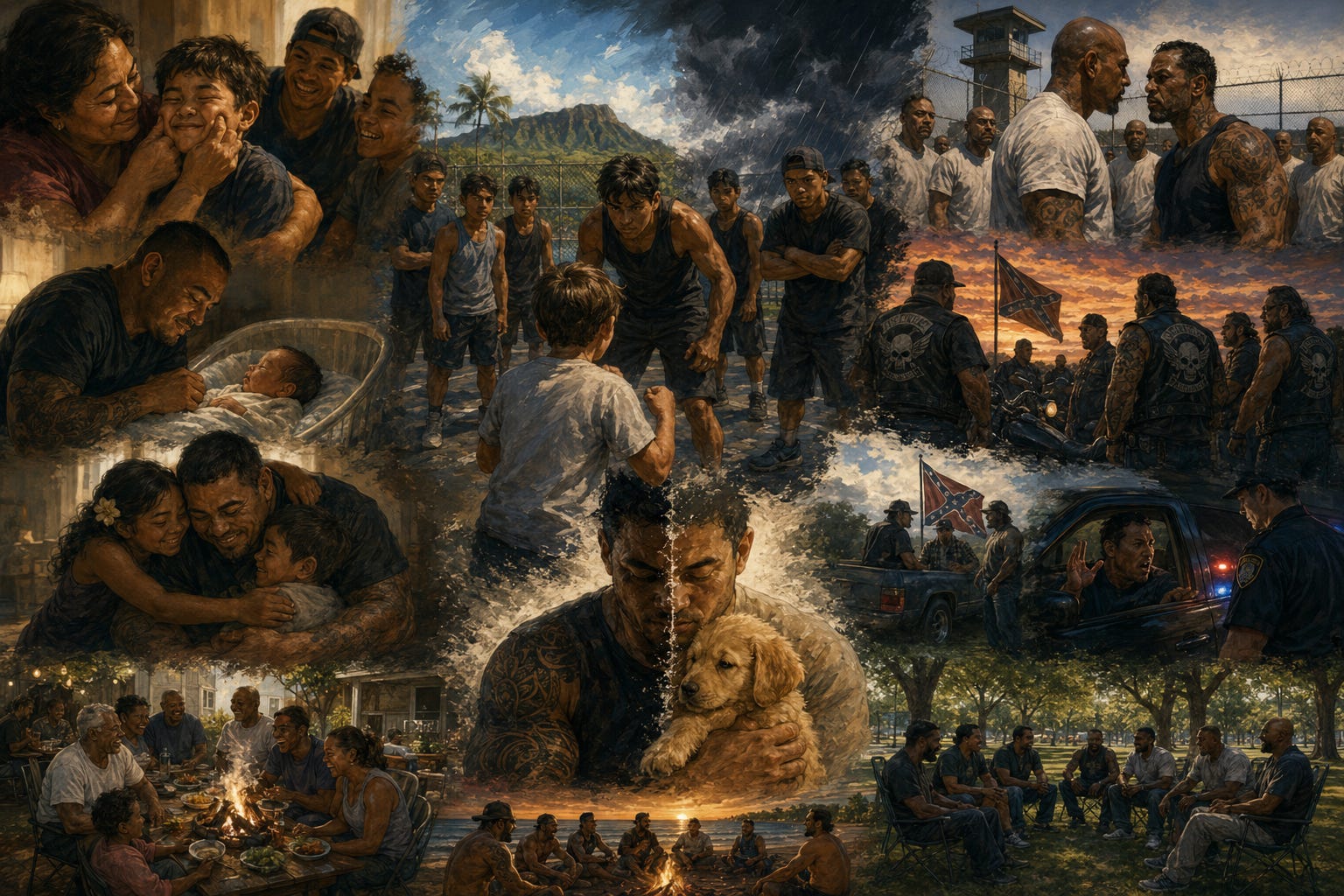
I was six years old when my parents moved us from 240 East 35th Street, Murray Hill, Manhattan, New York City, to Honolulu, five thousand miles from every relative I had except the two who moved with me. We landed in a government-subsidized garden apartment complex in Salt Lake, across the street from Aliamanu Elementary. Only child. Latchkey kid. No cousins, no older brothers, no uncles down the block. Just me, alone with the fact that the local kids ran in packs and I couldn’t fight a pack, I could only ever fight the first kid dumb enough to get close.
I’m fifty six now. Most of those kids are fifty five, fifty six, fifty seven. I’m friends with a lot of them on Facebook. And here’s the thing nobody tells you at six years old, standing in a schoolyard convinced you’re about to get jumped: every single one of them was a squish.
What a squish is
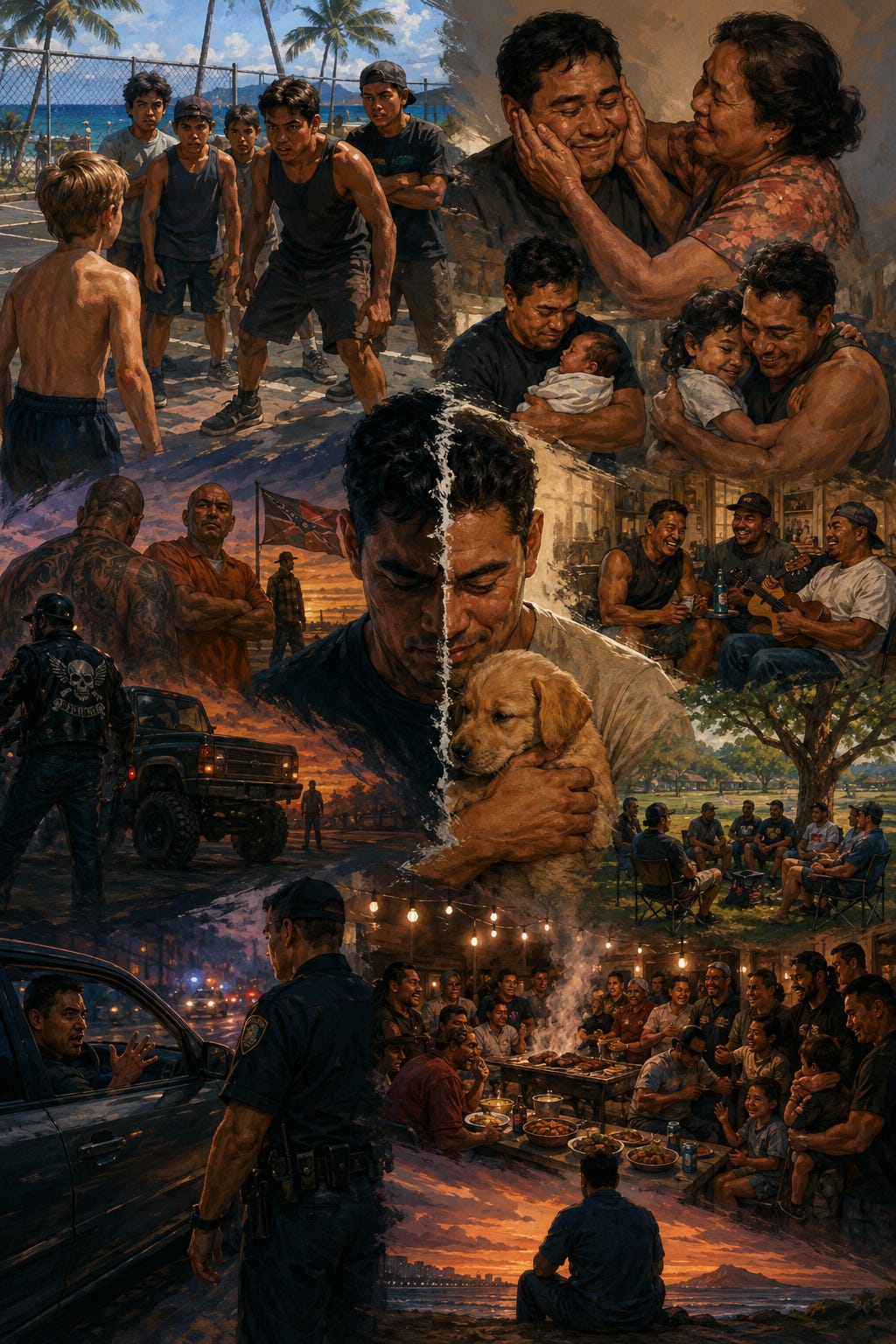
A squish is the actual person. The one who lets his mom squeeze his cheeks in front of his friends and doesn’t pull away. The one who coos over his own kid’s bassinet like it’s the first miracle he’s ever seen. The one who hugs his nieces and nephews and means it completely, no fronting, no chip on the shoulder, nothing to prove to anybody. The squish is soft, warm, playful, and it is who every single one of us actually is underneath whatever we’re wearing that day.
I don’t mean soft as in weak. I mean soft as in true.
The mistake, and it’s a mistake I made for most of my life, is thinking the squish is a phase. Something you have at eight and lose somewhere around thirteen, the year you stop wanting to hold your mother’s hand in public. It isn’t a phase. It never leaves. The body just grows a bigger costume around it, shoulders and a chest and height and a jaw that starts looking nineteen, then twenty five, then thirty five. But there’s still a little squish in there giving his mom and his grandma hugs and kisses. It just goes underground, and it only ever surfaces again when the room is safe enough to let it.
The armor is real, and it is not the person
Here’s where I used to get it wrong in the other direction, thinking the squish was the whole truth and the toughness was just theater you could see through and therefore ignore. That’s dangerous, and it’s a different kind of naive than being scared of the toughness in the first place.
The armor is called honor culture, and it isn’t fake. It’s a rational, load-bearing response to growing up somewhere that doesn’t have reliable institutions standing between you and getting hurt. No cop is coming. No principal is coming. No HR department, no lawsuit, no lawyer. In that world, the performance of toughness is the actual deterrent. You front hard enough, often enough, and consistently enough, and most fights never happen at all, because 99% of the time the other guy backs down first. That’s not cowardice on his part. That’s the system working exactly as designed. It’s a shared language, a script everyone in it was handed early, usually by an uncle or an older brother, and it comes with real de-escalation built in: the dozens, the posturing, the shirt-off boxer shuffle in front of an audience of friends. Most of that theater is the entire fight. Nobody has to actually get hurt for honor to be satisfied.
Bikers do it in their colors. Prison does it on the yard. Rednecks do it with a truck and a flag. The block does it with a walk and a look. It was never about race. It’s honor culture, full stop, and it shows up anywhere institutions are absent or untrusted, which is most of human history, in most of the world, for most of the people in it.
And the reflex it runs on doesn’t care what you know about the guy’s actual heart. You think I’m bad? You looking at me funny? Don’t disrespect me. That reflex fires the instant it perceives a threat to status, and it does not pause to ask whether you’ve met his grandmother. Knowing someone is a squish underneath does not make it safe to test him. That’s not a contradiction in the theory. That’s the whole point of it.
The kid with no rulebook
Here’s my pin in this, because I don’t think I get to write the anthropology without putting myself inside it.
My own parents weren’t honor-culture people. They were urbane, educated, the kind of people who’d have been at home in Northern Virginia or the Bay Area, not Kaimuki. So nobody ever handed me the script. When a kid squared up in front of me, shirt coming off, doing his little dance for his friends, I didn’t read it as theater with an exit built in. I read it as the last second before real violence, because nobody had ever told me it might not be. So I hit first. I hit the kid who looked like the leader, as hard as I could, and I didn’t stop until it was over, because my dad, a Marine, had trained me that way, and because I genuinely believed, every single time, that this was existential.
For years I felt sick about that. Prison rules on a playground, against kids who might have just been doing what a dare demanded. But I don’t think it was cruelty. I think it was a preemptive strike, in the literal doctrinal sense, the same logic that governs a country that’s never been able to trust a shared rulebook with its neighbors and has learned that hesitation is the one thing it can’t afford. I didn’t know the dozens. Nobody offered it to me. I wasn’t a member of honor culture and I wasn’t safely outside it either. I was dropped straight into its terrain with none of its protections, and the only doctrine available to a kid like that is: strike first, strike hardest, end it before the numbers arrive.
I’m not saying this to be forgiven. It just happened. I’m still working out what to do with it.
The fights that weren’t about hate
I used to believe those Hawaii fights were about hatred of me specifically, some kid working out generational resentment on the nearest available haole. I’ve softened that read considerably.
Those kids were scared too. Scared of losing face in front of their friends, scared of a dare going wrong, scared of being the one who backed down when everyone was watching. They were copying uncles and older brothers and cousins, because that’s what the culture handed them as the template for how a man moves through a threat. They had a script. I didn’t. Two scared kids, two completely different relationships to the same moment, and neither of us actually hated the other.
That’s the pattern, and it isn’t limited to playgrounds. Watch a driver get pulled over and turn defiant with a cop. That’s rarely hatred in the moment. It’s mortal fear with nowhere honest to go, so it comes out sideways, as attitude, because raw undisguised fear feels like the most dangerous thing you could possibly show. Fear dressed as defiance at least feels like you’re holding a card. Almost none of this, anywhere, is really about hate. Almost all of it is fear wearing a costume that happens to look like menace from the outside.
The one exception, because this isn’t absolution
Some men never take the armor off. Not at home, not with their wife, not with their own kids. They keep the honor reflex running against everybody, permanently, because everybody has become the other to them. Those men are domestic menaces, and nothing here excuses that. The squish theory isn’t a blanket pardon. It’s an observation about the general case, and the general case has exceptions that matter enormously to the people living inside them.
The barbecue
There’s a reason getting invited to the barbecue is treated as such a specific honor in Black Southern culture. It isn’t about the food. It’s about being let far enough inside that you get to watch an entire family, uncles included, revert completely to being squishes together. No fronting, nobody performing for anybody, because there’s no outsider left in the room to perform for.
Hawaii doesn’t really do luaus, not real ones, that’s mostly for tourists. What we actually have is hibachi at the beach. Getting invited means the same exact thing the barbecue means: you’ve been trusted enough to watch the pack turn into puppies.
And you don’t even need the invitation to see it. Walk past a park in a neighborhood that isn’t yours and look at the group sitting together, not performing for the street, just existing with each other. You can watch the squish running in real time from across the street, if you’re paying attention. It was just never for you to see.
Why the fronting fools people
Most outsiders only ever encounter a group at its most armored. You see the block posturing, the biker in his colors, the kid with the chip on his shoulder, and you never once see what happens after the door closes and the beer opens and the takeout gets passed around. So you assume the armor is the whole person. You assume menace is the baseline and softness is the exception, when it’s the exact opposite. The softness is the baseline. The menace is the costume, put on for the street, taken off the second the street isn’t watching.
Don’t fall for the fronting. Not in the way that gets you hurt, walking up on a man in his armor like you’ve already earned the right to test him. And not in the other direction either, deciding an entire group of people is nothing but what you’ve seen them perform for you at their most defended.
My old church used to say that when you leave, you go out and see the face of God in the people around you. I’d revise that now. When you leave, go out and see the six year old squish in the people around you. He’s in there. He was always in there. Even in me, on the worst day I ever had in a schoolyard, throwing punches I didn’t know how to stop, at a kid who was every bit as scared as I was, and every bit as much of a squish as I turned out to be myself.