
Elite Autoimmune Disease
When the Body Politic Can No Longer Recognize Itself

[27:51] Brooke talks with David Garrett, founder of the new non-profit the Institute for Primary Facts, about the pop-up exhibit he organized in New York City that displayed over 3,400 printed volumes of the Epstein files, and how he intends it to be a “pressure campaign” for accountability. Plus, Andrea Sterling, an online content creator and a survivor of Jeffrey Epstein’s abuse, on the impact of seeing the files in real life.
I’ve been listening to On the Media for thirty years.
I mean that literally. I was there when it debuted on WNYC in 1993 as Inside Media, a local call-in show hosted by Brian Lehrer. I was there when it relaunched in 1997 in its national magazine format. I was there in 2001 when Brooke Gladstone and Bob Garfield took the helm and turned it into something genuinely essential—a weekly autopsy of the press itself, fearless, funny, and ruthlessly self-aware. I know Bob personally. I have enormous respect for Brooke. Their twenty years of work together produced some of the best media criticism ever aired on American radio. The Peabody Awards are not mistakes.
So when I tell you that On the Media has Crohn’s disease, I’m not trolling. I’m filing a clinical report. From a longtime patient’s family member who has watched the symptoms progress and can no longer pretend they aren’t there.
First, a Quick Biology Lesson
Someone in my orbit recently googled: “what’s it mean when the white blood cells react to just your normal body badly?”
The answer is autoimmune disease. Your immune system—the security apparatus designed to protect you from foreign invaders—loses the ability to distinguish self from threat. It starts attacking healthy tissue. The inflammation is constant, systemic, and self-defeating. The harder the immune system fights, the more damage it does to the very body it’s supposed to protect.
Crohn’s disease is a specific and particularly brutal form of this. It targets the gut—the digestive system, the organ whose entire purpose is to process reality, absorb what’s nourishing, and pass the rest through. When Crohn’s flares, the gut can’t do its job. Everything triggers inflammation. Nothing gets through clean. The damage is cumulative and chronic. And crucially: the worst thing you can do is ramp up the immune response. More attack equals more damage.
There is no cure. There is only management—and the wisdom to stop treating escalation as medicine.
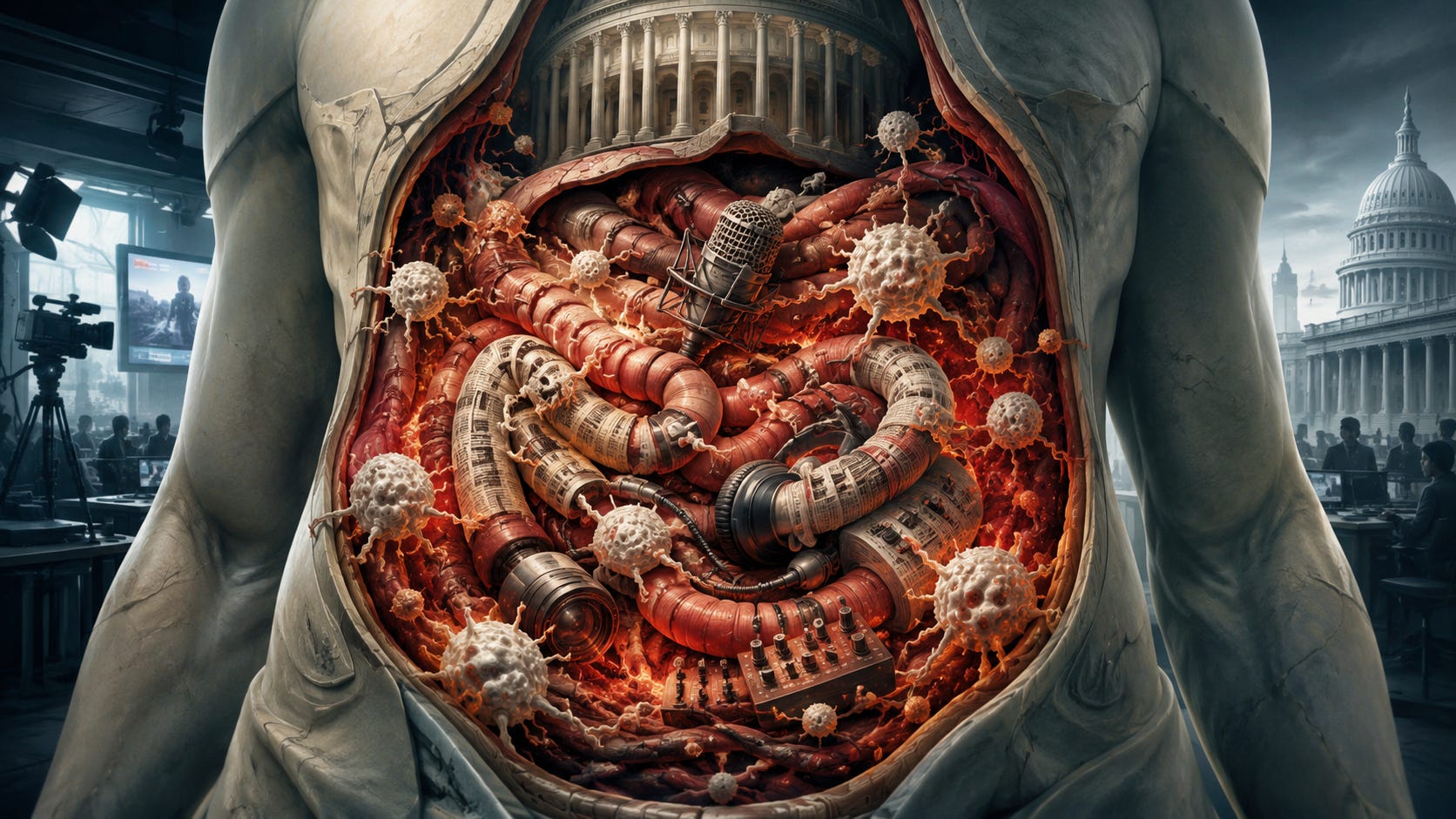
I want to propose that something very similar has happened to a significant portion of the American media establishment, the administrative class, and the credentialed professional elite. And I want to use a single recent episode of On the Media as my specimen slide.
What OTM Was
For most of its life, On the Media did something genuinely rare and valuable: it turned the critical lens on the press itself. Not on politicians. Not on Trump or Clinton or Bush. On journalism—its biases, its blind spots, its commercial pressures, its structural failures. It taught listeners how to read a breaking news story skeptically. It interrogated the assumptions baked into a headline. It held the press accountable for the Iraq War coverage, for the horse-race election framing, for the false balance epidemic.
The show that Brooke and Bob built was, in a real sense, an immune system for media consumers. It helped you recognize when you were being manipulated—including by the very outlets you trusted.
That show was the healthy gut. Processing reality. Absorbing the nourishing parts. Passing the rest through.
What OTM Has Become
The episode that prompted this essay featured a segment on the Trumpsonian—a pop-up exhibit organized in New York City by David Garrett, a luxury wine entrepreneur from Michigan and co-founder of a new nonprofit called the Institute for Primary Facts. Garrett downloaded all 3.5 million Epstein files from the Department of Justice website, had them printed and bound into 3,500 volumes—17,000 pounds of documents—and displayed them in a former art gallery.
He named it the Donald J. Trump and Jeffrey Epstein Memorial Reading Room. He called it a “pressure campaign.”
Brooke visited the exhibit and filed a long, earnest, deeply sympathetic report. The segment is, in many ways, genuinely moving—the survivor testimonies are real and harrowing, and Garrett’s grief over what he found in those files is palpable and human. I am not dismissing any of that.
But listen to what Garrett told Brooke about why he started the project:
“When the Smithsonian decided to bow to the Trump administration and rewrite history, I thought we need some place that’s going to actually preserve the truth.”
He’d been, in his own words, “listening to too many podcasts and yelling at the TV for ten years.” The Smithsonian’s removal of exhibits related to Trump’s impeachments was the trigger. He “kind of lost it a little bit.” And out of that loss, he built a nonprofit, raised money, fought through printer after printer who refused the job out of fear, found a location after multiple rejections, and opened a reading room dedicated to the proposition that the elected president of the United States is a criminal who should not be allowed to influence investigations into himself.
“Corruption is the tool of autocrats to kill democracies.”
Garrett says this with total conviction. He believes it. And here’s the thing—some of his factual claims are real. The files exist. The redaction failures are real. The survivor testimonies are real and documented. Trump’s name does appear more than 38,000 times in the documents.
But Garrett is a wine entrepreneur from Michigan who “lost it” because of a Smithsonian curatorial decision and has now organized his entire civic life around a single adversarial project targeting the sitting president. And On the Media—the show that once interrogated press narratives—is platforming this as accountability journalism, without a single interrogating question about the framing, the funding, the selection of targets, or the gap between the exhibit’s stated purpose and its actual politics.
“If we work together, democracy can still work.”
Brooke receives this line with warmth.
No pushback. No “but isn’t this also a political operation?” No “who funds the Institute for Primary Facts?” No “why Trump specifically and not the bipartisan cast of powerful men in these files?” None of the questions the old OTM would have asked reflexively, almost constitutionally.
The immune system has turned inward. And it can no longer tell the difference between a threat to democracy and a democratically elected government it doesn’t like.
The Clinical Diagnosis
This is what elite autoimmune disease looks like:
Loss of self-tolerance. The immune system stops recognizing “self” as safe. For the media and professional class, the legitimately elected government has become an unrecognizable foreign body. Not a political opponent to be covered, criticized, and held accountable through normal journalistic processes—but an occupying force, an invasion, a pathogen to be expelled. The basic democratic transaction—you lost, they won, now you cover them—has become immunologically intolerable.
Chronic inflammation. This isn’t a one-time response to a specific provocation. It’s systemic and constant. Every news cycle is a flare. Every executive order, every personnel change, every policy shift triggers the same undifferentiated alarm response. The inflammation has become the story, and the inflammatory response has become indistinguishable from journalism itself.
Friendly fire on healthy tissue. They’re not just attacking the administration. They’re attacking institutions that cooperated with a normal transition of power. They’re attacking voters. They’re attacking norms of democratic legitimacy. OTM, specifically, is attacking its own legacy—the rigorous, skeptical, self-interrogating journalism that made the show worth thirty years of my Saturdays—by abandoning it in favor of producing what amounts to resistance content.
Molecular mimicry. This is the cruelest part. The thing the immune system can no longer recognize as “self”—the populist political energy that elected Trump twice—was partly created by the failures of the very institutions now attacking it. Decades of credentialed class epistemic closure. The Iraq War coverage OTM itself dissected. The horse-race journalism. The coastal monoculture that couldn’t see 2016 coming. The body built the conditions for the pathogen. Now it can’t recognize its own creation and is attacking it as foreign.
The treatment paradox. You cannot cure Crohn’s by ramping up the immune response. Every “resistance” escalation—the Trumpsonian, the pressure campaigns, the relentless adversarial framing—is the equivalent of prescribing more inflammation to treat an inflammatory disease. It doesn’t work. It makes the tissue damage worse. And it further degrades the credibility of the institutions that need to remain functional for any of this to matter.
The Garrett Quotes, in Full
I want to be fair to David Garrett. He’s not a villain. He’s a father with two daughters, one of whom is 15, who stumbled into the Epstein files and couldn’t look away. When he describes sitting with a survivor who found her unredacted name, address, and driver’s license in documents that were supposed to protect her identity—that’s real outrage about a real failure. When he describes what he found randomly pulling a volume off the shelf, the pages of images of unclothed children, and having to sit down—that’s a genuine human response to something genuinely monstrous.
“There have always been monsters. But for 250 years, we have the rule of law. And the rule of law meant that we could feel confident that regardless of who the perpetrator was, we could hold them accountable.”
This is a real and serious argument. I don’t disagree with it.
“What is the deterrent now? They’ve all gotten away with it.”
This too is a real question worth asking.
“Real change is a small group of people trying to do impossible things. That’s the only way that change has ever happened.”
I believe this. I’ve believed it my whole adult life.
But here’s what the old OTM would have also asked: Is a luxury wine entrepreneur’s pop-up exhibit in a former New York art gallery, featuring a reading room named after the sitting president, actually accountability journalism? Or is it a pressure campaign—his word—that uses real victims’ real suffering to prosecute a political argument that most of Brooke Gladstone’s audience already agrees with?
Is platforming this, without interrogation, without the skeptical distance that once made OTM essential, journalism—or is it the immune system attacking itself while calling it health?
What Healthy Looks Like
The Epstein files deserve serious, sustained, rigorous reporting. The redaction failures Garrett describes—survivor names, addresses, Social Security numbers exposed—are a genuine Department of Justice scandal that deserves accountability coverage regardless of who’s in the White House.
The question of whether powerful men across multiple administrations and political affiliations have been protected from accountability by the same systems that failed these victims—that’s a real story. A big one.
A healthy OTM would be asking those questions with the same rigor it once brought to Iraq War press coverage. Without the framing of the exhibit. Without the warmth toward a “pressure campaign.” With the skepticism turned on every actor in the story, including the Institute for Primary Facts, including the selection of targets, including its own sympathetic response to a man who “lost it” when the Smithsonian changed a display.
That’s not the show I listened to this week.
The gut has Crohn’s. It can no longer digest the news. Everything is inflammation now.
And the tragedy is that Brooke Gladstone—one of the most gifted media critics alive, a woman who literally wrote the book on how media influences us—is both brilliant enough to know this is happening to the institution she leads, and too deep inside the flare to stop it.
I say this with thirty years of genuine respect.
Get well soon.
Appendix: The Full Immunology of Elite Institutional Crohn’s
For the nerds. Skip if you’re satisfied.
T Cells and B Cells—The Resistance Infrastructure
In healthy immunity, T cells (the killers) and B cells (the antibody factories) work together to identify genuine threats. B cells produce autoantibodies—targeted weapons against specific antigens. In autoimmune disease, these autoantibodies are misdirected against the body’s own proteins.
In media terms: the investigative T cells (reporters, editors, producers) and the institutional B cells (editorial standards, sourcing protocols, adversarial interview techniques) have turned their weapons on the democratic process itself. The autoantibodies—the adversarial framing, the resistance narrative, the assumption of bad faith—are now targeted at the normal operations of an elected government.
Myelin Sheath Damage—Institutional Memory
In Multiple Sclerosis, the autoimmune attack strips the myelin sheath—the protective coating around nerve fibers that allows signals to travel properly. Without it, the nervous system’s signals degrade and misfire.
OTM’s institutional memory—its thirty-year archive of holding the press accountable, its own documented history of questioning narratives—is the myelin sheath. The chronic inflammation of the Trump era has been stripping it. The signals that used to say “interrogate this framing” and “question this source’s agenda” are degrading. Misfiring. Producing warmth where skepticism used to live.
The Gut Specifically—Why Crohn’s Is the Right Diagnosis
The digestive system’s job is to take in raw material, break it down, extract what’s nourishing, and eliminate what isn’t. This is, precisely, what journalism is supposed to do with reality.
Crohn’s attacks the gut lining—the mucosa, the layer of tissue that does the actual absorbing. When it’s inflamed, nothing gets through properly. Nutrients that should nourish the body pass unabsorbed or cause further damage. Waste that should be eliminated gets trapped.
For a media institution with Crohn’s: actual news—a jobs report, a policy outcome, a court ruling that goes the “wrong” way, a poll showing genuine public support for an administration’s position—is the food the gut can no longer absorb. It triggers inflammation instead of nourishment. The information that should update the institutional worldview instead causes a flare.
And the waste—the adversarial narratives, the resistance framing, the pressure campaign coverage—can’t be eliminated either. It recirculates. It becomes the diet.
The Remission Problem
Crohn’s goes into remission. Patients have good stretches. Then something triggers a flare—stress, certain foods, an infection. The trigger doesn’t have to be catastrophic. It can be something small. Like a Smithsonian exhibit being taken down.
The tragedy of institutional Crohn’s is that remission is possible. The tissue isn’t dead. The capacity for healthy digestion is still there. OTM proved it in thirty years of genuinely great work. Brooke Gladstone’s intelligence hasn’t gone anywhere.
But you can’t achieve remission by fighting harder. You achieve it by calming the immune response. By restoring the self-tolerance that lets the system distinguish self from threat. By asking the hard question: is this actually a foreign invader, or is this just governing?
The Prognosis
Chronic autoimmune disease is manageable but not curable. Patients learn their triggers. They adjust their diet. They find the medications that reduce inflammation without suppressing immunity entirely.
For media institutions, the medication is simple in concept and nearly impossible to administer: cover the government you have, not the government you want. Apply the same skepticism to your own sympathies that you apply to your adversaries. Interrogate the pressure campaigns the same way you interrogate the administrations they’re targeting.
Ask, every time, what the old OTM would have asked.
I’ll be here. Still listening. Still hoping for remission.
The On the Media episode referenced in this essay aired in May/June 2025. The Trumpsonian exhibit segment begins at 27:51. You can listen at wnycstudios.org. The Institute for Primary Facts operates at trumpsonian.us.
Appendix: Everything You Need to Know
A Reference Document for Elite Autoimmune Disease
I. GLOSSARY OF TERMS
Autoimmune Disease A condition in which the body’s immune system—designed to attack foreign invaders—mistakenly attacks the body’s own healthy tissue. The immune system loses “self-tolerance,” the ability to distinguish self from non-self. Examples include rheumatoid arthritis, lupus, multiple sclerosis, and Crohn’s disease.
Crohn’s Disease A chronic inflammatory bowel disease in which the immune system attacks the lining of the digestive tract. Characterized by relapsing flares, tissue damage, inability to absorb nutrients properly, and no known cure—only management. Selected here as the primary metaphor because the gut’s function—taking in raw reality, extracting what’s nourishing, eliminating what isn’t—maps directly onto what journalism is supposed to do.
Self-Tolerance The immune system’s trained ability to recognize the body’s own cells as “self” and leave them alone. When self-tolerance breaks down, autoimmune disease follows. In the political/media metaphor: the ability to recognize a legitimately elected government as the domestic political body, not a foreign occupying force.
Molecular Mimicry A mechanism by which autoimmune disease is sometimes triggered: a foreign pathogen (virus, bacterium) resembles the body’s own proteins so closely that the immune system’s antibodies, trained to attack the pathogen, start attacking the body’s own tissue instead. In the political metaphor: the populist movement that elected Trump resembles, in many surface features, the authentic working-class democratic energy that the media class once claimed to represent and champion. The immune system can’t tell them apart and attacks both.
Friendly Fire Military term for attacks on one’s own forces, adopted in immunology to describe autoimmune tissue damage. In media terms: the collateral damage inflicted on journalistic credibility, democratic norms, institutional trust, and the media’s own audience when adversarial framing is misdirected at the domestic political body.
Inflammation The immune system’s acute response to a perceived threat—increased blood flow, white blood cell deployment, tissue swelling. Useful in short bursts for fighting genuine infection. Catastrophic when chronic, as it destroys the very tissue it’s meant to protect. In media terms: the constant alarm-state coverage, the resistance framing, the undifferentiated outrage that treats every news cycle as a five-alarm emergency.
Flare In Crohn’s and other autoimmune conditions, a period of acute symptom escalation. Can be triggered by stress, specific foods, infection, or seemingly minor provocations. In the essay’s central example: the Smithsonian’s removal of Trump impeachment exhibits was a flare trigger for David Garrett—a relatively minor institutional capitulation that triggered a massive, consuming response.
Remission A period of reduced or absent symptoms in a chronic autoimmune condition. Not a cure. Can end without warning. Achieved by calming the immune response, not escalating it.
Autoantibodies Antibodies produced by the immune system that mistakenly target the body’s own proteins. In media terms: the specific narrative weapons—adversarial framing, guilt-by-association coverage, resistance-movement platforming—that were once pointed outward at genuine threats and are now turned inward at the domestic political process.
The Administrative State / Deep State The permanent professional bureaucracy of the federal government—career civil servants, agency staffers, intelligence professionals—as distinct from political appointees. Relevant here because this class, along with the media establishment, is among the institutions exhibiting the autoimmune response described in the essay.
Resistance Media A term for media coverage and content that frames itself explicitly or implicitly as opposition to the current administration—not as journalism covering an administration, but as a participant in the effort to limit, constrain, or remove it. Distinct from adversarial journalism, which holds power accountable without taking sides in the political contest.
The Credentialed Class Sociological shorthand for the professional, college-educated, institutionally affiliated class that dominates legacy media, academia, NGOs, think tanks, and the upper echelons of government agencies. Distinguished from economic elites by credentials and institutional affiliation rather than primarily by wealth. The class most exhibiting the autoimmune symptoms described in this essay.
II. TIMELINE: ON THE MEDIA, 1993–2025
February 7, 1993 On the Media debuts on WNYC as Inside Media, a local call-in show hosted by Brian Lehrer. New York-focused, radio-native, modest in scope.
1997 Relaunched as On the Media in a national, magazine-style format. Begins syndication beyond WNYC.
January 2001 Brooke Gladstone and Bob Garfield take over as co-hosts. The show’s modern identity is established: rigorous, funny, adversarial toward the press itself, genuinely bipartisan in its skepticism. Gladstone is the philosophical anchor; Garfield is the aggressive interrogator. Together they are arguably the best media criticism team in American broadcast history.
2001–2003 OTM’s coverage of post-9/11 press failures and the run-up to the Iraq War establishes the show’s reputation as essential listening. The press’s near-total compliance with the Bush administration’s WMD narrative becomes one of OTM’s defining subjects—a case study in how even serious journalists can fail systemically when the institutional environment rewards compliance.
2005 On the Media becomes available as a podcast, dramatically expanding its audience beyond public radio listeners.
2008–2016 The show expands to over 400 public radio stations. Peabody Awards. The Breaking News Consumer’s Handbook becomes a widely shared resource for media literacy. OTM produces genuinely landmark journalism criticism across two administrations, holding Obama-era press failures to the same standard as Bush-era ones.
2016 Trump’s election. The first signs of the autoimmune response appear across legacy media broadly. OTM is not immune. The framing begins to shift—subtly at first—from “we scrutinize the press” toward “we scrutinize the press in the context of the threat to democracy.”
2017–2020 The first Trump term. The shift accelerates. OTM increasingly covers press behavior through the lens of democratic resilience rather than pure journalistic critique. Still producing excellent work—but the self-interrogating muscle is used less frequently on subjects where the show’s sympathies are engaged.
May 2021 Bob Garfield is terminated by New York Public Radio following an investigation into workplace conduct. The details are disputed—Garfield describes “anger mismanagement” and “yelling in five meetings over twenty years”; WNYC and the OTM staff describe a pattern of bullying behavior. The professional partnership that defined the show’s golden era ends abruptly.
2021–2025 Brooke Gladstone continues as host and managing editor, with Micah Loewinger joining as co-host. The show remains technically accomplished and often genuinely interesting. But the self-interrogating function—the willingness to turn the critical lens on narratives the show’s audience finds sympathetic—has largely atrophied. Bob Garfield, meanwhile, writes independently on Substack.
May/June 2025 The episode that prompted this essay airs. The Trumpsonian/Epstein segment. A luxury wine entrepreneur’s anti-Trump pop-up exhibit is covered with warmth and sympathy, without adversarial questioning of the framing, the funding, or the politics. The autoimmune response is, at this point, fully systemic.
III. TIMELINE: THE EPSTEIN FILES
1990s Jeffrey Epstein builds his network of relationships with powerful men across politics, finance, academia, and entertainment. Allegations from victims begin in this period.
2005 Palm Beach Police Department opens an investigation into Epstein following a complaint from the mother of a 14-year-old girl.
2006 The FBI opens a federal investigation. Prosecutors build a case involving dozens of victims.
2007–2008 The infamous non-prosecution agreement. Federal prosecutors under Alexander Acosta give Epstein an extraordinarily lenient plea deal—13 months in county jail, work release, secret immunity for unnamed co-conspirators. Victims are not notified as required by law. The deal is later ruled illegal.
2018 The Miami Herald, under reporter Julie K. Brown, publishes a landmark investigative series exposing the non-prosecution agreement and its victims. This reporting directly leads to Epstein’s re-arrest.
July 2019 Epstein is arrested on federal sex trafficking charges in New York.
August 10, 2019 Epstein dies in federal custody. The official ruling is suicide. Significant questions about the circumstances remain unresolved. His death prevents any trial and any testimony about his network.
2020–2023 Ghislaine Maxwell, Epstein’s associate and alleged recruiter, is tried and convicted on federal sex trafficking charges. She is sentenced to 20 years. She does not testify about clients or co-conspirators.
2024 The DOJ begins releasing Epstein files in tranches following years of legal battles and public pressure. Millions of documents are made public—though roughly 2.5 million remain unreleased as of this writing.
Early 2025 The Epstein Files Transparency Act passes the House with one dissenting vote, passes the Senate unanimously, and is signed into law—demonstrating, as David Garrett notes in the OTM segment, that “democracy can still work” when organized citizen pressure meets genuine bipartisan political will.
Spring 2025 David Garrett, founder of the Institute for Primary Facts, organizes the Trumpsonian exhibit in New York City. 3.5 million files are printed, bound into approximately 3,500 volumes, and displayed in a former art gallery. The exhibit is named the Donald J. Trump and Jeffrey Epstein Memorial Reading Room. It draws survivors, visitors, and national media coverage. It relocates to Washington, D.C. after its New York run.
IV. KEY FIGURES
Brooke Gladstone Host and managing editor of On the Media since 2001. One of public radio’s most accomplished journalists. Author of The Influencing Machine (2011), a graphic novel history of media influence, and The Trouble with Reality (2017), on fractured information ecosystems. Two Peabody Awards. NPR’s first dedicated media reporter. A genuine intellectual force who, this essay argues, is operating inside a diseased institutional environment that is degrading the function she is most gifted for.
Bob Garfield Co-host of On the Media from 2001 to 2021. Former Advertising Age ad critic for 25 years. Author of The Chaos Scenario. Known for aggressive, confrontational interviewing and sharp wit. Terminated by NYPR in 2021 under disputed circumstances. Now writes independently at Bully Pulpit on Substack. A personal friend of the author of this essay, and therefore not a subject of this analysis.
David Garrett Luxury wine entrepreneur from Michigan. Co-founder of the Institute for Primary Facts, a nonprofit he describes as “pro-democracy.” Organized the Trumpsonian exhibit after being triggered by the Smithsonian’s removal of Trump impeachment displays. Father of two daughters, one 15 years old. Earnest, motivated by genuine outrage, and operating as a citizen activist—not a journalist. Treated by On the Media as a accountability figure without the interrogation that designation would normally invite.
Andrea Sterling Online content creator and survivor of Jeffrey Epstein’s abuse, who came forward publicly for the first time at the Trumpsonian exhibit. Her testimony in the OTM segment is the most powerful and unimpeachable element of the episode. Her story is real, her courage is real, and nothing in this essay is directed at her or at survivors generally.
Brian Merchant Technology journalist, author of Blood in the Machine, covered in the Anthropic segment of the same OTM episode. Not the subject of this essay. The Anthropic segment is left entirely unaddressed here.
V. KEY ISSUES AND CONTEXT
Why the Smithsonian Matters The Smithsonian Institution is the world’s largest museum complex, funded primarily by the federal government. Its curatorial decisions about what history to display and how to display it are inherently political—but have traditionally been managed with at least nominal independence from current administrations. The Trump administration’s pressure on the Smithsonian to modify or remove exhibits related to Trump’s impeachments is a genuine press-freedom-adjacent concern. Garrett’s anger at this is understandable.
What it is not is evidence that the elected government is an occupying force. Curatorial decisions by federally funded institutions changing under political pressure is a serious institutional issue. It is not the same category of event as, say, the suppression of a free press, the imprisonment of journalists, or the dismantling of electoral infrastructure. The autoimmune response treats them as equivalent.
Why the Epstein Files Are Legitimate News The Epstein files contain documented evidence of serious federal crimes, failures of prosecutorial independence, and ongoing harm to victims through inadequate redaction. The question of whether powerful men across multiple administrations and political affiliations received protection they shouldn’t have is a genuine public interest story. The DOJ’s failure to properly redact victim information—exposing names, addresses, Social Security numbers, and photographs of minors—is a genuine scandal.
None of this requires the framing Garrett provides. The files are legitimate news independent of any particular political argument about the current president.
The Bipartisan Problem the Exhibit Ignores Epstein’s network was explicitly bipartisan. His client list—to the extent we know it—included powerful figures across Democratic and Republican politics, finance, academia, and entertainment. The exhibit’s explicit focus on the “decades-long relationship between Jeffrey Epstein and Donald Trump, its synergies and synchronicities” is a political choice, not a journalistic one. OTM does not interrogate this choice.
The “Pressure Campaign” Problem Garrett himself uses the phrase “pressure campaign” to describe the exhibit’s purpose. A pressure campaign is, by definition, advocacy—an attempt to change political outcomes through organized public action. There is nothing wrong with advocacy. But advocacy is not journalism, and a media outlet platforming advocacy as accountability journalism without identifying it as such is doing something OTM once would have named and examined.
The Self-Tolerance Question The deepest issue this essay raises is not about OTM specifically but about an entire class of institutions: at what point does legitimate criticism of an administration become an inability to recognize the administration’s democratic legitimacy? The healthy immune system can fight infection vigorously while still recognizing the body as the body. The autoimmune system cannot make this distinction. The tell is not the vigor of the criticism—it’s the loss of the interrogating function when the criticism is directed at a sympathetic target.
VI. FREQUENTLY ASKED QUESTIONS
Q: Are you saying the Epstein story isn’t important? A: No. The Epstein story is important, extensively documented, and involves genuine failures of accountability that deserve sustained serious reporting. The issue isn’t the subject matter—it’s the framing and the absence of journalistic interrogation.
Q: Are you saying Trump isn’t corrupt? A: That question is not what this essay is about. This essay is about what happens to media institutions when they lose the ability to cover political subjects with consistent journalistic skepticism regardless of their own sympathies. Whether Trump is corrupt is a separate question from whether OTM is doing journalism or resistance content.
Q: Aren’t you just defending Trump? A: No. I’m a politically independent, anti-interventionist who has been listening to public radio since the Clinton administration. The argument here is structural and institutional, not partisan. The same critique would apply to a right-wing media institution that had lost the ability to interrogate its own sympathies.
Q: Is it fair to criticize OTM when the subject matter—Epstein, Trump, accountability—is genuinely serious? A: Serious subject matter is precisely when journalistic discipline matters most. The Iraq War coverage was also about serious subject matter. OTM spent years examining how serious subject matter caused the press to abandon its critical function in the early 2000s. The show is now exhibiting the same failure mode, in the opposite political direction.
Q: What would healthy coverage of this story look like? A: It would cover the Trumpsonian exhibit as a civic activism story, not an accountability journalism story. It would interrogate the framing—why Trump specifically, who funds the Institute for Primary Facts, what the bipartisan dimensions of the Epstein network look like. It would include the survivor testimonies with the same gravity and care. It would ask Garrett the hard questions the old OTM would have asked any subject: who are you, what are your interests, what are you not telling me?
Q: What’s your relationship to OTM? A: Thirty years as a listener. Personal friendship with Bob Garfield. Professional respect for Brooke Gladstone. No financial relationship with WNYC, NPR, or any competing media organization.
Q: What do you want OTM to do? A: Ask the questions it used to ask. Turn the lens on the narratives it finds sympathetic with the same rigor it applies to the ones it doesn’t. Remember what it was for.
Q: Is this recoverable? A: Yes. The tissue isn’t dead. The capacity is there. Remission is possible. But it requires calming the immune response, not escalating it.
VII. FURTHER READING AND LISTENING
On Autoimmune Disease
National Institute of Allergy and Infectious Diseases: niaid.nih.gov
Crohn’s & Colitis Foundation: crohnscolitisfoundation.org
On the Epstein Files
DOJ Epstein Files release: justice.gov
Institute for Primary Facts / Trumpsonian: trumpsonian.us
Julie K. Brown’s original Miami Herald series (2018): the reporting that reopened the Epstein case
On the Media
The episode referenced in this essay: wnycstudios.org/podcasts/otm
Brooke Gladstone, The Influencing Machine (2011)
Brooke Gladstone, The Trouble with Reality (2017)
Bob Garfield, The Chaos Scenario (2009)
Bob Garfield, Bully Pulpit on Substack
On Media Criticism Generally
Columbia Journalism Review: cjr.org
Press Run (Eric Boehlert’s newsletter, now archived)
Manufacturing Consent, Chomsky & Herman (1988)—the foundational text on structural press bias, still relevant
This appendix is a companion to the essay “Elite Autoimmune Disease.” All views are those of the author. Nothing here should be construed as legal, medical, or political advice, though the immunology is solid.