
For Your Protection
How Altruistic Authoritarianism Became the West's Most Successful Export

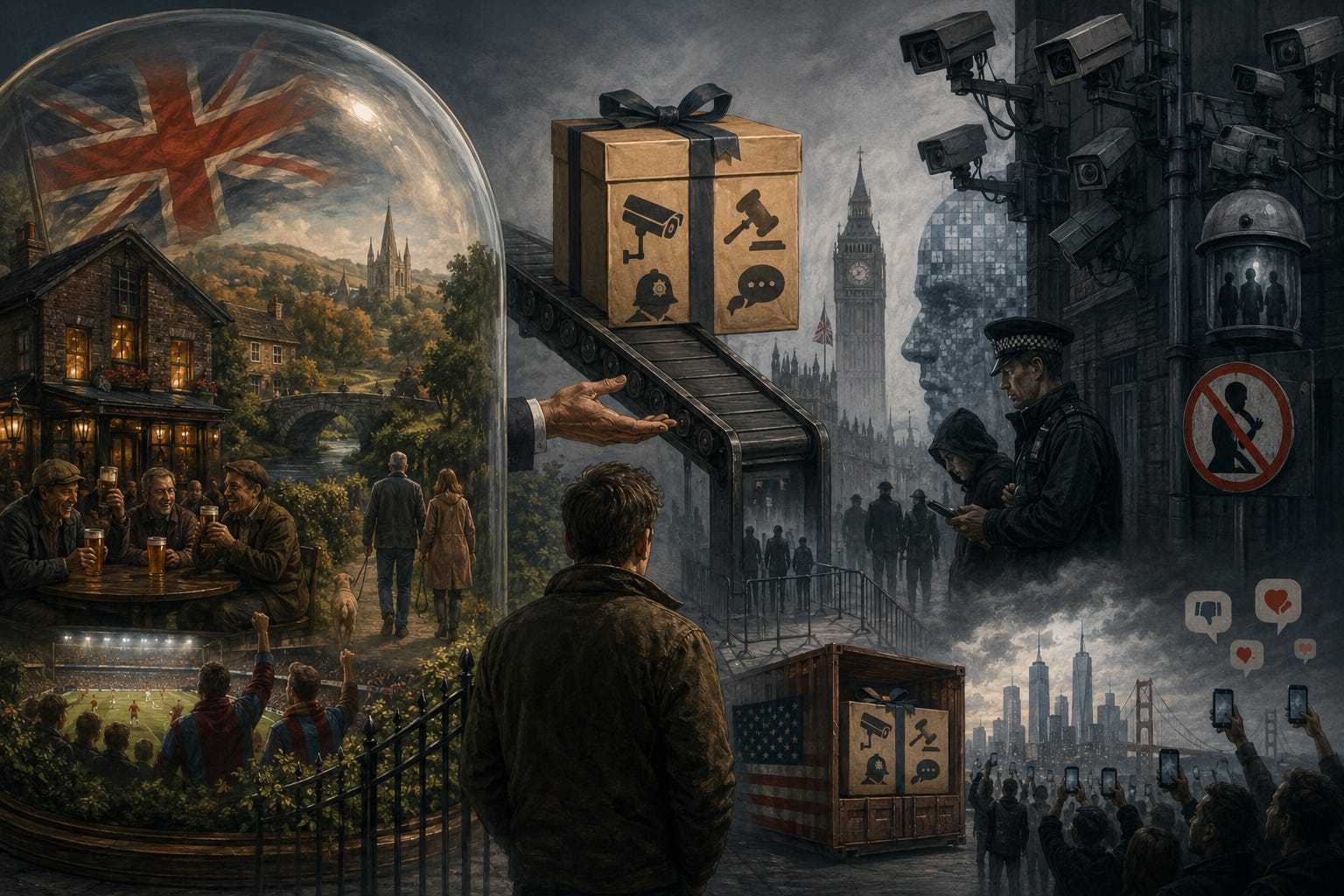
I spent the better part of yesterday in a 200-comment Threads argument with British people about per capita wealth. It started with a simple observation—the UK ranks below all 50 US states in GDP per capita, dead last, 51st place, and Brits surveyed about this guessed they ranked 7th—and it ended somewhere around Clarkson's Farm, the Stasi, and the philosophical question of whether contentment and prosperity are the same thing.
They are not. But that's not the piece.
The piece is what I noticed about how they argued. Not the substance—the architecture. The assumptions baked so deep into the framing that they couldn't see them. The reflexive reach for victimhood as leverage. The confidence that safety and freedom are synonyms. The genuine, unironic belief that a country with more CCTV cameras per capita than almost any nation on earth, that arrests people for tweets deemed "grossly offensive," that creates buffer zones around abortion clinics where silent prayer is a prosecutable offense—that this country is freer than America because it has the NHS.
I am an anglophile. I studied at UEA Norwich. I punted in Oxford. I spent Christmas in Wales and Hogmanay in Edinburgh. I still own a Barbour jacket. I love the pub, the beer garden, the Sunday walk, the cheerful tolerance for boredom that Americans have completely lost. I am not writing this to be cruel. I am writing this because Britain is the laboratory. And what's growing in the petri dish is coming here.
The Stasi Didn't Lose. It Got a Rebrand.
Here is the thing about East Germany that nobody wants to say: most people were fine.
Not the dissidents. Not the intellectuals who ended up in Stasi files or exile or prison. But the ordinary people—the ones who went to the beer garden on Sunday, who watched state television, who kept their heads down and didn't say anything that wasn't cricket—they were, by their own account, largely content. The Ostalgie is real. Reunification surveys showed significant portions of former East Germans mourning the certainty, the community, the sense that someone competent was managing things. The dissidents who escaped and wrote memoirs represent a fraction. The rest made their peace.
The Stasi had 91,000 official employees. It also had somewhere between 500,000 and 2 million informal collaborators—ordinary neighbors, colleagues, family members who reported on each other not at gunpoint but voluntarily, because it felt like the right thing to do. Because the state had successfully framed civic loyalty as mutual surveillance. You weren't spying on your neighbor. You were protecting the community.
Now ask yourself: what is the difference between that and screenshotting someone's tweet and mass-reporting it? Between calling someone's employer because of something they said online? Between the volunteer army of people who, for free, for clout, because it feels virtuous, surveil and report their fellow citizens for speech infractions?
The mechanism is identical. The aesthetic is different. The jackboots became lanyards. The Volkspolizei became the content moderation request form. The informant became the ratio.
For Your Protection
The genius of altruistic authoritarianism—and it is genius, in the way that any sufficiently successful parasite is genius—is that it never arrives announcing itself. It arrives as care.
Every expansion of state power in modern Britain comes wrapped in the language of protection. The exclusion zone around an abortion clinic isn't a speech ban. It's protecting vulnerable women. The hate speech prosecution isn't censorship. It's holding people accountable for harm. The social media arrest isn't surveillance. It's community safety. The knife restriction isn't disarmament. It's saving lives.
Each individual measure, considered in isolation, sounds reasonable to a reasonable person. The architecture they build together does not.
In my Threads conversation, a commenter named andy_hames explained patiently that nobody in Britain is arrested for praying silently. They're arrested for being in breach of an exclusion order, because their purpose in being there is to intimidate potentially vulnerable women. I thanked him for the clarification. Then I pointed out that he had just explained, with great precision, exactly what I was describing. The government decided that silent prayer constitutes intimidation. The government created the zone. The government defined the crime. He had described the mechanism of altruistic authoritarianism and presented it as a rebuttal to my argument about altruistic authoritarianism.
The line moved. He explained how. And he thought he was winning.
Bread and Circus, Revised
The Romans understood that a population requires two things to remain manageable: bread and circus. Feed them, entertain them, and they will not revolt. The formula has been updated for the modern welfare state. The bread is the pub—cheap, warm, socially mandatory, the central institution of British working-class life. The circus is the football club—tribal, passionate, a container for loyalties that might otherwise become politically inconvenient.
I don't say this to condescend. I say this because I watched it in real time across 200 comments. The Brits in that thread were genuinely, sincerely proud of their country. They believe in the NHS the way Americans believe in the Second Amendment—as a sacred covenant between citizen and state, a symbol of collective identity that transcends its practical function. When I pointed out that NHS satisfaction is at 21%, the lowest since surveys began in 1983, that 7 million people are on waiting lists, that the government itself has called the system "broken"—they didn't update their belief. They explained why the metric was wrong.
This is not stupidity. This is something more interesting: the successful internalization of a narrative so deep it functions as identity. To criticize the NHS is to criticize Britain. To criticize Britain is to criticize yourself. The serf who loves the castle isn't confused about the power relationship. He has simply been given enough—the pub, the match, the free GP appointment, the sense of belonging to something—that the trade feels fair.
coletteoddy, who became the most interesting interlocutor in the thread, said it best near the end: "I am going to say we both know what our own country is worth and how OK we both are with that." That's not false consciousness. That is a genuinely contented person who has correctly assessed that the terrarium is comfortable and the walls are not worth testing. She's right that the world is angry and the internet has given everyone the whole world to argue with instead of just their family. She's wiser than most of the others.
But here's the thing about terrarium contentment: it requires that you not try the door.
The Perception Gap
The detail that started all of this—that Brits surveyed guessed they ranked 7th among US states in per capita wealth, when the actual answer was 51st—is not really about economics. It's about the gap between what a population believes about itself and what the data shows. That gap is not an accident. It is the product of a specific information environment, a specific emotional investment in national narrative, and a specific institutional interest in maintaining the story.
Britain exports a version of itself—sophisticated, humane, post-imperial, properly guilty about empire but culturally enriched by it, sensible in ways that hysterical Americans are not—that its citizens have largely consumed wholesale. The NHS is the envy of the world. British democracy is ancient and stable. British press is robust and irreverent. British culture is a gift to humanity.
Some of this is true. A lot of it is the national mythology that every country maintains to make itself legible to itself. Americans do the same thing. The difference is that American mythology is at least honest about its vulgarity. We brag about our wealth, our power, our guns, our freedom to fail spectacularly. The British mythology is more seductive because it's wrapped in modesty. We're not like those Americans. This very sentence is the tell.
What's Coming Here
I said Britain is the laboratory. Here is what I mean.
The speech prosecution apparatus that Britain built—the Online Safety Act, the hate speech statutes, the Public Order Act buffer zones, the Malicious Communications Act—is not uniquely British. It is the leading edge of a legal philosophy that is actively being imported into American blue states and into the policy platforms of American progressive institutions. The campus speech codes of the 2010s were a rehearsal. The social media deplatforming of the 2020s was the main event. The next phase is legislation.
As California goes, so goes America. As Britain goes, so goes California.
The mechanism is always the same: identify a vulnerable population, frame the speech restriction as their protection, and make opposition to the restriction into an attack on the vulnerable population. You are not defending free speech. You are defending the right to harass trans children. You are not defending due process. You are defending rapists. You are not defending open borders. You are defending the replacement of the native population. The accusation is designed to make the defense impossible without accepting the framing.
This is not a left-wing conspiracy. It is a structural feature of how power consolidates in liberal democracies once it discovers that naked coercion is inefficient and that virtue is a more effective lever than fear. Altruistic authoritarianism doesn't need a Gestapo. It needs a Twitter ratio and an HR department.
The Written Constitution Question
Britain does not have a written constitution. This is not a quirk. It is load-bearing. Without a written constitution, there is no fixed floor below which rights cannot fall. The government of the day defines what rights mean, and the definition can be updated by parliamentary majority. The exclusion zone exists because parliament created it. The speech prosecution exists because parliament enabled it. The CCTV panopticon—Britain has more cameras per capita than almost any country on earth, including China by some measures—exists because nobody wrote down that it couldn't.
Americans with a written constitution have watched their speech protections erode through social pressure, institutional capture, and corporate policy rather than law—which is arguably more insidious because it's harder to fight. But the floor is still there. The First Amendment is still there. The Second Amendment—which is really a canary, not a gun policy—is still there. When a government comes for the guns, you know everything else is negotiable. Britain proved it: handguns gone in 1997, kitchen knives now a policy conversation, and somewhere a bureaucrat is filling out a form about your hedge trimmer.
The freedom to be dangerous is the freedom that guarantees all the other freedoms. A population that cannot protect itself cannot refuse anything.
A Final Word to the Brits
I genuinely love your country. The conversation I had on Threads was one of the more interesting I've had on social media in years, and several of you—coletteoddy, smargiassienrico, even poleboy with his "knob jockey" opening—were genuinely engaging with the argument rather than just performing outrage.
You are not serfs. You are not stupid. You are a population that made a series of reasonable-seeming tradeoffs over several decades and arrived somewhere that looks, from the inside, like a comfortable arrangement, and looks, from the outside, like the slow relinquishment of things you won't know you needed until you try the door.
The gap between 7th and 51st is not really about money. It's about what you believe about yourselves, and whether that belief has been stress-tested against reality, and who benefits from you never finding out.
Every one of your vices is one of our virtues. Every one of our virtues is one of your vices.
We're just more honest about which is which.
Chris Abraham is a writer, digital strategist, and recovering Anglophile based in Arlington, Virginia. He publishes at chrisabraham.substack.com.
Chris, this is genuinely impressive prose; polished, fluid, confident, and at times beautifully sharp.
For example:
“The freedom to be dangerous is the freedom that guarantees all the other freedoms. A population that cannot protect itself cannot refuse anything.”
That is powerful writing. The prose is so smooth that it glides over very large analytical gaps before I even noticed they occurred; surely, hence I landed in cloud-cuckoo-land, amused, staring at swirling clouds, and realizing nothing actually stuck in my head.