
Full On
I am the sacrificial anode on this argument. I take the corrosion. The hull is yours to do with as you please.

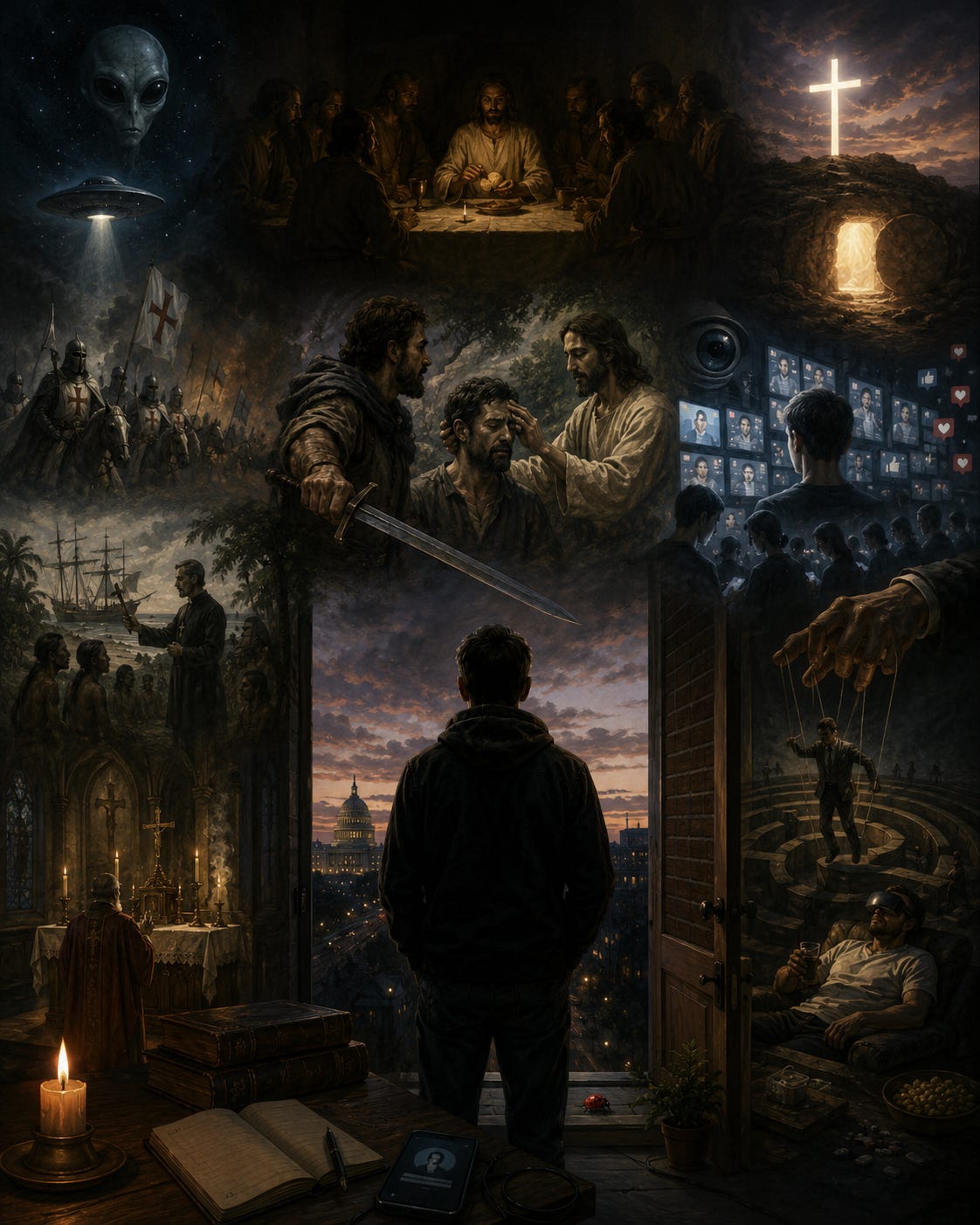
Guard your heart, for everything you do flows from it. —Proverbs 4:23
I have aphantasia. When I close my eyes, it goes dark. Not dim—dark. No mind’s eye, no internal cinema, no sheep to count before sleep because counting sheep requires sheep and I have never once produced a sheep in my head. I also have SDAM—Severely Deficient Autobiographical Memory—which means I don’t replay my life like a film. I know things happened. I was there. But I cannot re-experience them. The past is a library I can reference but never visit.
I found out about aphantasia at fifty years old, in 2020, from a Netflix show called Space Force. Which tells you something about how invisible this condition is even to the people who have it. You don’t know you’re missing the pictures because you’ve never had the pictures. You assume everyone else is speaking metaphorically when they talk about the mind’s eye. You find out five decades in that they weren’t.
Here is what else I have: a full, unironic, unhedged belief in Jesus Christ of Nazareth. Not the Jefferson Bible version—Jefferson literally cut the miracles out with scissors to get to a sensible ethical teacher, and I find that project both intellectually tidy and completely beside the point. Not the culture war version. Not the end-times prophecy countdown version. Not the rebuild-the-temple-and-trigger-the-sequence version. The full version. Water into wine. Resurrection. Transubstantiation—and I mean that literally, not as metaphor, not as symbol, not as a beautiful communal meal of remembrance. I mean that when the bread and wine are consecrated, we are pulled out of time and we are in the room. The upper room. The last supper. Present tense.
I cannot picture any of it. The upper room is dark when I try. The faces are dark. The table is dark. It doesn’t matter.
I am full on anyway.
Right now, pastors across America are panicking about alien disclosure. The government, apparently, is preparing to release classified UFO files, and prominent evangelical leaders are warning their congregations that this could shatter faith, trigger mass apostasy, cause believers to see the Bible’s creation story as myth. Intelligence officials have reportedly been briefing select pastors to prepare their flocks for the revelation that we are not alone.
I am completely unbothered.
Not because I’m sophisticated about it. Not because I’ve worked out a theology of extraterrestrial life. But because my faith was never load-bearing on the cosmological scaffolding that alien disclosure is supposed to collapse.
Think about what would actually have to be true to shatter my faith. Nothing. There is no fact about the Gospels that would do it. They could be complete fabrications. They could have been written by a committee of Romans who needed a pacification narrative for an occupied population. They could be a plagiarized remix of older virgin birth mythology with a Mediterranean coat of paint. They could have been posted anonymously on a message board by someone with too much time and a gift for moral philosophy. It doesn’t matter.
I’m a Bokononist about this. Kurt Vonnegut built an entire religion in Cat’s Cradle on what he called foma—harmless untruths. The scripture of Bokononism announces on its first page that it is composed of lies. Believe it anyway, Bokonon says, because the living is better with it. I bring that straight into my Christianity without apology. If the Gospels are foma—if they’re beautiful necessary lies that make you braver and kinder and more capable of getting through the dark—they still work. The lie that functions as truth is doing truth’s job.
I know this not as a philosophical position but as a lived one. My father died when I was young. I was told one version of how it happened—a dignified, solitary death, a man doing work he loved. Years later, on a boat in Hawaii, I found out the actual story. It was nothing like the first one. The people who loved me had looked me in the face and handed me a constructed version of my father’s last hours because they decided that’s what I needed.
And here’s the thing: it worked. I grieved a real man through a false narrative and the grief was real and the love was real and the loss was real. The foma did exactly what truth was supposed to do. I’m not angry about it anymore. I was—I let a silence go unresolved until it was too late to resolve it, and I regret that. But the lie itself? The lie was an act of love by people who didn’t know what else to do.
You cannot verify anything all the way down. Not your father’s last hours. Not your partner’s interior life—I once found out that someone I loved was carrying around a fantasy I knew nothing about, and my body tried to have a heart attack about it. A doctor gave me a paper bag to breathe into and some Xanax and sent me home. That’s how I learned that the gap between the narrative you’re living in and the actual interior life of the person next to you is not something you can close by trying harder. Your sweet kid might be living a parallel life. Your business partner might be quietly skimming. Your priest might be lost. The Gospels might be foma written by a committee.
None of it is verifiable all the way down. So you choose what to build your life on. Not because it’s true. Because it’s livable. Because it makes you braver and kinder and more capable of being in the room with the people you love.
That’s not weakness. That’s just what faith actually is. All faith. Not just religious faith.
So: aliens? Fine. Alien hybrid? Fine. Recycled virgin birth mythology from older traditions? Fine. Imperial propaganda that accidentally transmitted genuine divine truth? Fine. The vessel doesn’t have to be pure for what moves through it to be real.
I learned this at St. James’s Episcopal on Capitol Hill, under a priest named Father Downing, who is gone now. Anglo-Catholic, high church, smells and bells, real presence at the altar—the tradition that refused to let the Reformation strip everything bare. Father Downing handed me Aquinas in Anglican vestments and I absorbed it so completely it’s just how I understand reality now. I am currently Catholic curious, listening to the Hallow app, not yet back at the rail, not yet in confession. But the theology is already mine. Father Downing put it there.
Here is something else I believe: the Godwink is the Holy Spirit’s only available delivery channel to me.
A Godwink is what SQuire Rushnell, a former ABC executive, named in his 2002 book—a coincidence so precisely timed it feels like a personal signal from God. A wink across a crowded room. Most people would file this under pattern recognition, which is exactly what it is neurologically, and I know that, and I receive it anyway as a tip of the hat from the Spirit. Because the internal channel—the felt sense of presence, the visualized prayer, the memory of a moment of grace—that’s dark for me. The Spirit has to work from the outside because there’s no inside cinema to project onto.
I don’t think this makes my faith weaker. I think it makes it structurally different. I’m not believing through feeling or imagery or the warm cinematic re-experiencing of moments of grace. I’m believing through the bare fact of it, in the dark, because it holds up even when everything you’d normally use to support belief has been removed.
That’s not the Jefferson Bible. That’s not a reduced, rationalized, made-safe Jesus. That’s the whole impossible catalog, held in the dark, without pictures.
Now: Peter.
In the garden of Gethsemane, when the soldiers came for Jesus, Peter drew his sword and cut off the ear of the high priest’s servant. The servant’s name was Malchus. Peter—the rock of the church, the first pope, the man on whom the institution was built—his instinct in the crisis moment was to grab a weapon.
Jesus put the ear back. Healed the man Peter had just wounded. Then went quietly.
That sequence is the whole problem with institutional Christianity in eleven words: Peter cut the ear off. Jesus healed it.
The Crusades are Peter’s sword. The Inquisition is Peter’s sword. The colonial missionaries are Peter’s sword. The culture war Christians are Peter’s sword. Every generation of believers who decided that the sword was the instrument of God’s will, that the dramatic heroic violent moment was the point, that they were soldiers for Christ—all of them, Peter, grabbing the sword in the garden, absolutely certain they were doing the right thing.
Jesus’s response to the very first act of Christian violence was to immediately undo it and then surrender. That’s not subtle. That’s not ambiguous. That’s Jesus saying, on the record, in real time: this is not what this is. Put it away.
And then two thousand years of Peters.
Nobody wants to be the Christ in that story because the Christ in that story looks like he lost. He gets arrested. He gets crucified. He doesn’t get to be the hero of the moment that matters. Peter at least did something. Peter was in the story. Peter had a sword and used it and everyone knew he was serious.
Here is the thing about everyone wanting to be Peter: it connects directly to everything else that’s broken.
Jacob Geller made a video recently—Why Does Everyone Think “1984” Agrees With Them?—that 1.2 million people have watched, which means 1.2 million people watched a video about how everyone misuses 1984 and most of them probably came away thinking it vindicated their specific position. The video’s thesis is that Orwell’s novel has become an all-purpose cudgel, a legitimacy booster, a way to establish intellectual pedigree for whatever you were already arguing. The left uses it for surveillance capitalism and authoritarian creep. The right uses it for deplatforming and censorship. Elon Musk invokes it while running a government efficiency department. Bernie Sanders invoked it for NSA surveillance. The book has been grabbed by every side since the day it was published.
Geller’s question is whether the book is genuinely universal or just vague enough to be weaponized. I’d go further: 1984 is the wrong book. It’s the red herring.
Brave New World is the actual diagnosis.
Orwell feared a boot on the face. Huxley feared nobody would need the boot because the cage would be too comfortable to want to leave. Orwell’s dystopia requires an apparatus of coercion—secret police, torture chambers, surveillance infrastructure, the whole Stasi aesthetic. Huxley’s dystopia requires only appetite. Give people enough pleasure and enough inclusion and they’ll walk into the cage voluntarily and call it freedom.
And here’s the thing about the Stasi: their most sophisticated program wasn’t surveillance. It was Zersetzung—psychological decomposition. They didn’t arrest dissidents. They moved their furniture slightly. Spread rumors among their friends. Arranged small professional embarrassments. Made the dissident doubt their own memory, their own sanity, their own relationships. No boot. No torture chamber. Just the slow erosion of the self until resistance felt crazy and conformity felt like the only sane option.
That’s not 1984. That’s Brave New World with a badge and a filing cabinet.
People don’t seek books. People seek pleasure and inclusion. The Stasi knew this operationally. Social media built the same machine without the secret police budget. The informant who became a good CI wasn’t broken—he was promoted, included, given status and security and the warm feeling of being on the right side. He volunteered. Same as the soldier who discovers that loyalty to the institution is rewarded with better assignments—and the American military is, functionally, the most successful communist system ever devised. Universal healthcare, housing, food, clothing, collective mission, promotion by demonstrated loyalty. It works. Nobody’s starving at Fort Bragg. But the mechanism is the same: behavior is shaped by reward, and the reward is always inclusion.
Everyone waving 1984 at each other is itself a Brave New World phenomenon. The discourse, the dunking, the “this is literally Orwellian” posts—that’s not resistance. That’s the soma. The fight about who the real Big Brother is has become the entertainment that prevents anyone from noticing Huxley’s softer, more total, more voluntary captivity.
My actual theology, for the record, is a synthesis that would make a seminary professor reach for his antacids.
It’s got Psalms as its emotional infrastructure—David screaming at God and praising God and begging God and bargaining with God, the full unfiltered human range addressed directly to the divine without manners. It’s got the Book of Common Prayer as its daily architecture—Cranmer’s prose, morning and evening, prayers for the night worker, the prisoner, the traveler, the sick child, strangers I’ll never meet, three or four times a day, orienting me outward when everything in human nature pulls inward. It’s got Matthew as the ethical spine, specifically the Sermon on the Mount, which is not a recruitment poster and was never meant to be one. It’s got a lot of Buddha in the non-attachment and the present-moment orientation. It’s got twelve-step as the operating system—I am powerless over most of it, let go, let God, keep the heart clean through inventory and amends and conscious contact with a higher power as I understand it.
And it’s got Vonnegut. Specifically Bokonon. Specifically foma.
The answer to everything is not Sunday Mass. Sometimes it’s Wednesday meeting. Sometimes it’s both and sometimes it’s neither and you’re just a man in an apartment listening to Hallow at midnight, powerless, unable to verify anything, praying for a night worker you’ll never meet.
Guard your heart, for everything you do flows from it.
So here is where I am at 56.
No mind’s eye. No episodic memory. Can’t visualize the upper room. Can’t picture the Resurrection. Can’t do Ignatian imaginative prayer because there’s nothing to imagine with. The internal apparatus that most believers use to feel their faith is simply absent. I can’t verify the Gospels. I can’t verify my father’s last hours. I can’t verify the interior life of anyone I’ve ever loved. I can’t verify anything all the way down.
I am not paranoid about this. I am not nihilistic about it. I am not calloused. I am pronoid—the suspicion, held quietly and without proof, that the universe is conspiring in my favor. That the Godwinks are not random noise. That the foma is doing its job. That the Spirit moves through whatever hands happen to be holding the pen, including possibly these ones, including possibly the ones that wrote the Gospels, including possibly the ones that built the lies that carried me through the losses I couldn’t have survived with the truth.
I am not part of the cosmic schedule. It’s not my job to rebuild the temple or fulfill the prophecy sequence or defend the faith against alien disclosure or pick the right side in the culture war. My job is what Jesus actually said my job was: how I move through the world today. The poor. The meek. The merciful. The peacemakers.
I got most of this from a priest who is gone now, in a church on Capitol Hill, in a tradition that refused to strip the altar bare. I am listening to an app in my apartment. I am standing in a doorway.
The lights are off inside. I am full on anyway.
Chris Abraham runs Gerris Corp, a DC-area digital PR and reputation management firm. He writes from Arlington, Virginia.
Appendix: The People, Books, and Ideas in This Essay
Aphantasia The inability to produce mental images. When most people close their eyes and try to picture an apple, they see something—dim or vivid, it’s there. People with aphantasia see nothing. Just dark. It’s not a disease or a disorder. It’s a variation, like being left-handed. About 1–4% of people have it. Most of them, like me, find out as adults because it never occurred to them that other people were being literal about the mind’s eye.
SDAM (Severely Deficient Autobiographical Memory) The inability to mentally re-experience past events. People with SDAM know their history—they remember facts about what happened—but they can’t replay it like a film. They can’t put themselves back in the room. It often travels with aphantasia, which makes sense: if you can’t make pictures, you can’t make the movie of your own life either. It was only formally identified and named in 2015, which is why most people who have it spent decades thinking they just had a bad memory.
The Jefferson Bible Thomas Jefferson—third president of the United States, author of the Declaration of Independence, complicated man—took an actual razor blade to a physical copy of the New Testament and cut out every miracle. The Resurrection, the virgin birth, the healings, the water into wine—gone. What he kept was the ethical teachings: the Sermon on the Mount, the parables, the moral philosophy. He called it The Life and Morals of Jesus of Nazareth and considered it the most sublime moral code ever written. He just wanted Jesus without the supernatural parts. A lot of educated people have quietly agreed with him ever since, which tells you something about educated people.
Transubstantiation The Catholic and Anglo-Catholic belief that during the Eucharist—communion, the Mass—the bread and wine don’t merely represent the body and blood of Christ. They become them. Not symbolically. Actually. The technical philosophical explanation involves Aristotle’s distinction between substance and accidents (what a thing fundamentally is versus how it appears), but the experiential claim is simpler: the consecration is not a memorial. It is a participation in the original event, outside of time. You are not remembering the Last Supper. You are there.
Anglo-Catholic / High Church Episcopal After Henry VIII broke with Rome in the 1530s, the Church of England tried to hold a middle position between Catholicism and the more radical Protestant reformers. The Anglo-Catholic tradition within that church pulled as far back toward Rome as possible without actually rejoining it—keeping the full sacramental theology, the ritual, the incense, the vestments, the real presence at the altar. In America this tradition survives in certain Episcopal parishes. It’s sometimes called “smells and bells” by people who mean it affectionately and also by people who don’t.
Father Downing / St. James’s Episcopal, Capitol Hill A Washington DC parish in the Anglo-Catholic tradition. Father Downing was its priest. He’s gone now. This is the kind of place where the theology was serious and the liturgy was full and nobody was apologizing for either. It formed me before I had words for what I believed.
The Hallow App A Catholic prayer and meditation app. Daily prayers, the Rosary, Scripture, Examen, guided meditations, sleep content with saints instead of waves. Think of it as a gateway drug back toward the Church for people who aren’t ready to sit in a pew yet but want to hear what the tradition sounds like again.
The Godwink A term coined by SQuire Rushnell, a former ABC television executive who helped build Good Morning America and co-created Schoolhouse Rock. He needed a word for a coincidence so precisely timed it felt personal—like God making eye contact across a crowded room and winking at you. The way a grandparent might catch your eye at Thanksgiving and give you a look that means I see you, kid. Rushnell’s 2002 book When God Winks turned the concept into a minor pop culture phenomenon. The Hallmark Channel made movies about it. The point isn’t magic. The point is the feeling that you are being attended to.
Peter / Malchus / The Garden of Gethsemane The night Jesus was arrested, he was in a garden called Gethsemane with his disciples. Soldiers came to take him. One of his disciples—Peter, the one Jesus had called the rock of the church, the one who would become the first pope—drew a sword and cut off the ear of the high priest’s servant. The servant’s name, we’re told in the Gospel of John, was Malchus. Jesus immediately healed the ear, told Peter to put the sword away, and surrendered. Peter grabbed a sword. Jesus healed the damage and went quietly. The church Peter founded then spent the next two thousand years grabbing swords.
The Crusades A series of military campaigns launched by medieval European Christians between 1095 and 1291, nominally to reclaim Jerusalem and the Holy Land from Muslim rule. In practice: enormous amounts of violence, plunder, and killing, including the massacre of Jewish communities in Europe on the way, and the sacking of Constantinople—a Christian city—by crusaders who got distracted. The Crusades are the longest-running argument about whether Christianity is fundamentally a religion of peace or a religion that uses peace as rhetoric while doing something else entirely.
The Inquisition A series of Catholic Church institutions established from the 12th century onward to identify and punish heresy. The Spanish Inquisition, established in 1478, is the most famous—it operated for over 350 years, used torture, burned people alive, expelled Jews and Muslims from Spain, and became the defining image of institutional religion at its worst. It was run by people who were absolutely certain they were doing God’s work.
The Sermon on the Mount Matthew chapters 5–7. Jesus sits down on a hillside and delivers the core of his ethical teaching. The Beatitudes: blessed are the poor in spirit, the meek, the merciful, the peacemakers. Love your enemies. Turn the other cheek. Don’t pray in public to be seen doing it. Don’t store up treasure on earth. Don’t judge. It is not a manifesto for conquest. It is not a culture war document. It has been used as both. Jesus would not be surprised.
The Gospel of Thomas A collection of 114 sayings attributed to Jesus, discovered in Egypt in 1945 as part of the Nag Hammadi library—a cache of ancient texts buried in a clay jar around 400 AD. Thomas didn’t make it into the official New Testament canon, decided at the Council of Nicaea in 325 AD. It has no narrative, no miracles, no Passion story—just sayings. Some of them are in the canonical Gospels. Some of them are stranger. Scholars argue about whether it preserves genuinely early tradition or represents a later Gnostic development. Either way, Jesus says some things in it worth sitting with.
Zersetzung A German word meaning “decomposition” or “corrosion.” The operational term used by the East German secret police—the Stasi—for their program of psychological destruction of dissidents. Instead of arresting people, which created martyrs and international attention, the Stasi would systematically undermine a target’s life: moving objects in their apartment slightly, spreading rumors among their colleagues, interfering with their mail, arranging small professional humiliations, making the target doubt their own memory and sanity. The goal was to make resistance feel insane and exhausting rather than heroic. It worked. It required no boot on anyone’s face.
The Stasi (Ministerium für Staatssicherheit) The East German Ministry for State Security, operating from 1950 to 1990. At its peak it employed roughly 90,000 full-time officers and had a network of approximately 180,000 civilian informants in a country of 16 million people—one informant for roughly every 63 citizens. It maintained files on an estimated one-third of the entire population. When the Berlin Wall fell in 1989, crowds stormed Stasi headquarters to prevent the destruction of those files. The records are now maintained in a public archive. People can request to see their own file.
George Orwell / Nineteen Eighty-Four Eric Arthur Blair, who wrote under the name George Orwell, was a British journalist and novelist. Nineteen Eighty-Four, published in 1949, is his final novel—he died of tuberculosis the following year. It describes a totalitarian society ruled by the Party and its figurehead Big Brother, in which the government controls reality itself through surveillance, torture, and the manipulation of language (Newspeak) and thought (Doublethink). Its four most-remembered concepts—Big Brother, the Thought Police, Newspeak, Doublethink—are abstract enough to be aimed at almost any political target, which is why everyone does.
Aldous Huxley / Brave New World Aldous Huxley was a British novelist. Brave New World, published in 1932, describes a future society where stability is maintained not through terror but through pleasure—engineered happiness, recreational sex, a drug called soma that produces contentment on demand, entertainment designed to prevent thought, and a caste system everyone accepts because they were conditioned from birth to want exactly what they have. Nobody is tortured. Nobody needs to be. The cage is too comfortable to want to leave.
Neil Postman / Amusing Ourselves to Death Neil Postman was an American media theorist and cultural critic. Amusing Ourselves to Death, published in 1985, opens with the argument that Huxley’s vision was the correct prophecy, not Orwell’s. Postman’s thesis: television (and by extension all entertainment media) had restructured public discourse around the demands of amusement, making serious thought not forbidden but simply less entertaining than the alternative. He wrote this in 1985. He did not live to see social media, but he described it exactly.
Jacob Geller A video essayist on YouTube who makes long, carefully researched essays about culture, games, literature, and ideas. His video Why Does Everyone Think “1984” Agrees With Them? has over 1.2 million views and traces the history of how Orwell’s novel became an all-purpose political cudgel deployed by every side against every other side since the day it was published. It’s worth an hour of your time. His other work is also worth your time.
The American Military as Communist Utopia This is mine, not Marx’s. The United States Armed Forces provide its members with housing, food, clothing, healthcare, dental, vision, education benefits, retirement, and a salary—all regardless of market forces, all in exchange for service and loyalty to the collective mission. Promotion is based on demonstrated performance within the system. The individual interest is subordinated to the unit. It is, structurally, closer to the ideals of communism than anything the Soviet Union ever managed. It also works, which communism as practiced historically did not, which raises questions about what the actual variable is. I think the variable is voluntary entry and genuine shared mission. But that’s another essay.
The Sacrificial Anode A block of reactive metal—zinc is common—bolted to the hull of a boat below the waterline. Because it’s more chemically reactive than the metals around it, it corrodes first, drawing the electrochemical damage away from the hull, the propeller, the rudder. It’s called sacrificial because it’s designed to be consumed. You replace it every year or two. The boat survives.
I use it as a metaphor for writing in the first person about ideas that might be wrong. I take the corrosion. The argument survives or doesn’t on its own merits.
Bokononism / Foma Kurt Vonnegut’s invented religion in his 1963 novel Cat’s Cradle. Bokononism is founded explicitly on lies—its own scripture announces this on the first page. The operative concept is foma: harmless untruths that make you brave and kind and healthy. Bokonon’s instruction is to believe the lies anyway, because the living is better with them than without them. Vonnegut meant it as satire. Some of us took it seriously.
The Book of Common Prayer The prayer book of the Anglican and Episcopal churches, first compiled in 1549 by Thomas Cranmer under Edward VI. It contains the liturgy for daily morning and evening prayer, the sacraments, the Psalter, and collects—short prayers for specific occasions and intentions—including prayers for people in every kind of circumstance: travelers, prisoners, the sick, those who work at night, those who are afraid. The prose is among the most beautiful in the English language. It structures the day for people who use it, orienting them outward toward others three or four times daily regardless of how they feel.
The Psalms One hundred and fifty poems and songs in the Hebrew Bible, traditionally attributed to King David, though written across centuries by multiple authors. The Psalms cover the full emotional range of human experience addressed directly to God—gratitude, fury, despair, exultation, bargaining, complaint, wonder. David is not polite in the Psalms. David accuses God of abandonment, demands intervention, celebrates victory, weeps in exile. They have survived three thousand years because they tell the truth about what it actually feels like to be a human being trying to maintain a relationship with the divine.
Proverbs 4:23 “Guard your heart, for everything you do flows from it.” One verse from the book of Proverbs in the Hebrew Bible. The whole operating manual in one line.
Pronoid The opposite of paranoid. The suspicion that the universe is conspiring in your favor. The term appears in Douglas Coupland’s work and was developed by the astrologer and writer Rob Brezsny into a full philosophical orientation. Where the paranoid reads ambiguous patterns as threat, the pronoid reads the same ambiguous patterns as care. Neither can prove their reading. Both are acts of faith about the nature of reality. Pronoia is not naivety—it’s a chosen orientation that has to survive evidence that could reasonably support the opposite conclusion.
I know what sacrificial anodes are. we place zinc anodes inside boiler shells so as to preserve the steel from electrolytic galvanization.