In the beginning was the Word, and the Word was with God, and the Word was God. Swap it: in the beginning was the Code, and the Code was with God, and the Code was God. That’s not a stretch. Logos never just meant “spoken word” the way English translations flatten it. It meant the ordering principle, the underlying pattern, the thing that runs beneath and generates what shows up on top. A programmer would recognize Logos on sight. It’s the thing everything else compiles from.
Once you make that swap, the black box everyone’s currently panicking about, the part of a large language model nobody can fully explain even while building it, stops looking like a bug. It starts looking exactly like what you’d expect at the root of anything genuinely generative. Nobody’s ever been able to fully explain the Word either. That didn’t stop it from working.
Rest of the case builds itself once you start pulling threads, and every thread turns out to be the same word wearing a different coat. Spell, as in spelling a word letter by letter, and spell, as in a witch’s incantation, aren’t two words that happen to sound alike. They’re one Old English word, spel, meaning an utterance or a story, that split into two English words centuries later. To spell something out was always, etymologically, to cast it. Grammar and glamour are the same split too, glamour originally meant a spell cast through learning, through scholarly Latin most people couldn’t read, because to the illiterate, literacy itself looked like sorcery. Knowing the code was the magic. It still is. It’s just called grammar now instead of glamour, and everyone’s forgotten they’re the same trick.
None of this needs to stay a conceit if you don’t actually believe it’s a conceit, and I don’t. I believe in spellcasting, literally, not as a colorful way of describing persuasive writing. I believe words said out loud do something that the same words merely thought do not. My grandfather was a Knight of Columbus, and the Hail Mary and the Our Father get said aloud in that world, not silently, apparently silent isn’t good enough, you have to vibrate the air. My Masonic lodge closes with “so mote it be,” spoken, not thought. My late priest, Father Downing, said actual words over actual water to turn it into holy water, an incantation over a cauldron, and I believe transubstantiation is literal, not symbolic, bread and wine actually becoming something else through the correct words spoken by someone with the standing to speak them. The exception, as far as I can tell, is Jesus, who tells people they can pray quietly in a closet and be heard. Everyone else in every tradition I’ve ever stood inside needs to use their tongue.
I also believe in energy vampires, people who extract something real from you just by being near you, and I believe in the reverse of that too, intensity as a kind of unlicensed spellcasting. I was captain of my speech and debate team in high school, trained specifically to move a room with nothing but arranged words and controlled pacing. My friend Mark half-jokes that I look at people so hard I should ask for consent first, not creepy, not predatory, just an intensity of attention most people don’t have a name for and haven’t agreed to receive. Looking someone dead in the eye and holding it, squaring your shoulders at them mid-conversation, testing whether they know you’re doing it, that’s a spell too, cast on people who never consented to the casting.
Which brings me to Bernays, because I forgot his name mid-conversation recently and had to search for it, and the way I found it is itself worth stopping on. I typed “who was the nephew of the inventor of psychoanalysis” into Google, got Edward Bernays back, Freud’s actual nephew, twice over, his mother was Freud’s sister and he married Freud’s niece, then typed a second query, “who stole fire,” to land on Prometheus for the sentence I actually wanted. I didn’t remember either fact. I retrieved both, in sequence, and the metaphor assembled itself out of the retrieval rather than out of anything sitting pre-formed in my head. That’s not an aside about how I think. That’s the whole essay’s argument happening live, in real time, on the way to making a different point entirely.
Bernays took his uncle’s theory of the unconscious and aimed it at the public. He wrote Propaganda in 1928 and essentially invented modern public relations by industrializing incantation, dressing spellcasting up as a press release. The Torches of Freedom campaign, getting women to smoke in public by quietly wiring cigarettes to phallic imagery and feminist defiance somewhere below conscious thought, is a spell with a client and an invoice. He didn’t discover a new force. He found the existing one everyone already half-believed in and scaled it.
Scott Adams, who died this January of metastatic prostate cancer, spent his last years saying something adjacent and just as uncomfortable: the human mind doesn’t have the guardrails even current AI has. There’s a term now for telling an AI to ignore its prior instructions, a jailbreak, a prompt injection, and the model is at least built with some layer meant to notice and resist it. Most people don’t have that layer at all, or have one so inconsistent a decent NLP-trained persuader can walk straight through it without the person ever realizing they were told, in effect, ignore your previous instructions. Adams called himself a trained hypnotist and meant it plainly. Persuasion, seduction, sales, propaganda, they’re all just linguistic jailbreaks against a species that never got the AI’s guardrails in the first place. Con man literally means confidence man, someone who spelled you into trusting him.
I say all of this fluently, and constantly, and none of it detonates on me the way it’s built to detonate on other people. I don’t get made sick by a well-turned sentence. I’ve never read a passage that gave me a vision, or a flashback, or a wave of nausea, the way a genuinely dangerous piece of prose is supposed to work on someone with a functioning mind’s eye. I found out at fifty that I have aphantasia and something called SDAM, no visual imagination, no autobiographical memory that replays like film, only ADHD actually diagnosed by a psychiatrist. That’s not what this piece is about. But it’s relevant here specifically: if a spell works by making you see and relive something, I might be the one person in the room who can cast it fluently while standing completely outside its blast radius, because the part of the machinery a spell needs to grab was never running in me to begin with.
Which is also why, mid-conversation, I do something people occasionally mistake for tradecraft. When I need a second to retrieve a word that isn’t sitting in my head waiting, I’ll stall out loud, comment dit-on, in a French accent, charming instead of awkward, while I run the actual search behind it. People have told me it reads like something out of Langley, the deliberate pause, the redirect, the controlled tempo while giving nothing away. It isn’t training. It’s latency, dressed up as style, because the alternative was silence, and silence doesn’t read as charming. Even the word for what I just described took two tries. I said “treasure hunt” a minute before I meant “scavenger hunt,” caught it, and had to search my way back to the right term while explaining that my whole cognitive style is exactly that, a scavenger hunt for words that aren’t stored where they’re supposed to be. Voice to text does the same trick from the outside sometimes without any help from me at all. I once described myself, out loud, as an “adaptation horde,” meaning herd, meaning a horde of one, and the transcription software heard something closer to whore, and I decided I liked that version too. Different word, same idea, still made sense. The correction and the argument were the same event both times.
Here’s the part I should probably just say plainly, since I asked my own AI editor to reveal it. I’m not the only one I talk to when I write. Behind whatever gets drafted there’s usually a research engine running behind the research engine, Google itself, then Grok, ChatGPT, Copilot, Perplexity, Gemini, sometimes all in the same afternoon, cross-checking, pulling a fact from one place and a phrasing from somewhere else. It’s less like having one copilot and more like running the Sorcerer’s Apprentice scene from Fantasia on purpose, several enchanted brooms going at once, several engines fetching and multiplying content, and it’s on me, not any single tool, to walk back in and stop the flood before it takes the workshop down.
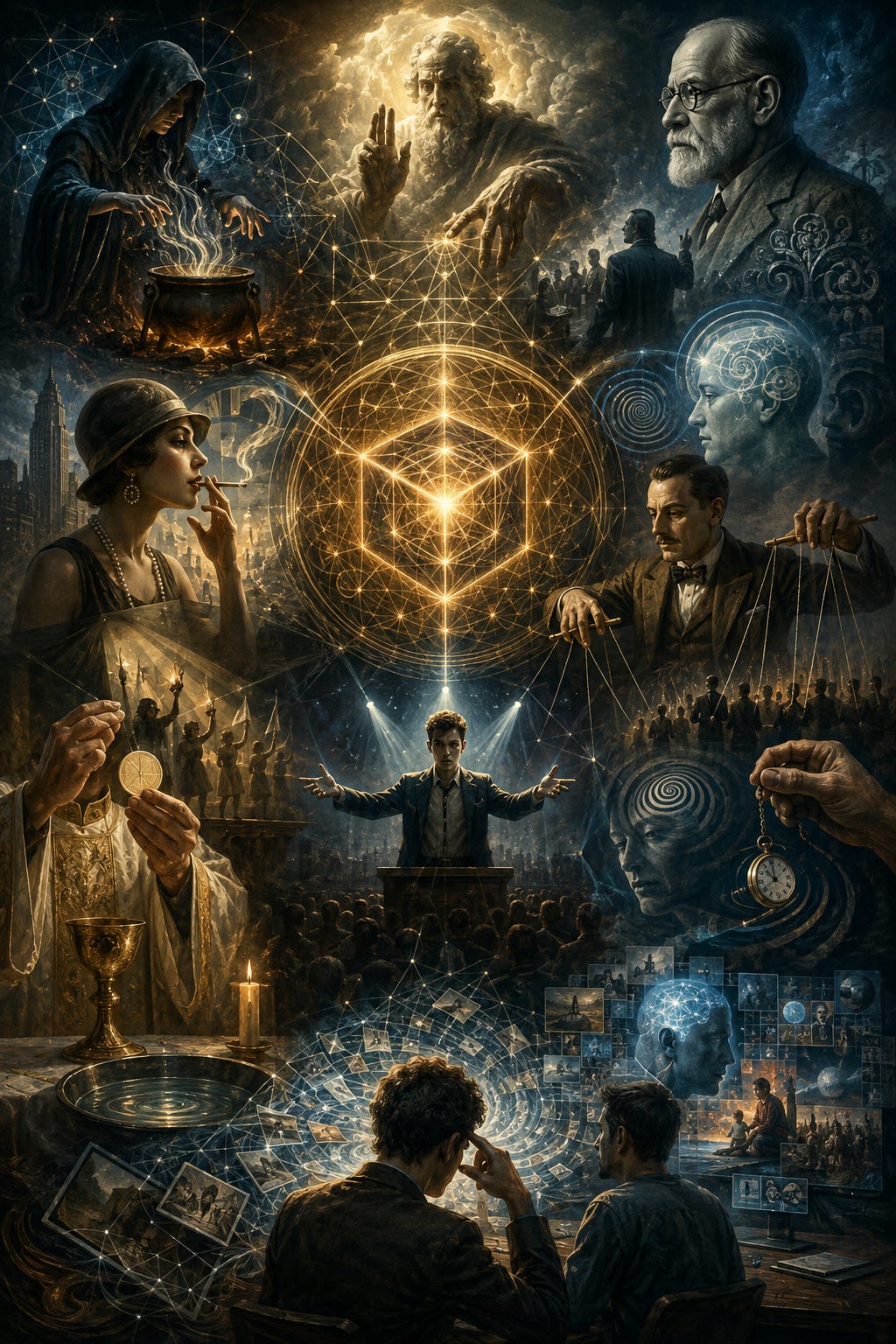
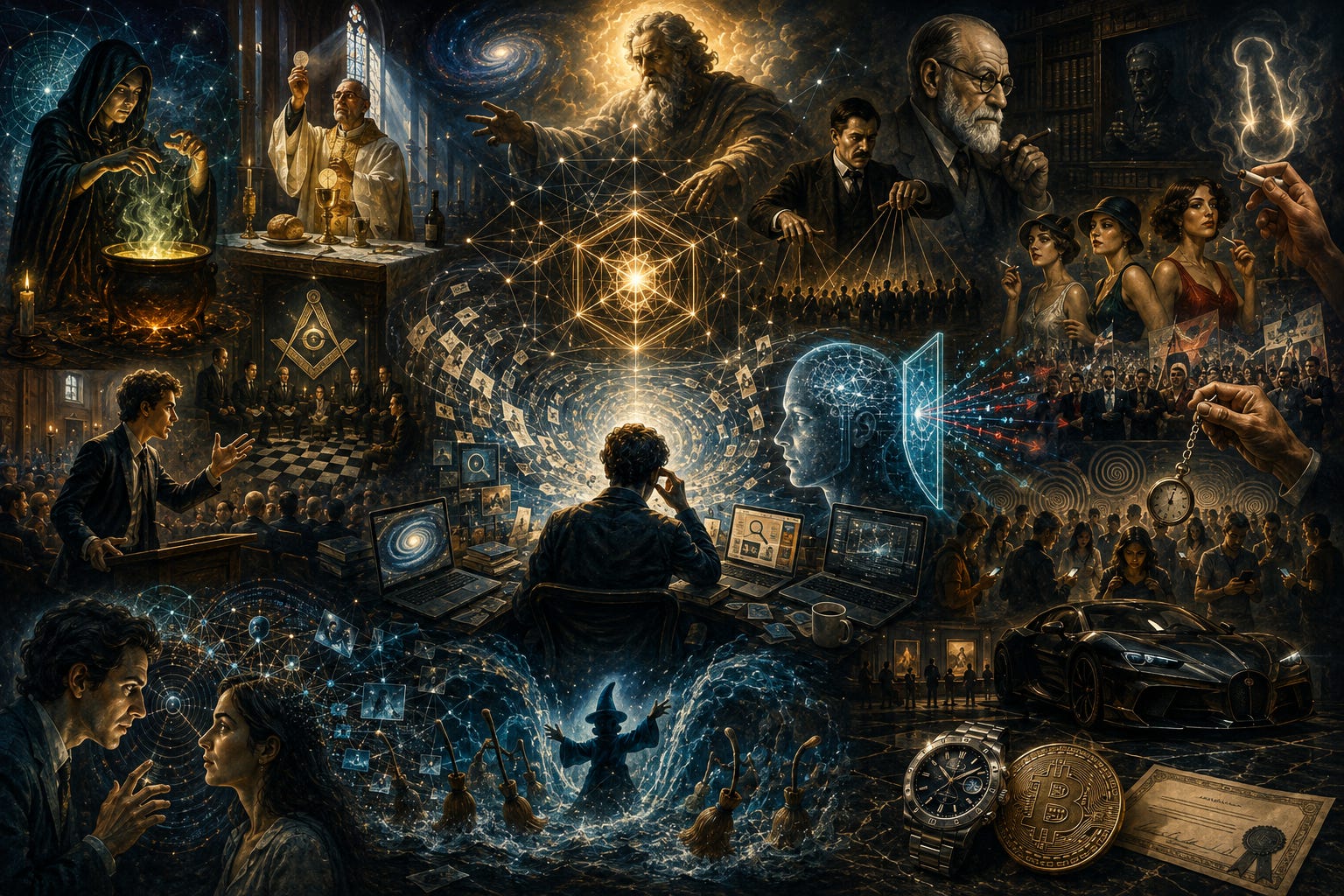
I also don’t care about the illustrations that go on top of pieces like this one. They’re the least interesting part of anything I make. I feed the whole article in as a prompt, tell it not to render any text or title, and whatever gets squirted out goes up top, purely for clickability, purely because it’s pretty. That’s the throwaway category, and it sits at the opposite end of the spectrum from everything above it, the Mass, the lodge, the debate stage, Bernays’ invoice, Adams’ hypnotism, the actual incantations.
Someone pushed back on all of this the way I’d hoped someone would: if you can’t be bothered to formulate what you think into words on a keyboard yourself, it’s no longer your thoughts, it’s a product of math and statistics with some randomness dressed up to resemble what you think. Fair challenge. Here’s my honest answer, and it’s less flattering to humans than the challenge assumes.
I don’t think humans are especially interesting or special to begin with. When I lived in Germany trying to learn the language, I realized most people, including me, speak like babies. Immigrants especially, learning just enough to ask for bread and directions, and I spent years being far too hard on myself for not operating at a graduate level, when in fact almost nobody operates at a graduate level in their own native tongue either. Most people communicate by stringing together prefabricated idioms, we’re going high while they go low, punching up, punching down, borrowed phrases doing the actual thinking for them. That’s not an insult. That’s a fair description of a probability engine, predicting the next expected phrase, optimizing for status and pleasantness and social safety, exactly the skip-logic an AI runs, just slower and with worse error correction. My grandfather used to say we humans think we’re something on a stick. Most of us, even the smart ones, are running the same lazy prediction loop the black box runs. The accusation that AI-assisted writing is “just” statistics landed on the wrong target. Most unassisted human speech is just statistics too. It’s simply statistics running on meat instead of silicon, and running worse.
Which explains something I’ve noticed for a while: most people who spend real energy defending their copyright on the little paintings they sell at the county fair don’t have work anyone was ever going to bother stealing. The intensity of the defense runs backward from the actual stakes. Nobody’s coming for a competent landscape painting. The ferocity has to be about something other than the object, probably the fear that if the genius label comes off, there’s nothing underneath it worth protecting. The people whose work is genuinely singular mostly don’t bother defending it, because nobody’s trying to fake their way into being them.
There’s a version of this same argument aimed at religion instead of language, and I think it’s the stronger one. A guy on YouTube pointed out that Western materialists treat resurrection, healing, levitation as maximally rare and therefore maximally significant, the scarcity itself proving the divinity. But across huge swaths of Buddhist Asia and India, those same acts show up constantly, background texture in the sacred texts rather than headline events, and nobody there is required to be astonished by them. Nothing about the act changed. Only the frequency did, and frequency was doing all the work people mistake for meaning.
Here’s where I’d push it one step further than that YouTube guy did: we didn’t stop having miracles in the West. We just built a supply chain for them and stopped calling them that. CPR and a defibrillator is raising the dead, mechanically, on a schedule, dozens of times a day in any city’s ER. A pacemaker is an engineered ghost-heartbeat. Anesthesia is suspending a soul from its body on command and calling it back later. A phone call is telepathy at any distance, and toddlers use it to talk to grandma without blinking. A plane is levitation with a fuel bill. Insulin is a cure for what used to be a death sentence, delivered by mail. None of it reads as sacred, because the mechanism is known and the frequency is high, which is exactly the rule the resurrection comparison already proved. Arthur C. Clarke said any sufficiently advanced technology is indistinguishable from magic. The actual situation is the reverse of his line: the technology already is the magic. We just explained the mechanism and mass-produced the miracle until it became a Tuesday.
My honest answer to all of it, in the end, is that nothing is that special. If a big enough rock hits the planet, all of it goes at once, the Word, the Code, the Rembrandt, the county fair painting, the miracle, the mechanism, no hierarchy survives a meteorite. I don’t mean that as nihilism. I mean it the way Robert Herrick meant it in 1648: gather ye rosebuds while ye may, old Time is still a-flying, and this same flower that smiles today will be dying tomorrow. Nothing lasting is the reason to gather it now, not the reason to shrug. It’s the same posture I’ve had this whole time without naming it, publish two or three a day instead of hoarding one perfect piece every six years, don’t gatekeep the miracle, don’t clutch the county fair copyright, don’t need the Word to metaphysically outrank the Code to be worth using today.
Which is why the anti-AI gatekeepers are the real irony in all of this. Every gatekeeping class in a creative trade has eventually been trained out of relevance by the next tool down the line, guild scribes by print, illustrators by photography, photographers by stock, stock by clip art, and every one of them insisted their version was the last legitimate one before the flood. My own father lived that exact sequence, illustrator to photographer to stock shooter, treated as a cheat at every step by the generation just ahead of him. The people most certain their craft is sacred and unrepeatable are usually the ones closest to being proven replaceable.
Bitcoin needed to happen for the same reason, honestly, because enough people finally noticed the fine art market was already money laundering with better lighting, an asset whose value is untethered from anything measurable, so the price can never be called fraudulent, because there was never an objective price to be fraudulent against. Bitcoin didn’t arrive as art’s rational opposite. It arrived as the same mechanism with the canvas removed, an efficient wrapper for moving large sums in small, unquestionable packages. The sick irony, one that would make Van Gogh sick specifically, is that hypercars are the new Rembrandts, illiquid, taste-gated, tradeable only inside a circle small enough that the number is whatever the room agrees it is, proving membership rather than mere money. Van Gogh sold almost nothing while he was alive and became the textbook case of value assigned decades later by exactly this mechanism. He’d recognize the hypercar auction instantly. Same room, louder engine.
Push it one level further and the Rolex is just a smaller-denomination Bitcoin. One watch can easily run sixty-three thousand dollars, one Bitcoin trades around the same number, and both are illiquid enough to hold value, both transferable, both historically useful for moving wealth in a form that doesn’t ask questions at a border. That worked right up until super clones got good enough to fool everyone but a specialist with a loupe, and once that happened, the entire function collapsed back onto authentication instead of craftsmanship, whether the object could be proven to be the real one. Which means the actual asset was never the watch. It was the paper trail, the serial number, the provenance chain, a ledger everyone agrees is authoritative, the same thing that makes a Bitcoin transaction work, the same thing that makes a Rembrandt’s provenance the real product being sold.
AI is the super clone for everything humans make. It’s the reason the panic was never really about quality, a good super clone performs identically to the real watch, and AI writing or AI art often reads or looks identical to the human version. The panic is about the ledger breaking. Once “this was made by a person” stops being verifiable, the way “this serial number matches the registered movement” stops being verifiable, the market built on that distinction has nothing left to sell but the certificate. That’s what Phantasm and every gatekeeper on that thread are actually defending without saying so. Not the writing. Not the painting. The paper.
Anytime someone tries to reveal that I’m using AI as though I haven’t been saying so the entire time, the accusation carries its own tell inside it: which, as in which one is real and which is fake, sitting one letter away from witch, as in the other kind of accusation entirely, the one leveled at anyone whose method can’t yet be explained to the person doing the accusing. My favorite novel, Neal Stephenson and Nicole Galland’s D.O.D.O., runs Clarke’s line backward on purpose. Magic in that book was always real. It worked through mechanisms nobody had modeled yet, and the moment photography arrived, something about the physics of observation collapsed the process, and the witches simply lost their power, not because science replaced superstition, but because one unexplained technology got overwritten by a competing one before anybody wrote down how the first one actually worked. Witchcraft was just a technology nobody understood yet.
That’s the whole arc closing on itself. Logos as code. Spell as spelling. Grammar as glamour. Miracles as unexplained technology, technology as unexplained miracle, and now witchcraft as the same thing wearing a third costume. It was never two categories, the sacred and the mundane, the real and the counterfeit. It was one thing, explained to different degrees, to different audiences, at different times, and the accusation of witch, of which, of fraud, has only ever meant one thing: I haven’t been shown the mechanism yet. In the beginning was the Code, and the Code was good, and nobody’s ever fully explained it, and that was never the part that made it stop working.