

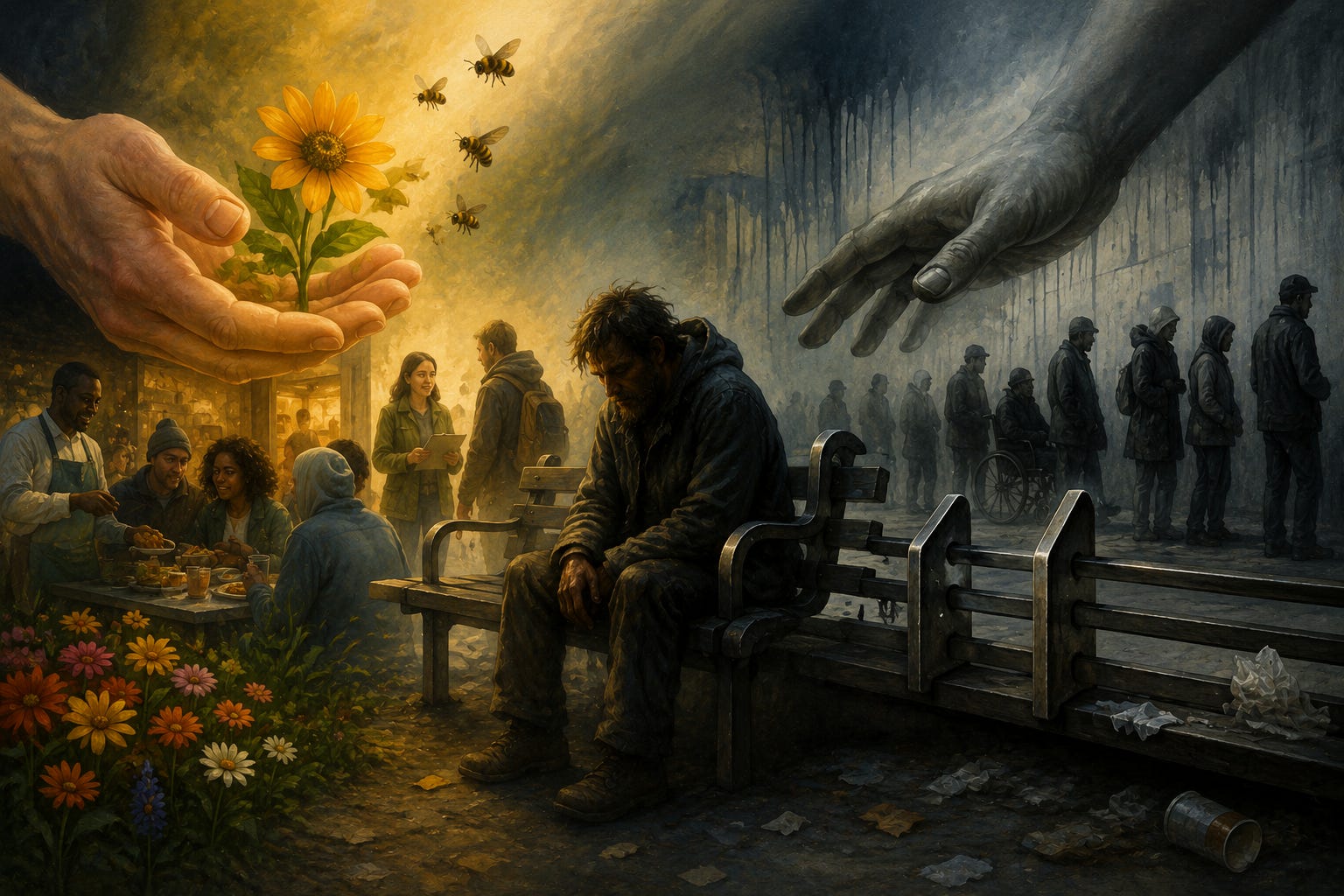
In January 2024, the United States counted 771,480 people experiencing homelessness on a single night, the highest number recorded in HUD's national point-in-time series. In 2023, 54.2 million Americans were classified as needing substance-use treatment, but only 12.8 million received it, meaning more than three quarters of the people judged to need treatment did not get treatment as federally defined. Housing First, one of the dominant responses to chronic homelessness, performs much better at the specific thing its name promises: randomized-trial evidence finds participants about 2.5 times as likely to be housed 18 to 24 months later, while showing no clear corresponding reduction in substance use. None of these numbers proves conspiracy, corruption, indifference, or failure. They suggest something more interesting. America has become capable of spending enormous amounts of money keeping vulnerable people housed, fed, medically stabilized, enrolled, monitored, protected from immediate catastrophe and repeatedly returned from the edge without necessarily solving the conditions that put them there. A lost cause, in ordinary English, is something into which further investment is no longer expected to produce a worthwhile result. My question is whether we have constructed a humane public version of that judgment about people: not abandonment, not extermination, not cruelty, but maintenance after expectation has been withdrawn. We will keep you alive. We will keep trying to keep you indoors. We will reverse the overdose. We will replace the phone. We will renew the benefits. We will respect your autonomy. What we may no longer be doing, in some cases, is seriously betting on your return.
That distinction matters because maintenance is not nothing. Housing First really does house people. A systematic review of randomized trials found that participants were 2.46 times as likely as control groups to be housed 18 to 24 months later, with fewer emergency-department visits and hospitalizations. The same review found no clear difference in substance use, and another randomized Housing First study likewise found no reduction in daily substance use after 12 or 24 months. That does not make Housing First fraudulent. It means housing is an outcome and recovery is another outcome. Public policy becomes confused when it treats success at the first as proof that the second question has been answered.
The addiction numbers make the distinction harder to ignore. SAMHSA estimated that 54.2 million Americans aged twelve or older needed substance-use treatment in 2023. Only 12.8 million received it, 23.6 percent of those classified as needing treatment. The remaining three quarters were not all homeless, were not all incapacitated, and were not all asking for treatment, but the scale tells us something important about the world in which arguments about addiction policy occur: the United States is nowhere near a condition in which everybody who needs recovery treatment is receiving it and policymakers are merely choosing whether to be strict or permissive about the final few holdouts. Most of the federally defined treatment need sits outside treatment altogether.
Homelessness produces the same uncomfortable split between keeping someone from disaster and restoring someone to ordinary participation. HUD's national count found 771,480 people homeless on a single night in January 2024. HUD does not merely count beds or meals and call the problem solved; its national data systems track housing placement, returns to homelessness and other outcomes. The bureaucracy itself therefore recognizes the difference between servicing homelessness and ending an episode of homelessness. But the sheer number of people remaining outside or in shelter means that the distinction between management and durable exit is not philosophical decoration. It is the problem.
This is where I want to use the phrase black sheep paternalism. Every sufficiently large family eventually learns the difference between loving somebody and believing in his judgment. There is the brother whose rent gets paid directly because nobody wants to discover what happens if the rent money arrives as cash. There is the cousin who remains unquestionably part of the family but is not entrusted with the principal of the trust because everyone knows that generosity can become accelerant. The family does not revoke his membership. It may spend astonishing amounts of money preserving it. What quietly disappears is investment in the future. Nobody stops caring whether he eats. They stop asking what he might become.
That is the possibility I want to examine in American social policy. Not whether social workers secretly want homelessness, whether nonprofits conspire to preserve their grants, or whether harm reduction is an elaborate plan to kill addicts. Those theories require motives that are unnecessary to explain institutional behavior. A system can be staffed almost entirely by decent people and still settle into an equilibrium in which keeping someone alive, housed or administratively attached becomes easier to accomplish than restoring capability. Institutions respond to incentives, measurements, legal constraints and the limits of human agency. No villain is required for a system to become excellent at maintenance.
I know the difference because I spent roughly fifteen years volunteering at Miriam's Kitchen in Washington, working as a sous chef and dining-room captain. Miriam's began with the uncomplicated act of feeding hungry people and later developed social services, outreach and housing work. Its own strategic history says essentially that: the organization started in 1983 because people needed meals, then realized that seeing the same people return year after year meant meals alone were insufficient. Its filings describe the dining room as an entry point through which guests could be connected to income, healthcare and housing. One filing reported roughly 70,000 meals annually, basic services for about 4,000 people and more intensive social-service work with roughly 1,200 of them.
That is not how I remember an industrial complex. I remember a flower.
The food was the flower. People came because breakfast and dinner were worth coming for, because the room was clean, because there were bathrooms, coffee, conversation and a place to sit without being treated as contamination. Once people came through the door, the social workers could find them. Those were the bees. Someone who might otherwise be almost impossible to reach was suddenly sitting in the same place often enough for somebody to ask whether he had identification, Medicaid, Social Security, veterans benefits, healthcare, a telephone, housing paperwork, clean clothes, treatment, education or a job prospect. Miriam's own historical performance reporting shows exactly that mixture: meals on one side, housing, income and healthcare connections on the other.
The guest did not have to accept any of it. He could eat and leave. There was still a price, because every civilized room has a price. You had to behave. You could not threaten the other guests, terrorize the staff, start fights or make everybody else pay for your inability to regulate yourself. There were usually some very large men around capable of making that boundary clear when conversation failed. I do not consider that a violation of autonomy. A dumpster makes fewer demands on your conduct, but the dumpster also does not cook breakfast. The price of sharing a room with other human beings is acknowledging that they exist too.
That distinction between unconditional sustenance and conditional participation is where Lost Cause begins to get difficult. There is a kind of compassion that says, "You are hungry, so eat." There is another kind that says, "You are in trouble, so here is a ladder." There is another that says, "You keep refusing the ladder, but we are not going to let you freeze." Eventually somebody has to decide whether the ladder remains the objective or whether keeping the person alive at the bottom of the hole has become the objective.
That decision is rarely announced. Nobody writes LOST CAUSE across a case file. Institutions use gentler language: stabilization, harm reduction, client choice, supportive services, permanent housing, continuity of care. Much of that language describes useful and humane things. The danger is not the vocabulary. The danger appears when stabilization stops being a stage and becomes a destination.
There was a man who lived for a long time on a metal bench near Columbia Pike and South Barton Street in South Arlington. He did not merely sit there occasionally. The bench became where he lived. Over time he became filthy and increasingly unwell. A woman from social services used to visit him regularly, alone, without security, bringing water and little necessities and talking with him. Nobody dragged him away because his life offended the neighborhood's aesthetic expectations. For a long time the response was astonishingly restrained: check on him, offer things, talk, leave him alone.
Eventually two Arlington police officers appeared. I watched from Starbucks for hours. They wore blue rubber gloves because he was dirty, but there was no theatrical show of force. They stood several feet away, often near the curb, spoke to him and waited. Eventually an ambulance arrived. Eventually he went onto a gurney and was taken away. I do not know what happened to him afterward.
I know what happened to the bench. Armrests were welded across it so nobody could comfortably lie there again, and similar divisions subsequently appeared on other benches nearby.
The scene has stayed with me because nobody in it needs to be a bastard. The social-services worker could be doing exactly what she should. The police could be exercising exemplary restraint. The emergency personnel could be acting at exactly the threshold at which intervention became medically necessary. The people who altered the benches could reasonably believe that public furniture should remain usable by the larger public. Every individual decision can make sense and the total picture can still be strange.
For a long time the neighborhood tolerated the man. When his condition became intolerable to his body, he was taken somewhere else. Then the environment was altered so another person could not use it in quite the same way.
That is not evidence of a conspiracy. It is evidence of an equilibrium.
Human beings create equilibria everywhere. A chronically homeless man sleeps at Starbucks until he repeatedly screams at customers, at which point somebody complains. Perhaps a frightened customer gets a restraining order. Perhaps the store stops providing the accommodations it previously offered. Perhaps the police eventually enforce boundaries that nobody wanted to enforce earlier. The result can look cruel if the only person in the frame is the homeless man. Put everyone else back into the photograph and the problem changes. The woman being screamed at is also a citizen. The barista is also working. The person who wants to sit on the bench is also part of the public. Compassion does not abolish competing claims.
This is why autonomy cannot settle the question by itself. "Let him make his own choices" works cleanly only when the costs of the choices remain inside his own skin. Addiction, homelessness, untreated psychosis, violence, public intoxication and severe self-neglect routinely spill into other people's lives. At the same time, the opposite principle, "we know what's best, therefore we may compel you," has no natural stopping point. If preserving life overrides everything else, civilization rapidly becomes a padded room.
Life is immensely valuable. It is not infinitely preservable.
Human beings sometimes speak about death as though mortality were a systems failure. We are not Tolkien elves who would live indefinitely if only we optimized nutrition, medicine, housing, public policy and personal virtue. We are much closer to mayflies. Eighty years feels enormous because it contains almost everything we will ever experience, but eighty years is still eighty years. Everyone dies. Some people die after doing everything right. Some survive astonishing amounts of stupidity. Medicine, sanitation, housing, sobriety and social order can buy years, sometimes decades, and those years are worth buying. They do not repeal the terms of the species.
That matters because a society cannot define compassion as preventing every preventable death without eventually consuming liberty in the attempt. The alcoholic can be confined because alcohol might kill him. The addict can be confined because fentanyl might kill her. Motorcycles can disappear. Dangerous food can disappear. Solitude can disappear. Risk can disappear. Eventually life itself becomes the management of remaining alive.
The other extreme is equally barren. "His choice" can become a phrase we use when we have ceased trying.
This is where harm reduction becomes intellectually interesting rather than politically symbolic. Keeping somebody from contracting HIV, reversing an overdose or giving someone a stable apartment is not surrender. These interventions can preserve exactly the thing recovery requires: a living person. Housing First substantially improves housing stability and reduces some emergency healthcare use. It does not appear to make substance use worse, and it should not be accused of doing so. But neither does housing automatically cure addiction. The distinction is important because harm reduction makes the most moral sense as a floor beneath a person, not as a ceiling above him.
A social system therefore has at least three possible relationships with the person at the bottom. It can abandon him. It can control him. Or it can maintain him while continuing to offer ways back into fuller participation. The third is usually the least terrible option and therefore the one liberal societies gravitate toward. But it contains a hidden temptation. Maintenance is easier to standardize than transformation. A meal can be counted. A housing placement can be counted. A naloxone reversal can be counted. A Medicaid enrollment can be counted. A benefit application can be counted. Becoming capable, responsible, employable, trustworthy, sober, connected and independent is considerably harder to put into a quarterly dashboard.
The numbers themselves can therefore tell two stories at once. Seventy thousand meals is seventy thousand instances in which somebody ate. That matters. It is also seventy thousand meals that may or may not have changed the trajectory of the person eating them. A housing placement is a person no longer sleeping outside. That matters enormously. It does not tell you whether the person stopped drinking, found work, repaired a family, learned anything, made friends, accumulated savings or stopped requiring supportive services. None of those omissions invalidates the housing placement. They simply remind us that human flourishing cannot be collapsed into a single administratively convenient variable.
The mistake is assuming that because we cannot guarantee transformation, we should stop expecting it.
That is black sheep paternalism at institutional scale. You still get the jersey. You are still on the team. You get Gatorade and orange slices. Your name remains on the roster. Nobody throws you out of the stadium. But you sit on the bench permanently because everybody has privately decided there is no plausible game in which putting you on the field improves the outcome. At first they keep coaching you anyway. Eventually they stop.
The dangerous moment is not when the team cuts you. The dangerous moment is when it loves you enough to keep you forever and believes in you too little to ask anything difficult of you.
Melville's Bartleby understood the other side of this problem long before there were federal grants for supportive housing. Bartleby simply "would prefer not to." His employer keeps attempting accommodations because he cannot bring himself to discard another human being, but accommodation cannot produce desire. Eventually the problem becomes almost insoluble: what does one person owe another person who increasingly refuses participation in his own rescue?
Recovery traditions know this problem intimately. Twelve-step language begins with powerlessness, but it does not end with permanent passivity. Admitting that one cannot control alcohol is supposed to begin a process of radical personal change. Families learn a parallel lesson through detachment: you cannot recover another person on his behalf. That is not the same thing as concluding that he cannot recover.
The distinction is everything.
A lost cause is not necessarily somebody who cannot be saved. Sometimes it is somebody from whom the rescuers have stopped expecting a return on investment. Sometimes that judgment is rational. There are sunk costs in human affairs just as there are in war, business and medicine. Resources are finite. Attention is finite. Families become exhausted. Social workers become exhausted. Communities have other people to protect. Nobody possesses an infinite obligation to destroy himself attempting to rescue someone who continually refuses rescue.
But people are not failed factories or abandoned military campaigns. The arithmetic cannot be identical because a person can surprise you. An alcoholic can become sober after thirty years. A homeless veteran can finally trust the wrong social worker on exactly the right morning. Someone who burned every bridge at twenty-five can become the person rebuilding bridges at forty-five. The fact that transformation cannot be compelled does not make it imaginary.
So the humane society has an almost impossible task. It must be willing to maintain people whom it cannot presently repair without allowing maintenance to become a declaration that repair is impossible. It must respect autonomy without laundering abandonment through the language of choice. It must impose enough order that everyone else can live in the same city. It must sometimes accept "no." It must sometimes ask again tomorrow. It must recognize that some interventions work, some do not, and no program converts mortality into immortality.
Most of all, it has to resist the temptation to confuse having stopped expecting something from a person with having become compassionate toward him.
Feed him. House him if you can. Give him water. Replace the identification. Reverse the overdose. Treat the infection. Pay the rent directly if handing him cash would kill him. Put boundaries around him when his behavior harms other people. Leave the door open after the fiftieth refusal.
Just don't write the DNR on his future.