Nobody’s Trying to Capture AA
Why the most Christian room in America doesn’t know it’s church

Third in a loose series, after “Jesus Is Nobody’s Panda” and “Send the Redneck to the Cross.” Those were about what’s gone wrong with the church above ground. This one is about the church that never had to go through any of it.
If you think I haven't spent real years in the field, you won't take this seriously, so let me give you my credential. I am not in recovery. I have never had a coin, never stood up and said the sentence, never been a member of anything with the word Anonymous in its name. But in 1998 I fell in love with a woman named Michelle. She'd gotten clean and sober at nineteen. She was twenty-nine when we moved in together, and for three or four or five years, week after week, I went with her. I'd sit through her AA meetings, or her NA meetings, or—if she needed to talk about me, about us, about anything toxic in the relationship without me in the room—I'd walk next door and sit in Al-Anon instead, because I came by that one honestly: both my parents were alcoholics, and I'd been doing the work of loving an addict since I was a child, long before I ever loved Michelle. Capitol Hill, Dupont, all over the city. One of my closest friends from those years I met working at a sushi place; he was NA too. I was never an insider with a chip in his pocket. I was the anthropologist who lived with the tribe long enough to stop taking notes and just live there.
So when I tell you I think Alcoholics Anonymous is better at being Christian than the church is, I’m not theorizing. I use more AA slogans in a week than I quote scripture. I’m not being clever when I say that. It’s just true, and it embarrasses me a little, and I don’t think it should.
Washing her hair
I used to tell my friends: if a girl says she can’t see you Thursday because she’s washing her hair, don’t assume there’s another man. There might be a man, but his name is Bill, and he’s been dead since 1971, and she’s not cheating on you with him, she’s just got a standing commitment that outranks you completely, every week, no negotiation. That’s not a joke at her expense. It’s the truest thing I know about why people in recovery disappear on a schedule nobody outside the program can see. The meeting was never optional. You were.
The year nobody’s allowed to fall in love
Anyone who’s spent real time around those rooms knows the old advice handed to every newcomer: don’t get into a relationship for the first year. People hear that and think it’s about avoiding a messy breakup while you’re fragile. It’s actually a much sharper piece of theology than that, even if nobody in the room would call it theology. The compulsion that drove you to the bottle or the needle doesn’t go anywhere just because you put the substance down. It looks for the next vessel. Love is one of the best vessels there is—euphoric, obsessive, capable of completely rearranging your priorities the same way a drug does. They call it cross-addiction. I’d call it the doctrine of transitive sin: the disease isn’t really about the substance, it’s about the structure underneath any object you can pour yourself into instead of pouring yourself into the work. A year isn’t an arbitrary cooling-off period. It’s an acknowledgment that grace takes time to actually root, and that the easiest available counterfeit for the real thing is always close at hand, wearing a much more flattering face than a bottle does.
No crosstalk, no barring the door
I sat in those rooms long enough to watch the rules actually function, not just get recited. Nobody responds to anybody else’s share. You don’t get advice, you don’t get fixed, you don’t get argued with—you just get heard, and then the room says thanks for sharing, and moves to the next person. No crosstalk. That’s a harder discipline than most pastoral counseling manages, because it means sitting with someone’s worst sentence about themselves and doing absolutely nothing with it except witnessing it.
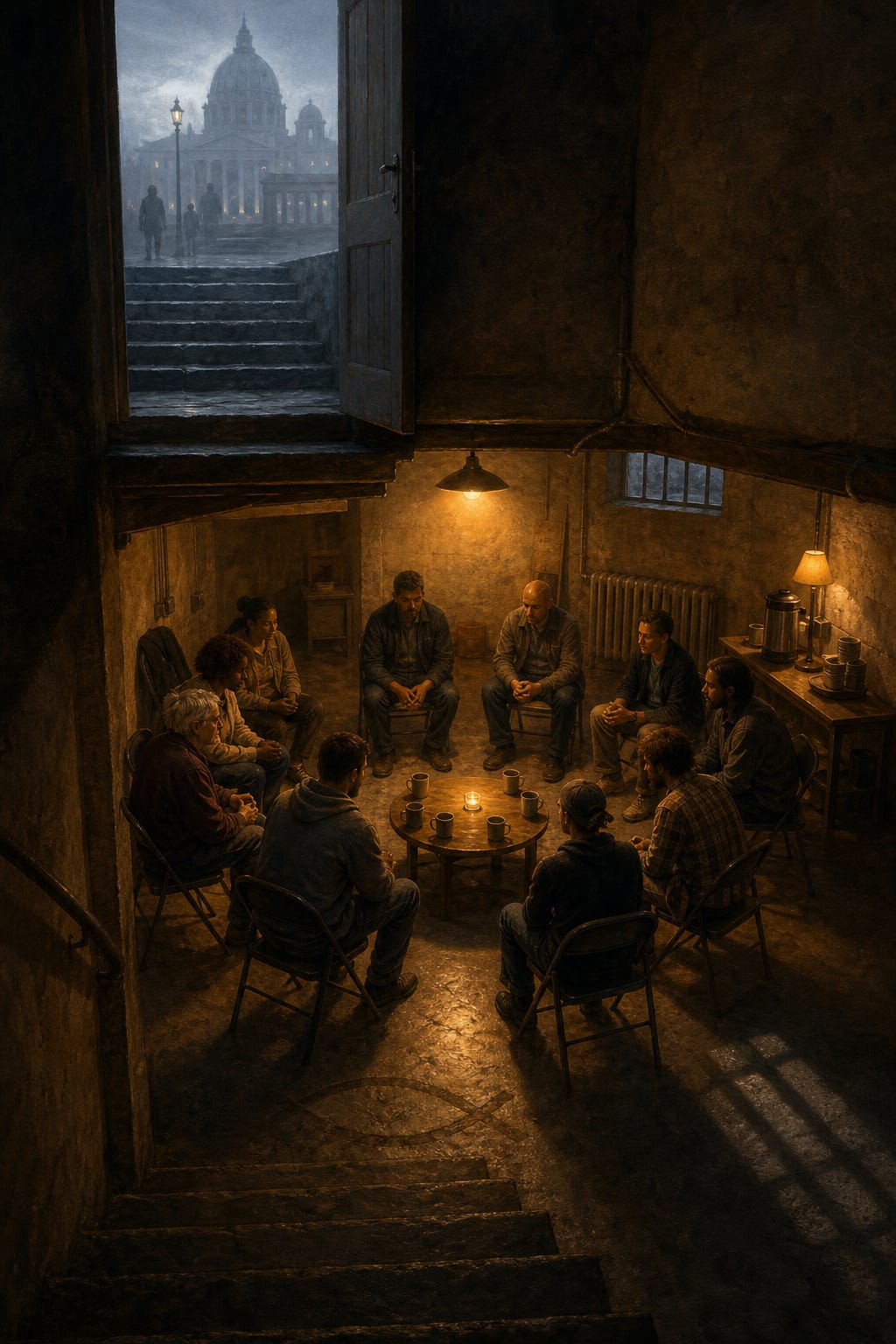
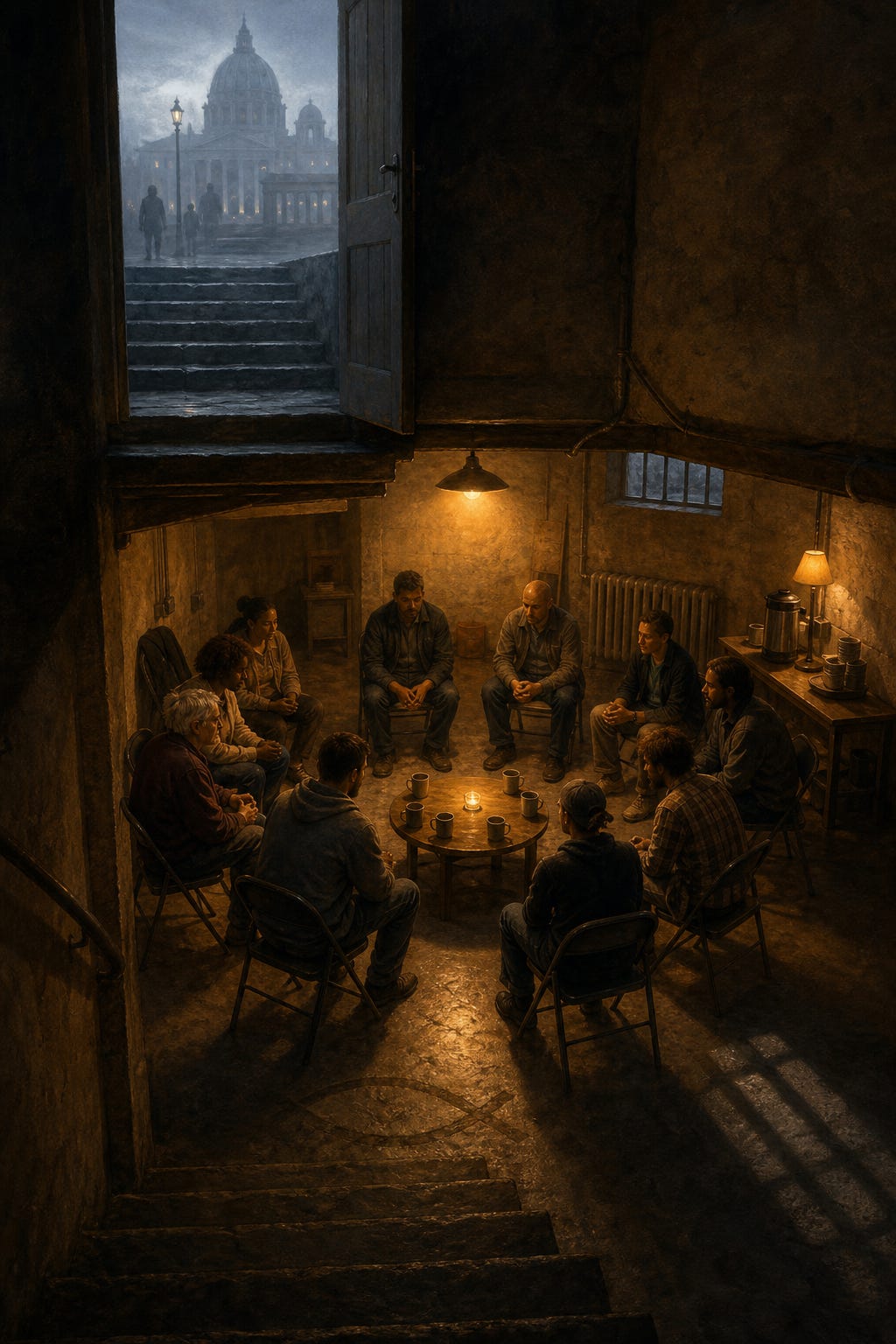
And nobody gets barred. I watched people walk in drunk, walk in high, walk in bragging about how good the bender felt, and nobody threw them out. The newcomer is the most important person in the room even when the newcomer is actively failing in front of everyone. A church that let someone stumble in mid-relapse and just sit there, unlectured, unejected, would be remarkable. I watched it happen on a regular Tuesday in a basement on Capitol Hill like it was nothing.
The finger only points at you
Here’s the line I keep coming back to: Hello, my name is Chris, I’m an alcoholic. Hi, Chris. That’s the entire form. You don’t get to name anyone else, diagnose anyone else, correct anyone else. You can only testify about yourself. I think that’s the whole of what Jesus actually asked of anyone he met one-on-one—not a doctrine to enforce on a crowd, a story to tell about your own brokenness that nobody else can twist into a weapon, because there’s no third party named in it to blame. The only people Jesus ever spoke to in pointed, accusatory, public terms were the Pharisees, the ones using righteousness to point outward. Everyone else got a parable or a question. Any Christian who tries to enforce morals on someone else isn’t doing what Jesus did. They’re doing what the Pharisees did. Twelve-step rooms encode the difference structurally: you are only ever allowed to point the finger at yourself.
A higher power, no church, no state
It skates under everything, the same way Masonry does. Not a religion. Not faith-based. No collection plate that goes anywhere, no doctrine you have to sign. And yet you cannot work the steps without surrendering to a power greater than yourself, however you define it. That’s not a loophole. It’s a tell. Strip every creed and council and schism out of two thousand years of Christian argument and what’s left, irreducibly, is exactly that one thing: the admission that you are not the biggest thing in the room. Jesus never asked for a belief system either. He asked for love—of God, of your neighbor, of yourself—and for the willingness to repent, which is a thing you do for your own sake, not a verdict someone else hands you. People flinch from repentance like it’s judgment. It isn’t. It’s the only homework that was ever assigned.
The hunger that isn’t Sunday dinner
There’s a specific thing I watched over and over that I’ve never seen described right: when someone in recovery says I need to find a meeting right now, that’s not devotion, it’s interdiction. It’s not an appetite for fellowship, it’s a circuit breaker going off. The craving cycle has started, the obsession is live, and a meeting is the thing that physically interrupts it before it completes—gets the person out of isolation, into a room of people who can actually recognize what’s happening, before the internal defenses fail completely. That’s why it can’t wait for next Sunday. You don’t say I’ll get back to my home group when I’m home, because the thing being intercepted doesn’t pause for travel either. It’s not loyalty to an institution. It’s a lifeline thrown at the exact moment it’s needed, which is sometimes a Tuesday in a city you’ve never been to before.
Most church attendance today runs on the rhythm of a Sunday roast—family gathers once a week, same pew, same time, comfortable and warm and basically social, with no equivalent sense that missing it could cost you something real. It wasn’t always that thin. The old Catholic Church ran daily Mass, seven days a week, for people who actually went every single day. The kooky evangelicals everyone likes to roll their eyes at are still doing this—daily Bible study, daily prayer, scripture every morning before coffee, because the book actually says pray without ceasing and some people took it literally. I don’t think that’s the same mechanism as a craving interrupt, and I want to be honest about the difference rather than flatten it: daily Mass is sustained devotion, freely chosen, building toward something. A meeting called in crisis is intervention, urgent and defensive, holding a line that’s actively under attack. But both of them assume something most modern churchgoing doesn’t: that the soul’s condition can deteriorate fast enough between Sundays that once a week isn’t actually enough to keep up with it. The old church built daily access because it took that deterioration seriously. AA built same-day access for the same reason, just with the stakes made literal and immediate instead of theoretical.
No calendar, no contagion
This is the part I think actually explains everything else: a meeting has no persistence. It happens, and then it’s over, and there is no committee, no vestry, no outreach program, no building fund, no pride parade float, no immigration statement, no prayer vigil calendar stretching into next spring. A church is an entire social infrastructure—weekly, monthly, yearly, an actual calendar that politics and identity and causes can colonize one committee meeting at a time, the way ivy gets into brick. Twelve-step rooms don’t have that infrastructure to colonize. There’s nothing standing between meetings for any ideology to move into. Everyone in the room is too hungry, too desperate, too singularly focused on not dying and not blowing up their own family to have any room left over for a cause. That singular, selfish focus is the immune system. Following the actual cult of Jesus, underneath everything else we dress it in, was always exactly that small and exactly that hard: don’t die, don’t destroy the people who love you, repent daily. Everything else the church has built on top of that is summer camp.
A room full of hawks
There’s a piece of game theory that’s stuck with me for years: a community made entirely of doves is gorgeous and almost defenseless, because a single hawk can walk in and exploit every bit of that trust before anyone even recognizes what’s happening. A church, full of people who’ve mostly never had to survive anything, is dangerously close to a population of doves. I watched something different in those rooms. Everybody in there had, at some point, been the hawk. People lied. People conned. Old-timers with twenty years sober still worked the new women coming through the door, and everybody joked about it the way men joke about the nineteenth hole—not because nobody cared, but because nobody was shocked. You’re not under oath in a meeting. Nobody fact-checks your share. People shared half-truths and outright lies constantly, and the room absorbed it without ejecting anyone, because everybody there had already run some version of that same con themselves. That’s not innocence. That’s inoculation. A room of recovering hawks, each one trying, daily and imperfectly, to practice the behavior of a dove, turns out to be far more durable than a room that never had to learn what a hawk looks like up close.
This is not performative
People have turned Jesus into a panda, into a hippie, into a mascot for whichever side needs an endorsement. What they’ve forgotten in the process is that sin was never a performance. Sin is hunger. It’s compulsion. It’s not pretending to be bad, it’s actually being unable to stop. I had a close friend from those years, a guitar player I traveled to Baltimore with, beautiful and talented and almost destroyed several times over by the same disease he was fighting in those rooms. We watched Trainspotting together once, the scene where they draw blood back into the needle to check for bubbles before pushing the heroin in. Everyone else in the room was disgusted. He was turned on. That’s not a detail I share to shock anyone. I share it because it’s the realest evidence I have that the thing being fought in a basement on a Tuesday night isn’t a metaphor. It’s not performative wickedness waiting to be lectured out of someone. It’s an actual hunger that can rewire what a person finds beautiful, and you cannot shame a hunger like that into submission. You can only recover from it, one day at a time, with help.
My priest once told me something about hell that I’ve never been able to shake: there isn’t a literal fire underneath the world waiting for sinners. Hell is what happens after death when you’re brought into the embrace of God and you cannot make yourself walk into it, because you feel too much shame, too much humiliation, too sure you don’t deserve it. Hell is self-imposed. It’s resentment, it’s the refusal of grace, it’s standing outside an open door convinced it isn’t really open for you. That is, almost word for word, what keeps a relapsed alcoholic out of the rooms long after the drinking should have stopped: not the world’s judgment, but his own conviction that he’s used up his welcome. Metanoia, the turn toward the embrace, is the only thing either system asks for. Nobody is locked out. People lock themselves out.
Which is why none of this was ever supposed to come with a waffle breakfast and a building fund. The earliest followers of Jesus were meeting in basements with a price on their heads, and it was never a social calendar, it was their actual eternal soul on the line, every single week. That’s not a comparison to recovery. That’s a description of it. Jesus Christ is a recovery cult. I’m a sinner, I repent, I sin no more. I’m a drinker, I stop drinking, I drink no more. I’m an addict, I stop using, I use no more. The Ten Commandments were the first Twelve Steps, just with fewer steps and no basement coffee.
And nobody in either system gets there by merit. Jesus says plainly that nobody deserves heaven—it’s grace, not earning, that gets you through the door. Step One says the same thing in different words: we admitted we were powerless over our addiction, that our lives had become unmanageable. Powerless is just the recovery word for the same admission. And the thing that meets you on the other side of that admission—the help, the higher power, the thing that does for you what you cannot do for yourself—has another name in the older language. Grace. Mercy. The Holy Spirit. It’s not a loose analogy. It’s the same mechanism wearing two coats, and the second coat happens to be the one nobody’s tried to take over yet.
The man who refused to be the mountain
Everybody who’s been to a meeting knows the name Bill W. They reference him, they read his book, the whole literature of the program runs through him. And yet nobody worships him. Nobody built him a statue. The shibboleth itself is named after him—are you a friend of Bill?—and the phrase works precisely because Bill isn’t the point of it. He’s the password, not the destination. John the Baptist said it first and best: he must increase, I must decrease. Bill W. spent his sobriety actually doing that, refusing the role of messiah even as the fellowship grew past anything he could have personally controlled, structuring the Traditions so that no leader could ever govern, only serve, so that no human being could stand between an alcoholic and whatever he understood his Higher Power to be. He stayed, by design, just another drunk who got clean.
Here’s what makes that genuinely rare, not just admirable: both Jesus and the Buddha said almost exactly the same thing Bill W. practiced, and both of their traditions did the opposite anyway. The Buddha told his followers, on his deathbed, to be lamps unto themselves, to seek no external refuge, that every one of them already carried Buddha-nature and needed no image of him to access it. Jesus told his disciples the kingdom of God is within you, that whoever believes will do the works he did and greater works still, and warned them specifically against taking honorific titles for themselves. Neither man asked to become an icon. Both became the most reproduced human image on earth—Buddha cast in gold by the literal ton, temple after temple, Jesus rendered as a six-hundred-and-thirty-five-ton concrete colossus on a Brazilian mountaintop with his arms spread for tourists to pose in front of, copying the exact gesture. The Golden Buddha in Bangkok isn’t an exception to that pattern, even though monks hid it under plaster for two centuries—they hid it to protect a literal gold idol from invaders, not because hiding it honored what the Buddha actually asked for. It’s still gold. It’s still cast in his image. It was only ever in danger because someone had already done the thing he told them not to do.
Bill W. is the actual anomaly, not Buddhism, not Christianity. Out of three men who each told their followers, in their own language, don’t make this about me, only one of them got obeyed. AA had every condition in place for a cult of personality—a charismatic founder, a movement growing past anyone’s ability to control it, a desperate population looking for someone to follow. Instead it has Traditions that forbid leadership from governing, a name nobody capitalizes into a faith, and a password that uses Bill’s first name precisely so it can never become his monument. He stayed human-sized on purpose, in a way neither Bethlehem nor Bodh Gaya ultimately managed to let their own founders stay.
The most beautiful prayer
I’m a thirty-two-degree Mason. I was confirmed Anglo-Catholic. I say the Our Father and the Hail Mary, and I mean them. But the prayer I actually reach for, the one I think I’ll be saying when I’m old, came out of a basement, not a missal: God, grant me the serenity to accept the things I cannot change, courage to change the things I can, and wisdom to know the difference. I didn’t pick that prayer because it’s easy. I picked it because it’s the only one I know that asks for exactly what I actually need, in the order I actually need it, every single day, with nothing wasted.
Serenity Prayer
God, grant me the serenity
to accept the things I cannot change,
courage to change the things I can,
and wisdom to know the difference.
Living one day at a time,
enjoying one moment at a time,
accepting hardship as a pathway to peace,
taking, as He did, this sinful world
as it is, not as I would have it,
trusting that He will make all things right
if I surrender to His will,
so that I may be reasonably happy in this life
and supremely happy with Him
forever in the next.
Amen.
I never got a coin. I was never the one standing up to say the sentence. But I sat in those rooms long enough, next to enough people, hearing enough of it, that I came out the other side with a higher opinion of what happens in a basement on a Tuesday night than I have of most of what happens in a sanctuary on a Sunday morning. That’s not blasphemy. I think it might be the most Christian thing I actually believe.