
Not a Manhunt
The bad hombre lie, the ladder that only sees motion, and why "never waste a crisis" cuts both ways.

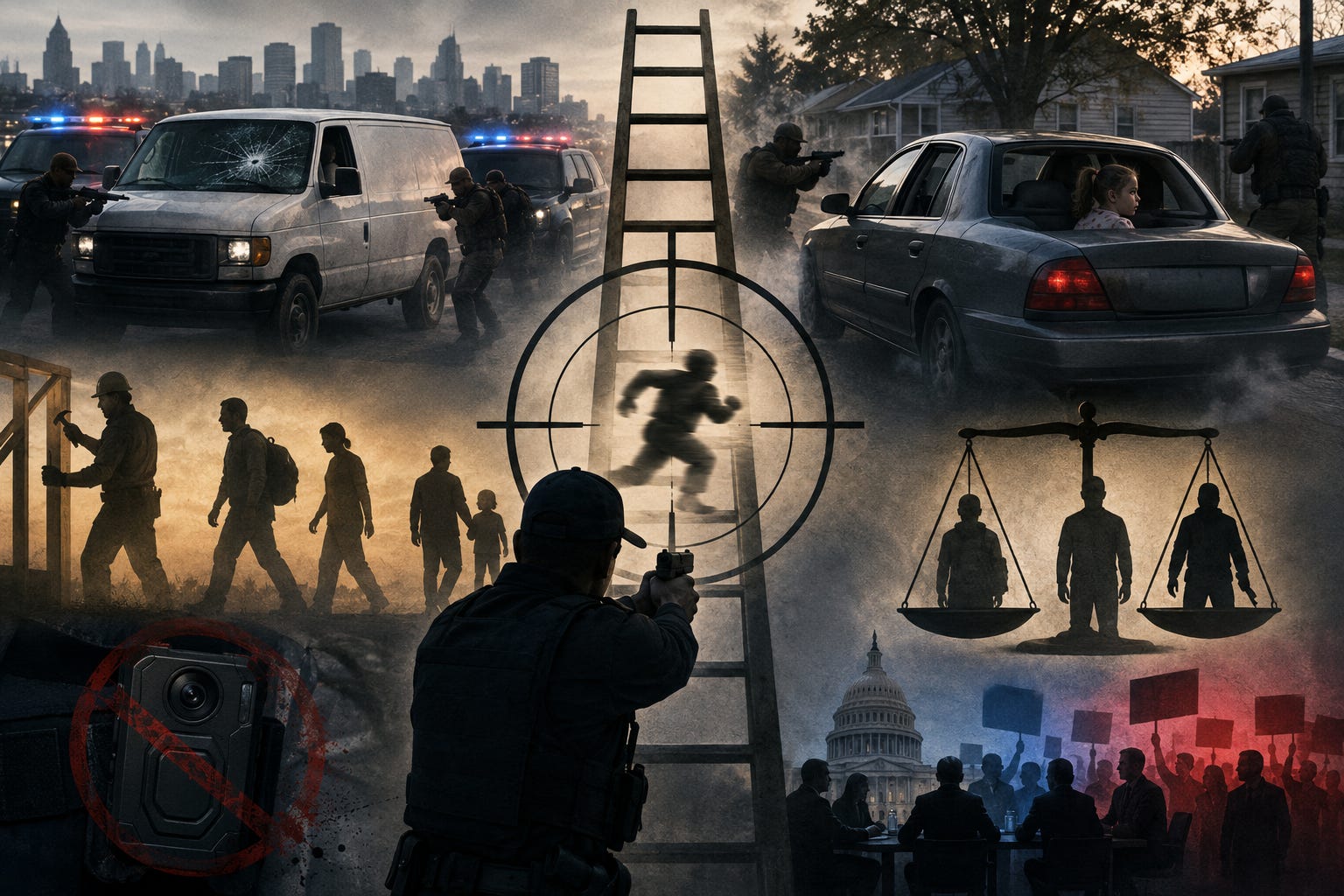
Lorenzo Salgado Araujo had lived in Houston thirty five years, building homes for other people's families, and on the morning of July 7 he was driving a work van full of his crew to a job site. Unmarked cars closed in around the van. He wasn't the man on the warrant, DHS admitted that later, he may have just resembled him. What his passengers say happened next is that he panicked, the way anyone might when strangers in plain clothes start boxing in a van full of expensive tools, and an ICE agent shot him through the window and killed him.
Six days after that, in Biddeford, Maine, agents were watching a house for someone else's removal order when a car pulled out of the driveway. The driver was twenty six year old Joan Sebastián Durán Guerrero, a husband and father with a valid Social Security number and work authorization, his three year old daughter in the back seat. He tried to get away. A neighbor told the AP he clearly heard the man yell "I tried to stop" right before the gunfire. He wasn't the target either. He was dead within the same week as a stranger in Texas he'd never met, killed by the same kind of agency for the same kind of reason.
All of the storytelling that follows a shooting like this, the thirty five years in Houston, the three year old in pajamas in Maine, the wrong man twice in six days, arrives in the wake of the body. None of it existed for the agent in the five seconds that mattered. That's the actual subject here, not two isolated tragedies but the mechanism that produced both of them the same way, six days apart, in two different states, under two different sets of facts that turned out not to matter.
**The bad hombre test**
Start with the distinction that exists on paper, because it's a good one and it's being erased in practice. Illegal entry is a misdemeanor. Illegal reentry after a formal deportation order is a felony. Actual violent crime gets prosecuted as violent crime, full sentence served in a real prison, supermax if the person is genuinely one of the most dangerous people in the federal system, then deportation after. That's three different categories of person, and the law already knows how to tell them apart. A guy who overstayed a visa or crossed without papers is not, by that fact alone, a bad hombre. A guy who's actually violent should go away for it, hard time in a hard place, then get sent home. Nobody sane argues against that second part.
The rot is in collapsing all three into one silhouette. Once "undocumented" and "dangerous" get treated as synonyms, the second category's treatment starts leaking into the first category's encounters. That leak has a body count, and Houston and Biddeford are what it looks like once it arrives.
**The only excuse on offer**
Once an agent has already decided, before the stop even starts, that the person in front of him could be dangerous, the only thing left to justify a shot is what happens in the next five seconds. And the only excuse either agency gave was a hunter's excuse. Not "we identified a violent felon and he attacked us." It was "the vehicle moved in a way that read as a threat." That's not an identification, that's a description of motion. It's the same attention a hunter gives to anything that bolts, not because the thing bolting is necessarily dangerous, but because bolting is the only signal a hunter is trained to react to once the chase is on. Who was actually driving arrives afterward, in a press release, always too late to have mattered.
Neither agent had a functioning body camera running, and it's worth being honest about why that's not really a surprise. Local beat cops wear body cameras because their departments were forced into it, city by city, after a decade of exactly these kinds of disputes. Federal agents historically haven't, ICE and CBP were never built on that model, and the recent promises to change that have mostly stayed promises. Both shootings are now under review by the FBI and the DHS Inspector General. Whether that review actually produces cameras on federal agents, as opposed to another statement about intending to, is the thing to watch, not the thing to assume.
**What the crisis actually moved**
Here's the part that matters more than either death on its own. Within a day of Biddeford, DHS ordered a nationwide stand-down on most vehicle stops, and agents were told to start routing warrant service through local partner agencies instead of running their own traffic stops. That's not nothing. That's an administration changing real behavior on real streets within about twenty four hours of the second body. The crisis worked, in the narrow sense that crises are supposed to work, it produced fast movement that ordinary process never would have.
But notice what that movement is actually made of. It's a pause, not a rule. It's a directive, not a law. It didn't touch the ladder itself, the thing that turns motion into a shot, it just told agents to generate fewer situations where the ladder gets climbed. We've watched this exact shape before. After Renee Good was killed in Minneapolis in January, the DHS secretary at the time made the same kind of promise, rapid reform, and six months later two more people are dead in near identical circumstances with the same missing cameras. The stand-down helps nobody who's already dead. It only exists because the heat demanded a visible response, and it will last exactly as long as the heat does. The moment attention moves to the next story, there is nothing in the actual policy, as opposed to the directive, that stops the ladder from being climbed again.
**Never waste a crisis, except this one**
The maxim is old. Machiavelli gets credit for the seed of it, Alinsky built it into an organizing philosophy, Rahm Emanuel made it the modern shorthand during the 2008 crash: a crisis buys political capital that calm weather never will. It's being tested on both sides of this story right now, and the version worth watching isn't the administration's pause, it's what the other side does with the opening. Some Democrats want to use these deaths to revive "Abolish ICE" outright, and their own strategists are warning them off it, pointing straight at the "Defund the Police" wreckage from 2020 as the cautionary tale.
That's the trap worth naming on the way out. The actual, provable scandal here is narrow: agents shot two non-targets, in two states, six days apart, with no cameras running, using a justification that describes motion instead of a person. That's winnable on the facts. Stretching it into abolition is the same move DHS just made in reverse, using the heat of the moment to push through something bigger than the incident earned, betting the urgency covers for the size of the ask. It didn't work for the last slogan, and there's no reason to bet it works for this one. What actually needs fixing is narrower and less satisfying than either side wants: put cameras on federal agents the way cities put them on local ones, and take the ladder's only rung away from agents who can't tell a fleeing felon from a frightened father in thirty five years worth of a life he was just trying to get home from. Everything else is theater, on both ends of the aisle, running on the same clock the heat is running on, and neither man in that clock is coming back when it runs out.