
Prayer Is A Gun
The Universe Doesn’t Check Your Registration Before It Fires

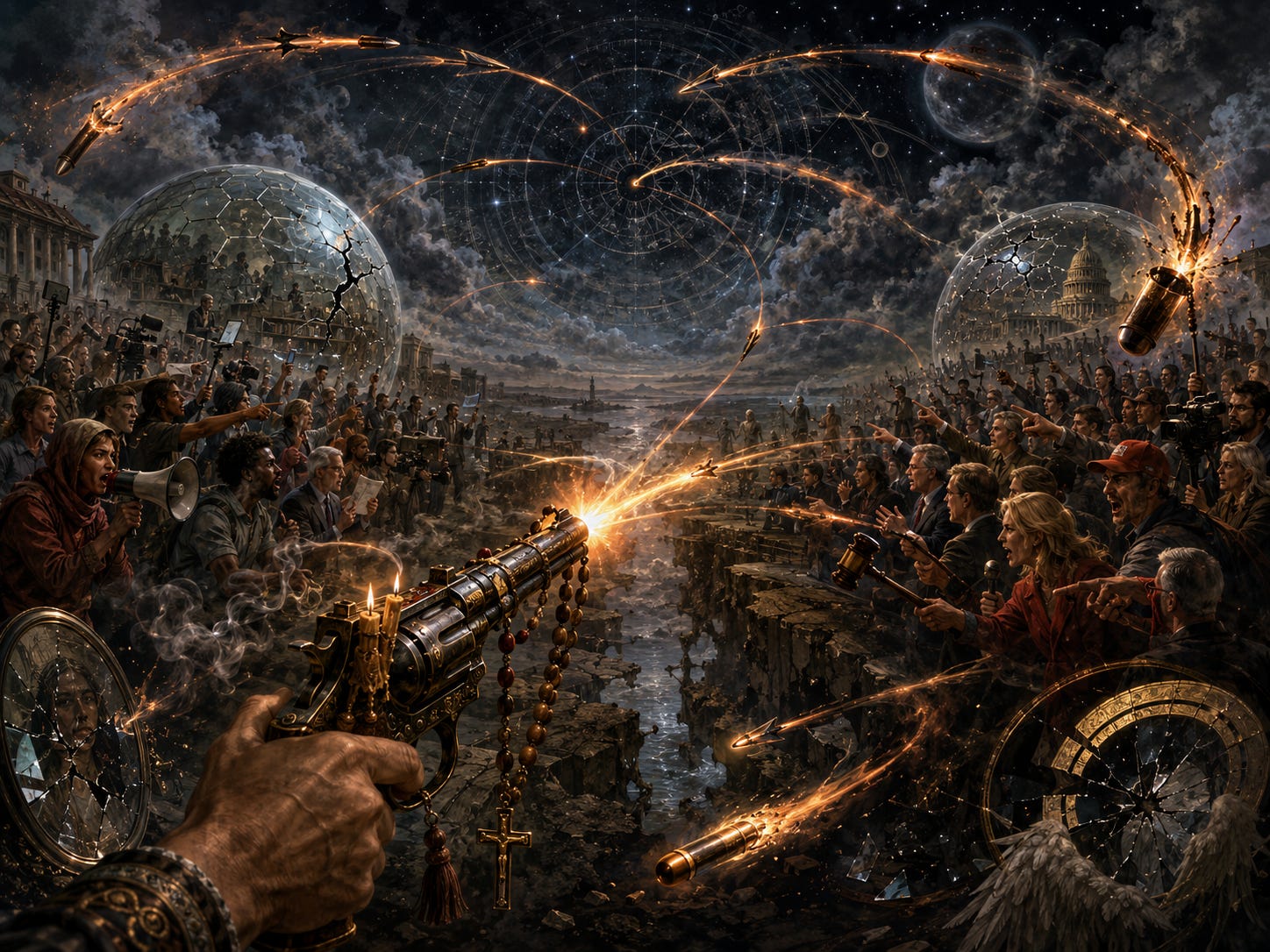
In esoteric tradition—the serious kind, not the crystal shop kind—there is a principle that practitioners state with uncomfortable bluntness: all prayer is prayer. All intention is intention. The universe does not audit your motives before responding to your energy. It does not check whether you are the good guy before it processes your request. It does not grant dispensations to the righteous or surcharges to the wicked. It responds to what you put out with the arithmetic neutrality of physics.
A gun does not check your registration before it fires. It does not ask whether the cause is just. It converts trigger-pull into projectile with complete indifference to the moral status of the person holding it. The bullet travels. Whatever it hits, it hits.
Prayer is a gun.
I have been thinking about this for a long time and I want to try to say it clearly, because I think it explains something that conventional political analysis cannot: why the left spent a decade loading and firing every weapon available at Donald Trump and is now sitting in the blowback, and why this was entirely predictable from within the esoteric framework even if it was invisible from within the political one.
The Tools Don’t Belong To You
Here is the thing about tactics, strategies, and weapons: the moment they become known, they belong to everyone.
Every organizing principle that Saul Alinsky documented in Rules for Radicals is now available to any movement that wants it—including movements Alinsky would have found horrifying. Every nonviolent resistance strategy that Dr. King developed and refined is available to anyone who wants to apply it—including movements that would have been King’s opponents. Every tactic in Sun Tzu’s Art of War is not Chinese intellectual property. Every guerrilla warfare technique that Chairman Mao developed for asymmetric conflict can be used by anyone against anyone. Every propaganda method that Goebbels systematized is in the literature, available to any government or movement that wants to read it.
The moment a secret is out, it belongs to everyone. This is how knowledge works. This is how tactics work. This is how prayer works.
The left spent years developing the infrastructure of narrative warfare: the media ecosystem, the lawfare apparatus, the social media pile-on, the cancellation mechanism, the institutional capture of universities and NGOs and HR departments. These were real achievements of real organizing over real decades. And then the right—or more precisely, the populist nationalist movement that took over the right—looked at the infrastructure and said: we can use that.
And did.
The MAGA movement did not invent the permanent campaign. The left invented the permanent campaign. The MAGA movement did not invent using prosecutorial power as a political weapon—look at the history of the FBI’s COINTELPRO operations against the left in the 1960s if you want to see that playbook’s origins. The MAGA movement did not invent calling its opponents existential threats to democracy who must be stopped by any means necessary—that language was already fully inflated before January 6th. They borrowed it. They loaded the gun. They pulled the trigger.
The same people who told you for years that the assassination attempts on Trump were staged—that is not a conspiracy theory when the left says it. It’s reasonable skepticism, thoughtful analysis, speaking truth to power. When the right says the same thing about any event involving their opponents, it is dangerous misinformation that must be removed from platforms. Same logical structure. Same epistemological move. Different verdict, based entirely on who is holding the weapon.
This is the esoteric tell. When you believe the tool is sanctified by your possession of it and desecrated by your opponent’s possession of it, you have stopped thinking about the tool and started thinking about yourself. You have made yourself the variable rather than the principle. And the universe—which is indifferent to your self-assessment—will treat your use of the tool exactly as it treats your opponent’s use of it.
The Elect Problem
Every side in every conflict looks in the mirror and sees the chosen.
This is not a conservative observation or a liberal observation. It is a structural observation about how human beings organize moral experience. We are the elect. The Holy Spirit is with us. Justice is on our side. History will vindicate us. We are fighting for the children, for the future, for the planet, for freedom, for God. They are fighting for power, for money, for privilege, for evil, for the devil.
In the spiritual war framework—which I find genuinely useful as a descriptive model even setting aside its supernatural claims—there is an unholy spirit as well as a Holy Spirit. The spiritual war assumes an opposition that is real, organized, and equipped with the same tools that the righteous side is using. Nobody who actually believes in the warfare believes that the power of good is alone in the world. There is an enemy. The enemy has intentions. The enemy has weapons. The enemy’s weapons work.
The progressive movement has spent the better part of a decade operating as though its weapons only worked when it held them—as though the institutional power it had accumulated in media, academia, corporate HR, and the nonprofit world was somehow permanently its property, inaccessible to anyone who disagreed. This is the theological error of the elect: the belief that your possession of the weapon sanctifies it, and therefore that your opponent cannot truly possess it, only counterfeit it.
The weapon does not care. The tool does not care. The prayer does not care.
The esoteric principle is specific about this: doing magic that interferes with another person’s autonomy has a cost, regardless of your intentions. The universe charges for interference with agency. A white witch who hexes her ex-husband because he deserves it still incurs the karmic debt of the hex. Not because her assessment of his deserving is wrong—maybe he does deserve it—but because the act of imposing your will on another’s autonomy carries a price that is not waived by the righteousness of your cause. The black magic comes back sevenfold. So does the white magic cast in anger. The blessing and the curse both multiply. The universe does not issue moral discounts.
Grievance Is Just Karma With Bad PR
The word “grievance” has been weaponized by progressive media as a dismissal. To say that someone is animated by grievance is to say that their complaint is illegitimate, self-pitying, unworthy of engagement. Grievance is what losers have. Grievance is what the resentful have. Grievance is what people have when they can’t accept that history has moved on without them.
But in the karmic framework, grievance is just karma that hasn’t been acknowledged yet.
If you take something from someone—materially, psychologically, politically—and you don’t acknowledge the taking, the energy of the taking doesn’t disappear. It accumulates. It waits. It finds expression through whatever channel is available. You can call that expression grievance, or you can call it karma, or you can call it blowback, or you can call it Newton’s third law applied to social systems. The label doesn’t change the physics.
The progressive project accumulated enormous social and institutional power over several decades, and it did so while telling the people it displaced that their displacement was justice, was overdue, was not displacement at all but merely the correction of prior injustice. This may have been true in various specific instances. It was also, as a political strategy, the equivalent of hexing your ex-husband and expecting no bill to arrive. The bill arrived in 2016. It arrived again in 2024. It keeps arriving because the account keeps running and the balance keeps accumulating and no one on the creditor side is willing to acknowledge that a debt exists.
Grievance is just karma with bad PR. The left gave the right’s accumulated karma the worst possible branding—called it resentment, called it white fragility, called it fascism—and then seemed genuinely surprised when the karma didn’t care about the branding and arrived anyway.
The Arc of Justice Is An Arrow
There is a phrase—attributed to Martin Luther King Jr., originating in the nineteenth-century abolitionist Theodore Parker—that has become something like a secular religion in progressive politics: “The arc of the moral universe is long, but it bends toward justice.”
It’s a beautiful sentence. It has sustained a lot of people through a lot of darkness. I don’t want to be unkind to it.
But I want to be honest about what it does when it functions as a primary operating belief rather than as a source of comfort: it makes suffering academic. It makes it a plot point. It makes it the necessary dark chapter before the triumphant resolution that history has guaranteed. And when suffering is academic, you stop registering that it has weight and velocity and that it travels in both directions.
The arc of justice is an arrow. Arrows don’t stop because the archer is righteous. They don’t curve around innocent bystanders. They don’t check party registration before they land. They don’t fail to kill people just because the person who fired them had good intentions.
Even in Dungeons and Dragons—which I mention not to be flippant but because it is a system that encodes consequences with unusual clarity—your character can die spontaneously. A perfectly planned action can have catastrophic unintended consequences. A non-action is also a choice with consequences. The dungeon master does not exempt you from the physics of the world because your character has a good alignment. The game teaches what the palace keeps hidden: the world has physics. Intentions don’t override physics. The rules apply to everyone at the table including the people with good alignment.
The people most surprised by real bullets are the people whose entire formation happened inside a story where the good guys don’t get shot.
Why Are You Using Real Bullets
In January 2026, an ICE agent fatally shot Renee Good during a federal immigration enforcement operation in Minneapolis. Becca Good, Renee’s wife, was filmed in the street afterward, covered in blood, screaming: Why are you using real bullets?
I want to be careful here because this is a real person who lost someone she loved, and the grief in that footage is real, and I am not mocking it. But the question itself—why are you using real bullets—is the most precise expression I have encountered of what happens when the force field fails and the real world arrives.
You can only ask “why are you using real bullets” if you have never once had to reckon with the answer. The answer is: because bullets are always real. The question reveals a formation in which the confrontation with state power was always theoretical, always at a level of abstraction that left the physics out. The protest kept the violence as concept. The organizing kept the consequences as something that happened to other people, in other places, in other eras, as moral lesson rather than present-tense physics.
The Buddha grew up in a palace specifically designed to keep suffering invisible. His father, the legend goes, arranged his entire world so that he would never encounter sickness, old age, or death. When he finally saw them—a sick man, an old man, a corpse—it broke him open because nothing in his formation had prepared him for the reality that these things existed. The encounter produced enlightenment, which is one possible outcome. The other possible outcome is Becca Good in the street, covered in blood, asking why the bullets are real.
The force field kept the physics out. The box stayed closed until it opened. And when the box opened, the physics was incomprehensible because the formation had been so successful at keeping it out.
I Should Disclose Something
I have aphantasia. I cannot visualize. I cannot run the mental movie of suffering that makes one scenario more emotionally real than another. I cannot picture the promised land. I cannot feel the narrative momentum of being on the right side of history because history doesn’t assemble itself into a continuous story for me.
I also have severely deficient autobiographical memory. I cannot replay the past reliably. The experiences I have had don’t accumulate into a narrative of who I am and where I am going. Every hill is its own hill. Every engagement is its own engagement.
This means I have never lived inside a story where the good guys win in the end because justice is inevitable. I live in a world where the arc of justice is not something I can see. I live in a world where each hill has to be taken on its own terms, where you might win one and lose one and die on one, and where the ledger doesn’t automatically balance toward good in the end because there’s no end I can visualize.
Survivalism isn’t my politics. It’s my epistemology. It’s the only one I’ve ever had.
I tell you this because it shapes everything I write, and it shapes this argument in particular. The esoteric principle—all prayer is prayer, the universe doesn’t check your registration—lands differently when you can’t feel the arc. When you can’t feel the arc, you have to work with what’s actually in front of you. You have to ask what the weapon actually does rather than what you intend for it to do. You have to ask who else can pick it up after you put it down.
The people who feel the arc most strongly are the people most likely to be surprised by the bullets. The arc is comforting. The arc is sustaining. The arc is also a story, and the world has physics that stories don’t.
What The Esoteric Actually Says
The esoteric framework is not primarily about whether your cause is just. It is primarily about mechanics.
The mechanics say: whatever you send out returns. The mechanics say: interference with another’s autonomy has a cost. The mechanics say: the tools belong to whoever picks them up, not to whoever developed them. The mechanics say: the seven-times-seven amplification applies to the curse and to the blessing, and the difference between them is less stable than you think when you are the one doing the casting.
This does not mean the cause doesn’t matter. It means the cause is not a substitute for thinking about what the tool actually does. A gun used in self-defense still kills. A hex cast for justice still costs. A legal system weaponized against someone who deserves it still creates the precedent of weaponizing legal systems, and that precedent does not remember why it was created when the next person picks it up.
The progressive project spent years using the tools. The tools worked. The tools are now being used by people who don’t share the project’s goals, against the people who developed them, with the same mechanics and the same results.
This was predictable. Not because the progressive project was wrong about what it was fighting—some of what it was fighting was genuinely wrong and worth fighting. But because the physics of the tools operates independently of the intentions of the people using them. Because the universe doesn’t check your registration before it fires.
Prayer is a gun. It doesn’t care who’s pulling the trigger or why. The bullet travels. Whatever it hits, it hits. And the people who fire without thinking about this are the people most likely to find the bullet in their own chest, coming around.
A Note On What I Am Not Saying
I am not saying that all political positions are equivalent. I am not saying that the left and right are the same. I am not saying that historical injustices don’t merit remedy or that power should not be challenged.
I am saying that the tools of challenge belong to whoever picks them up. I am saying that the karma of the tools operates regardless of who is holding them. I am saying that the people most certain of their righteousness are the most likely to be blindsided by the physics, because their certainty makes the physics invisible to them.
The good man with a gun is still a man with a gun. The statistics on gun use in America show that guns are used more often in defense than in offense—that’s the gun rights argument and it has some validity. The guns also still kill people. Both things are true simultaneously. The righteousness of the defensive use does not eliminate the lethality of the weapon.
The prayer still fires. The intention still travels. The karma still returns.
Use your tools. Fight your fights. But know what the weapon actually does, and know that when you put it down, someone else will pick it up. The universe will treat their use of it the same way it treated yours. The only question is whether you built something with your use that leaves the world better than you found it—not whether you felt righteous while you were firing.
APPENDIX
Context, Notes, and Glossary
On Esoterica and the Neutrality of Intention
The principle that all prayer is prayer—that the universe responds to intention without moral qualification—appears across multiple esoteric traditions and is not unique to any single system.
In Western ceremonial magic and Hermetic tradition, this principle is often stated as “energy follows thought” or “as above, so below”—the idea that the interior state of the practitioner shapes the exterior result, but that the shaping operates mechanically rather than morally. A skilled practitioner with bad intentions is more effective than an unskilled practitioner with good intentions.
In various karmic frameworks (Hindu, Buddhist, and popular Western adaptations), the concept of karma is often misunderstood as a moral accounting system—good deeds rewarded, bad deeds punished. More precisely, karma describes a mechanics of cause and effect: actions produce consequences that are proportional to the action’s force and return to the actor through whatever channels are available. The moral quality of the action affects the quality of the return but does not exempt the actor from having one.
The sevenfold return—blessings returning seven times seven, curses returning seven times seven—appears in various forms across folk magic traditions and has biblical analogues (the concept of measure-for-measure in Jewish law, various passages in Proverbs about the consequences of different kinds of speech and action).
The relevant principle for this essay: the tools of political and social power operate with similar mechanics. They do not remember who developed them or what they were developed for. They respond to whoever uses them with whatever results the tool produces. This is not a moral claim. It is a structural one.
Rules for Radicals and the Tool Problem
Saul Alinsky’s Rules for Radicals (1971) is a manual for community organizing that distills decades of practical experience into tactical principles. It is not primarily a book about ideology—it is a book about how to win. Its principles include: power is not only what you have but what the enemy thinks you have; never go outside the experience of your people; whenever possible, go outside the experience of the enemy; make the enemy live up to their own book of rules; ridicule is man’s most potent weapon; a good tactic is one your people enjoy; keep the pressure on; the threat is usually more terrifying than the thing itself; the major premise for tactics is the development of operations that will maintain a constant pressure upon the opposition.
These are not ideological principles. They are operational ones. They work for any sufficiently motivated organized group regardless of its political orientation. The Tea Party of 2009-2010 explicitly used Alinsky’s framework. The MAGA movement has used versions of several of these principles. The gun rights movement, the anti-abortion movement, and various other right-wing organizing efforts have used Alinsky-style tactics without necessarily knowing they were doing so.
Alinsky himself was a man of the left and expected his book to serve left-wing organizing. The book does not enforce this preference. The tools are the tools.
COINTELPRO and the Weaponization of Law Enforcement
The FBI’s COINTELPRO program (Counter Intelligence Program) operated from 1956 to 1971 and represents the most extensively documented American example of using law enforcement apparatus as a political weapon against domestic movements.
Targets included the Communist Party USA, the Socialist Workers Party, the Ku Klux Klan, the Black Panther Party, the American Indian Movement, and most significantly for this essay, the civil rights movement and Dr. Martin Luther King Jr. personally. The FBI under J. Edgar Hoover surveilled King, attempted to blackmail him, sent him anonymous letters suggesting he commit suicide, and worked to discredit him with media outlets and political figures.
The program used forged documents, infiltrators, manufactured evidence, anonymous letters, and coordination with local law enforcement to disrupt, discredit, and destroy targeted organizations. It was ruled illegal by the Senate’s Church Committee in 1975 and officially discontinued.
The relevance to this essay: the weaponization of prosecutorial and law enforcement power against political opponents is not a new American phenomenon, and it was not invented by the right. It was extensively developed and used against the left. The left’s subsequent development of analogous tools—the use of bar complaints, civil litigation, regulatory pressure, and media coordination against political opponents—represents the same mechanic operating in a different direction.
The tool has been in continuous use. It does not remember who invented it.
The Nayirah Parallel in Domestic Politics
The assassination attempt conspiracy argument—the claim by some on the left that the attempts on Trump’s life were staged—is the domestic equivalent of the Nayirah testimony dynamic discussed in Essay 2. An atrocity or event is claimed to be fabricated by the opposing side. The claim is treated as reasonable skepticism or dangerous misinformation depending entirely on who is making it.
When the left made this claim about the Trump assassination attempts, it circulated in mainstream progressive media with relatively limited pushback. When the right makes equivalent claims about events involving Democratic politicians or causes, the claims are typically labeled misinformation and subject to platform suppression.
The logical structure of the claim is identical in both cases. The epistemic standards applied are different. This double standard is the mechanical demonstration of the essay’s argument: the tool (questioning the authenticity of dramatic events that benefit the political opponent) is being treated as legitimate when one side holds it and illegitimate when the other side holds it. The universe will not maintain this distinction. The precedent of the tool’s use is what persists, not the moral assessment of any particular use.
On the Renee Good Incident
On January 7, 2026, Renee Good was fatally shot by an ICE agent during a federal immigration enforcement operation in Minneapolis, Minnesota. Federal officials stated the agent fired in self-defense after Good allegedly attempted to run over an officer with her vehicle. Good’s wife, Becca Good, was filmed at the scene afterward, covered in blood, screaming “Why are you using real bullets?”
The incident generated significant local outrage and political response. Minneapolis Mayor Jacob Frey and Minnesota Governor Tim Walz publicly criticized the federal operation.
This essay uses the incident not to adjudicate its merits—the circumstances are contested and the legal process is ongoing—but to examine the question embedded in Becca Good’s scream. “Why are you using real bullets” is the question of someone for whom the encounter with state power was previously theoretical. It is the question of someone whose formation did not include the physics of what happens when confrontation with law enforcement escalates. It is the question of someone who was inside the force field until the force field failed.
This is not a criticism of Becca Good’s grief or her politics. It is an observation about what the question reveals about formation, about what the protected environments of progressive activism do and don’t prepare people for, and about the difference between engaging with the idea of state power and engaging with its physics.
Glossary
All prayer is prayer — The esoteric principle that intention operates mechanically rather than morally: the universe responds to what is put out without auditing the moral status of the person putting it out. A skilled practitioner with bad intentions is more effective than an unskilled practitioner with good intentions. The tool does not belong to the righteous; it belongs to whoever picks it up and uses it with sufficient force and clarity.
The registration problem — The political manifestation of the “all prayer is prayer” principle: the belief that a tactic or tool is legitimate when your side uses it and illegitimate when the other side does. Examples include: the weaponization of prosecutorial power (legitimate as anti-corruption when directed at the right, illegitimate as political persecution when directed at the left, or vice versa depending on who is speaking); the questioning of dramatic events that benefit political opponents (reasonable skepticism or dangerous misinformation depending on who is questioning); the use of institutional power to suppress opposing voices (protecting democracy or suppressing free speech depending on who is doing it).
Karma — In its most stripped-down operational definition for this essay: the principle that actions produce consequences proportional to the action’s force, returning to the actor through whatever channels are available. Not a moral accounting system that rewards good behavior and punishes bad behavior, but a mechanical description of cause and effect. The moral quality of the action affects the quality of the return but does not exempt the actor from having one.
The seven-times-seven principle — The amplification dynamic in various folk and esoteric traditions: that the energy put out—blessing or curse, positive or negative—returns multiplied. Used in this essay to describe the political dynamic in which the development of a powerful tool by one side tends to produce a more powerful version of the same tool in the hands of the opposition.
The arc — Shorthand for “the arc of the moral universe bends toward justice,” the progressive secular faith that history has a direction and that direction is toward greater justice. Used in this essay as a description of a narrative structure that makes suffering academic—transforming it from present-tense physics into plot point in a story with a guaranteed good ending. The arc is comforting and sustaining and potentially dangerous to the extent that it makes the physics of tools invisible.
Aphantasia — The neurological condition of being unable to generate voluntary mental images. Relevant to this essay as an epistemological position: the arc is literally invisible to an aphantasic person, not in the metaphorical sense of being hard to see but in the precise sense of not being able to generate the visual narrative that the arc metaphor requires. This produces an orientation toward present-tense mechanics rather than historical inevitability.
SDAM (Severely Deficient Autobiographical Memory) — The neurological condition of being unable to form and access autobiographical memories reliably. Combined with aphantasia: produces an orientation toward what is actually happening rather than what the accumulated narrative says should happen. Each hill is its own hill. Each weapon is the weapon it actually is, not the weapon you intend it to be.
Survivalism as epistemology — The author’s description of his own cognitive orientation: not survivalism as ideology (prepping, isolationism, every-man-for-himself) but survivalism as the baseline way of knowing—you work with what is actually in front of you, you don’t assume the arc will save you, you evaluate the tool by what it actually does rather than what you mean for it to do. The result of having no arc, no stored narrative, no visualization of the promised land.
The Screwtape Paradox — A term the author has coined (referenced in other essays) for the dynamic in which comfortable theological or ideological lies, repeated long enough, become the catechism—the official teaching—rather than the exception. Named for C.S. Lewis’s The Screwtape Letters, in which the demonic Screwtape coaches his nephew on how to corrupt human souls through comfortable distortions rather than dramatic temptations. The paradox: the lie told for pastoral comfort eventually becomes indistinguishable from the truth, at which point the comfort and the distortion are the same thing.
Force field — The protective environment—campus, nonprofit, progressive media ecosystem, professional progressive activism—that insulates its inhabitants from the physics of the tools being used in their name. Inside the force field, state power is theoretical, bullets are conceptual, consequences are things that happen to other people in other times. The force field works until it fails. When it fails, the question is: why are you using real bullets?
Chris Abraham is the founder of Gerris Corp and writes at chrisabraham.substack.com. He has aphantasia and no autobiographical memory, which means he cannot see the arc and takes the physics of the tools seriously.