
Proportional
The math says school is safe. The culture says otherwise.

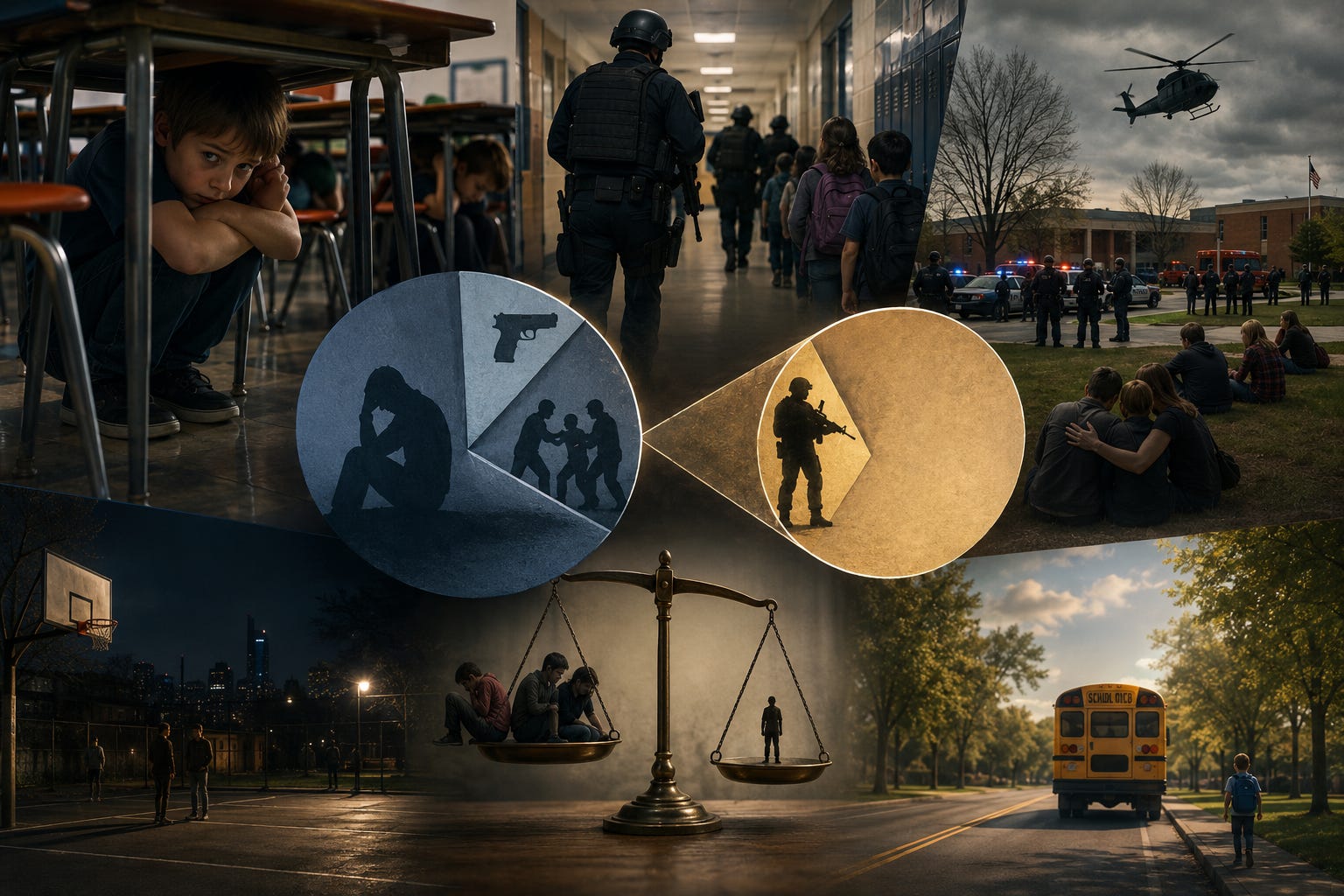
I grew up in the last stretch of the Cold War, going under a desk for drills against an event that never happened, not once, anywhere in the country. Not because the drill was honest about the odds. Because the drill was never about the odds. It was about rehearsing fear until it felt like fact.
We're doing it again. Ninety-five percent of American schools now run active shooter lockdown drills, and they're producing exactly what duck-and-cover produced: kids who believe the classroom is a likely place to die, built on numbers that don't survive contact with the source.
Here's what the source actually says.
The number nobody quotes
The odds of a specific K-12 student being killed by an active shooter, in their classroom, on any given school day: roughly 1 in 614 million. A student is more likely to be seriously hurt on the ride to school than inside the building once they arrive. School buses are, per the Department of Transportation, statistically the safest way a kid travels all day. Set foot inside the building and the risk drops again.
That's not a talking point. That's the Washington Post's math, built off research from Northeastern University criminologists who've spent careers on exactly this question. And it's the number that never makes it into the headline, because it doesn't need a headline. Nobody organizes around an event that isn't happening to your kid.
So how did "isn't happening to your kid" become "constant, ambient threat"? Not by lying about a single number. By redrawing three categories until the categories did the lying for them.
What's actually being counted
"Gun deaths among children" mostly means suicide, not homicide. Nationally, suicides have been the majority of all firearm deaths in America every year since 1995—58% in 2023, 62% in 2024. Among the narrower 1-to-17 bracket specifically, the picture flips somewhat: gun assaults have outpaced suicides since 2020, driven by a spike in urban shooting deaths. Both of those are true, and they get swapped in and out depending on which one makes the point somebody's trying to make that week. A tragedy involving a teenager and his father's unlocked handgun, alone, in a bedroom, gets folded into the same statistic as a mass shooting at a school. Neither the activist citing the big number nor the skeptic dismissing it usually tells you which one they mean.
"Teen" gets stretched until it includes people who are legally adults. A lot of the youth gun violence research defines its population as ages 10 to 24. That's not a typo—it's the standard bracket used by Everytown, the CDC's own mortality tables, and most of the academic literature. It's a defensible bracket for public health purposes. It is not a defensible bracket for a sentence like "children are dying," when a meaningful share of the deaths inside it are 20-, 22-, 23-year-olds. Words like "youth" and "teen" carry a mental image of a middle schooler. The data underneath frequently includes people who can legally buy the gun themselves.
"School shooting" doesn't mean what you think it means. The single most-cited tracker, the K-12 School Shooting Database, defines a school shooting as any instance where a gun is fired, brandished, or a bullet strikes school property—full stop, regardless of time, day, or motive. Its own methodology page says so directly: it counts gang shootings, domestic violence incidents, fights that escalate into gunfire, accidental discharges, suicides, and shootings at football games at 10 p.m. on a Friday, alongside the rare planned attack on a classroom full of strangers. A federal GAO review of this same data found that "dispute or grievance"-related shootings—arguments, retaliation, gang conflict—make up the largest single category, well ahead of anything resembling Parkland or Uvalde. One independent audit put the headline count as overstated by roughly 40% relative to what a layperson means by the phrase.
None of that makes those other deaths not real, or not worth counting somewhere. A kid shot in a gang dispute in a parking lot at 9 p.m. is a real death and a real tragedy. It is also not the thing a parent pictures, and is not the risk a lockdown drill is rehearsing for, when they hear "school shooting."
The actual argument
Strip out the suicides, strip out the after-hours gang incidents, strip out the 19- and 20-year-olds folded into "youth," and you're left with what people are actually afraid of: a stranger or classmate walking into a school during the day and shooting people at random. That event is real. It has happened, and it has killed children in ways that leave permanent scars on this country. It is also, by any honest accounting, a statistical outlier on the order of a plane crash—catastrophic when it happens, and vanishingly unlikely to happen to any specific kid, in any specific building, on any specific day.
Both of those sentences are true at once. Holding them at the same time isn't callousness. It's just accuracy—which is the one thing missing from almost every side of this argument, because accuracy doesn't drive donations, doesn't drive segments, and doesn't drive votes. Fear does. And fear doesn't need the real number. It just needs a big one, said with enough urgency, often enough, to a room full of kids hiding under their desks.
We ran that experiment once already, with a different bomb. It didn't go off either. That didn't stop an entire generation from growing up certain it would.