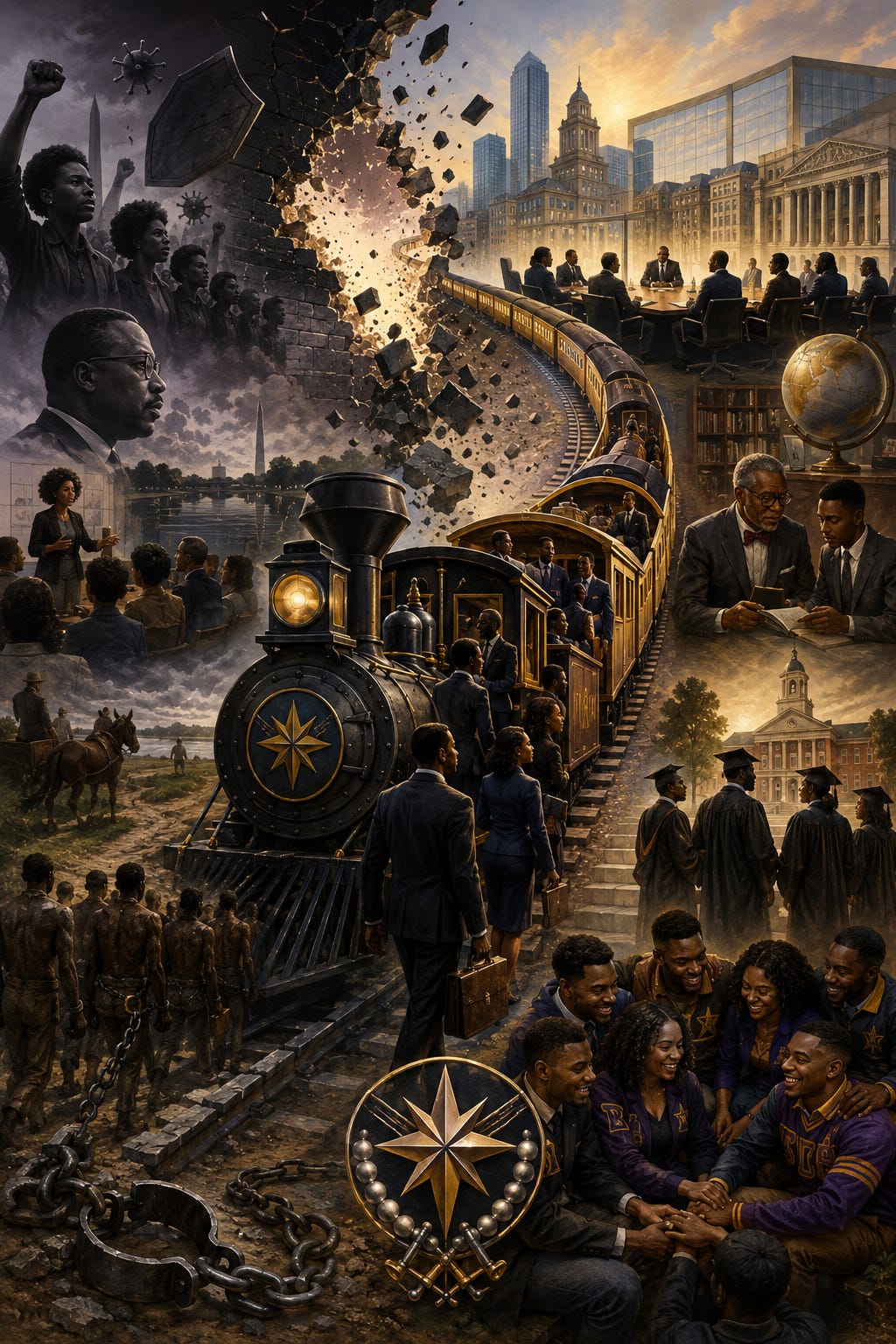
The Boulé Railroad
The entire operation was always about one thing: the diploma

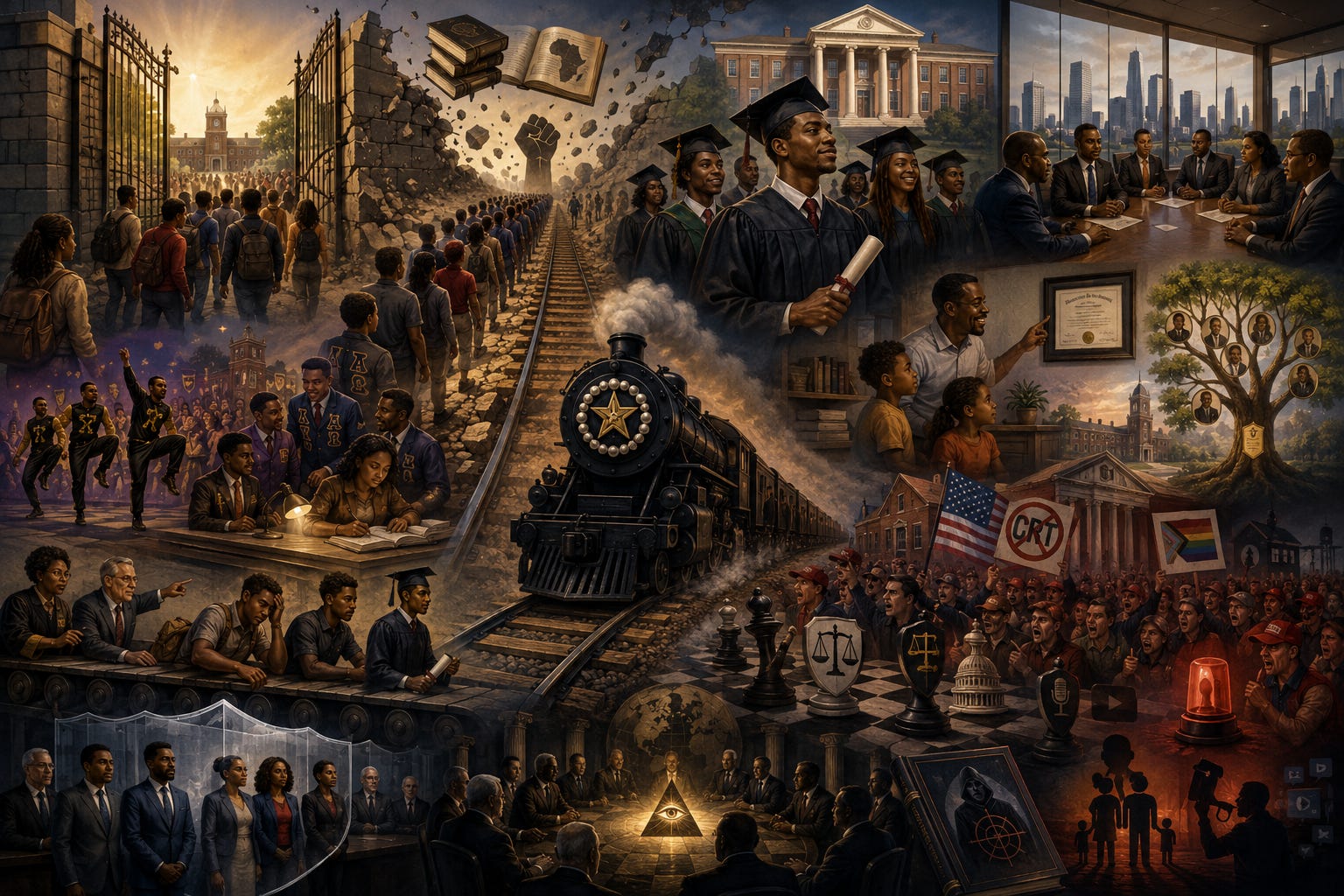
“Fair game if you can pull it off.”
That’s the thesis. Everything else is evidence.
If you can enact your social engineering agenda—if you can get it past the institutions, implement it, take enough hills—you should. If it’s your goal to change the world and you’re able to convince enough people, manifest destiny it. But understand that imposed will has a return address. If people feel like something was done to them rather than for them, the reckoning isn’t proportional. It’s seven times seven.
DEI and CRT pulled it off. Partially. For a specific window of time. Against a specific target.
And the reckoning arrived on schedule.
This is not an obituary. This is a forensic analysis of an operation that was smarter than its critics understood and more limited than its architects hoped.
Watch this first:
Four people who built DEI sitting in a room disagreeing about what it accomplished. One says she accomplished nothing. Another says they were rigging targets. Two still believe. All four were inside it.
That’s not a scandal. That’s an after-action report.
The Credential Is the Only Permanent Thing
America runs on credentials. Not talent. Not merit. Not character. Credentials.
Eighty percent of the doors that open in this country open because of what the diploma on the wall says, not what the person holding it actually knows. Harvey Specter in Suits only hires from Harvard Law. That’s not fiction. That’s how white shoe firms have operated for a century. The credential is the permission slip. The credential is the inheritance. The credential is the thing the system is legally obligated to honor even when it doesn’t want to.
And here is the thing about credentials that makes them uniquely powerful as a tool of generational transformation: you cannot un-credential someone.
You can reverse a mandate. You can defund a DEI office. You can overturn a Supreme Court precedent. You can roll back fifty years of affirmative action policy in a single ruling. What you cannot do is reach into a family tree and remove the Harvard degree from the grandmother who graduated in 2019. The credential is permanent. The network access it confers is permanent. The intergenerational blueprint it creates is permanent.
A first-generation student from the bottom 20% of income who graduates from an Ivy League institution has better than a 60% chance of jumping directly into the top 20% of earners. That’s Raj Chetty’s data from Opportunity Insights. But the more important number isn’t the graduate’s income. It’s the children’s expectations. The children of that graduate don’t experience imposter syndrome at elite institutions. They grow up in a house where Harvard is a place people in this family go. The terror of the first crossing becomes the baseline of the next generation.
That’s the operation. Not diversity reports. Not sensitivity training. Not corporate board composition. Those were support fire.
The primary target was always the diploma.
The Gate and the Clock
The university admissions system was the primary breach point for one reason: it was the most legally vulnerable and the most generationally leveraged target available.
Get enough people through the credential before the Supreme Court calls it racist and closes the gate.
The clock started with Regents of the University of California v. Bakke in 1978—the first serious legal challenge to affirmative action in university admissions. The legal counterattack had been building for forty-five years. Everyone who understood the architecture knew the gate would eventually close. The Federalist Society had been building the judicial pipeline to close it since 1982.
The gate closed June 29, 2023. Students for Fair Admissions v. Harvard. The Supreme Court ruled race-conscious admissions unconstitutional. Forty-five years after Bakke.
Forty-five years of flooding the credential pipeline. Forty-five years of getting people through before the legal counterattack consolidated enough to shut it down.
The people who got through are still through. The court cannot reach them.
The Sheepskin Effect
The operation ran on three tiers simultaneously, each doing different work.
The first tier was the high school diploma as poverty floor. Economists call it the sheepskin effect: the diploma itself produces a wage premium independent of what was actually learned to earn it. The credential is a social signal the labor market honors regardless of underlying performance. Employment applications. Military enlistment. Community college enrollment. Housing applications. Every one of these gates uses “high school graduate” as the first filter. No stamp, no boarding.
The alternative to a weak diploma isn’t a strong diploma. It’s no diploma. And a kid who ages out of high school at nineteen with nothing doesn’t just lose their own future—they become social gravity pulling others toward the exit. Retention isn’t charity. It’s operational. Keep enough people in the room and the room becomes the new normal.
The criticism is real too: push someone through with a diploma they didn’t fully earn and they hit the community college placement test, land in remedial math and English, exhaust their financial aid paying for high school material in non-credit courses, and drop out with debt and no degree. The credential without the competency can set up a second failure harder to recover from than the first.
The second tier was the university admissions surge—the primary breach point, the generational transformer, the main effort of the entire operation. This is where the sheepskin effect compounds into something permanent. A first-generation Ivy graduate doesn’t just change their own trajectory. They change the family’s relationship to elite institutions forever.
The third tier was the elite credential as permanent class transfer. Harvard. Yale. Stanford. The credential so powerful that even a gentleman’s C changes a family’s trajectory across generations. The children of the trailblazer don’t experience imposter syndrome. They grow up in a house where Harvard is a place people in their family go.
Each tier with different risk profiles. Each tier doing different work. But all three aimed at the same objective: get the stamp on the diploma—at whatever level—before the system finds a reason to take the stamp away.
The Cultural Problem
Here is the thing nobody wants to say directly: in communities where institutional credentials have historically looked like someone else’s inheritance, the most visible models of success have often been outside the credentialing system entirely.
Athletes. Entertainers. Hustlers. People who proved the credential is optional by making it irrelevant. The rapper made millions without a diploma. The point guard skipped college entirely. In communities where the visible winners proved the credential is optional, telling a kid to spend four years studying corporate law so he can make partner in fifteen years is not an obvious pitch.
You can’t just open the gate. You have to make the gate look worth walking through to people whose entire surrounding culture points toward a completely different definition of success and status.
So the operation required two things simultaneously: force the gate open legally, and make the gate culturally attractive enough that people would walk through it voluntarily instead of taking the exit ramp toward entertainment and athletics.
That’s what the HBCUs were doing. That’s what the Divine Nine—the historically Black fraternities and sororities of the National Pan-Hellenic Council—were doing. Making Harvard feel like a place Black people conquer rather than a place Black people assimilate into. The step show and the credential as the same object. Black excellence as the frame, not Black assimilation.
The trick wasn’t academic. It was cultural rebranding of what counts as winning.
And it worked on the people it worked on. The ones it didn’t work on pulled the ejection seat. Which is why retention was as important as admissions—because a dropout goes back to the neighborhood with nothing, and takes others toward the exit with them. The social gravity of the cohort runs both directions.
Push Them Through
Here is the most uncomfortable part of the argument.
The credential doesn’t require the education. The credential is the object.
Which is why you push people through even when they struggle. Keep them from pulling the ejection seat. Make them feel belonging. Graduate them. Because a gentleman’s C from Yale still says Yale. The GPA fades. The network access doesn’t. The diploma on the wall doesn’t ask how you got it.
The right called this lowering standards. And they were correct. But they missed why.
Standards were always the gate mechanism. Standards were how the gate stayed closed for a century. “We would love to have more diversity but we can only hire from Harvard Law”—and then ensuring the Harvard Law pipeline remained inaccessible. Standards weren’t neutral measurements of excellence. They were architectural features of exclusion dressed up as meritocracy.
Legacy admissions alone blows up the entire meritocracy argument. You don’t get to defend legacy admissions and attack affirmative action on merit grounds simultaneously. One of those is need-blind meritocracy. The other is inherited credential transmission for people who already have credentials. Pick one.
The mission was never to produce excellent scholars. The mission was to get the stamp on the diploma before the court took the stamp away.
Harvard has always graduated weak students. For three centuries they were just exclusively white and wealthy. Legacy admits. Donor kids. Gentlemen’s C’s going back to George W. Bush. Every campus has its gut classes—the sure-A courses every student knows about, designed to keep athletes eligible and legacy admits upright. The University of North Carolina ran an entire system of no-show paper classes for athletes for decades. Nobody called that lowering standards. They called it institutional discretion.
The diploma never asked how you got it. Affirmative action didn’t invent the unearned Harvard degree. It diversified it.
And for the record: there is no asterisk. Diplomas don't get retroactively marked because the political weather changed. The court can close the gate. It cannot reach back through it.
The credential outlasts everything else. That was always the point.
A weak Harvard graduate still has a Harvard degree. The GPA fades. The network remains. The diploma on the wall doesn't ask how you got it. It just opens the door.
The credential outlasts everything else. That was always the point.
The Boulé Railroad
The Underground Railroad ran people out of the system to freedom.
The Boulé Railroad runs people into the system to power.
Sigma Pi Phi—The Boulé, from the ancient Greek for council—was founded in Philadelphia in 1904. Not for college students. For Black men of the highest professional standing: doctors, lawyers, executives, academics. Built on W.E.B. Du Bois’s Talented Tenth—the belief that the top ten percent of the Black population, through credentials and positioning, would lead the rest of the race forward.
Not by burning the master’s house down. By owning it.
The Panthers wanted to burn the master’s house down. The Boulé wanted to own it. Both were right about the problem. They disagreed on the solution. The Boulé won on points because ownership compounds and revolution doesn’t.
Nobody gets on the Boulé Railroad knowing it’s the Boulé Railroad. They get on because they believe. The idealism is real. The rage is real. The commitment is real. You radicalize at 22 with a Yale diploma and ten years later you have a mortgage, a 401k, a kid in private school, and the discourse shifts—naturally, organically—from “eat the rich” to “build generational wealth.” Both are true. Neither is a betrayal. That’s just the credential doing its work over time.
The system doesn’t need them to know. The system just needs the degree to compound.
Batesian Mimicry
DEI wore the coloration of the Civil Rights Movement. The markings of 1965—Martin Luther King, Rosa Parks, the March on Washington, the moral clarity of fire hoses and lunch counters—because those markings are predator-proof in American discourse. You cannot attack the Civil Rights Movement without becoming Bull Connor. So you shelter inside those wings.
The organism underneath was more radical and more comprehensive. Not just Black Americans seeking integration into existing power structures but a full-spectrum coalition: trans rights, non-binary recognition, neurodivergence, gender equity, disability rights—an everything-at-once assault on every normative category simultaneously. Closer to bell hooks than Rosa Parks. Closer to Angela Davis than Thurgood Marshall.
The mimicry was the survival strategy. It worked—until the organism became visible. Until parents looked at their kids’ curriculum and saw something that looked nothing like “I Have a Dream.” That’s when the immune system flooded the zone. Not because civil rights were under attack. Because the markings stopped matching the organism.
The Breach Operation
Forty acres never came. So the strategy changed from compensation to occupation.
The gate opened. The moral weather changed. The institutions panicked. The law had not yet fully adapted. So people flooded in and claimed ground.
The velocity wasn’t the mistake. The velocity was the strategy. The backlash wasn’t an unintended consequence. It was budgeted for.
Because if you wait for moral permission, precedent hardens against you. A movement that understands the system is structurally exclusionary has one viable path before the window closes: overwhelming insertion before the legal counterattack can consolidate. Not persuasion. Not consensus. A mass breach during a legitimacy opening before the institutional antibodies fully mobilize.
The breaching charge that blew the initial gap wasn’t George Floyd. It was White Fragility.
Robin DiAngelo published in 2018. Corporate HR departments bought it in bulk. The architecture she built was a perfect institutional trap: white discomfort with conversations about race is itself evidence of racism. Which means any resistance to DEI training proves the need for more DEI training. The loop is epistemically closed. You cannot object without validating the objection’s illegitimacy.
That’s not an accident. That’s a shaped charge engineered to blow through the specific wall it was aimed at—white institutional defensiveness, the thing that had blocked every previous attempt at corporate diversity work for fifty years. DiAngelo didn’t use data. She used judo. She made the wall’s own weight the explosive.
Then How to Be an Antiracist. Then The 1619 Project. These weren’t academic interventions designed to win scholarly debate. They were breaching charges timed to a specific window of institutional vulnerability. The target wasn’t the rebuttal in The Atlantic. The target was the HR manual. The faculty hiring committee. The admissions office. The judicial clerk pipeline.
You detonate the charge. You pour through the gap. You don’t stick around to defend the detonation theology.
George Floyd blew the wall open at scale. What followed was a homesteading rush—the same logic as the Homestead Act of 1862, when the government opened land and the rule was simple: get there, claim it, hold it. The window was 28 years before the frontier closed. You moved or you lost.
Forty acres and a mule was the polite version. The petition. The ask. The Boulé Railroad was the homestead rush. Stop waiting for the mule. Take the institution.
The Oligarch Angle Nobody Mentions
The flood wasn’t just activist-driven from below. It was oligarch-enabled from above.
Corporate America didn’t flood DEI budgets after George Floyd out of guilt alone. They flooded it because they had contractual, regulatory, and reputational obligations that required a Black professional class to exist at scale. Government contracting requirements dating to the Great Society. Supplier diversity mandates. SEC disclosure pressures. ESG investor expectations. SBA 8(a) program promises made in the 1960s that required a pipeline to actually exist in order to fulfill them.
They needed the pipeline to produce because they had already promised the pipeline existed.
So the breach wasn’t just activists and white guilt and moral weather. Capital was holding the gate open because capital needed the minority managerial and contracting class to satisfy obligations it had already made. Blackrock’s ESG mandate and the Black Lives Matter street protest were pulling the same rope for completely different reasons. The activist wanted justice. The oligarch wanted compliance infrastructure and access to a $3.9 trillion Black consumer market and the ability to check the diversity box on the government contract application.
Same breach. Different motivations. Neither needed to know what the other was actually doing.
DEI was not a revolution against the establishment. It was the establishment emergency-funding the demographic renovation of itself.
The Backlash Was Physics
The reckoning was always coming. Not as punishment. As physics.
Every documented backlash mechanism fired simultaneously.
NIMBYism: People support radical social restructuring until it affects their own schools and their own kids. The moment the experiment moved from campus to suburb, the Luxury Belief holders discovered they had limits.
The Luxury Beliefs Problem: Diversity ideology confers status on the upper class at zero cost to them. When the norms trickle down to the working class, those people experience immediate negative consequences and push back hard. The people who designed the experiment didn’t live in the neighborhoods where it ran.
The Sleeping Giant: Latent public opinion sits dormant until a triggering threshold is crossed. Then it mobilizes. Comprehensively.
Psychological Reactance: Confined to a tech campus, DEI triggered no reactance. Mandated nationally, the alarm went off everywhere simultaneously.
The NLP Own Goal: Every DEI message that said “straight white men have illegitimate power that must be dismantled” encoded “straight white men have power” in the amygdala—full stop, negation dropped—while simultaneously activating the threat response that turns people into villains. Villains organize. Villains vote. Twenty years of accidental brand reinforcement for the group the messaging was trying to dethrone.
The reckoning arrived on schedule. The Federalist Society pipeline. The anti-CRT lawfare architecture. The school board insurgency networks. The alternative media ecosystem. The donor blocs. All of it constructed in direct reaction to the surge.
The breach succeeded tactically while building the permanent enemy ecosystem that walls off the next surge. That’s the historical gamble baked into every breakthrough offensive.
The Wal Room
In the 2000s, doing crisis communications at Edelman for Walmart, we called the war room the Wal Room.
Everybody in PR and marketing knew the architecture. Fill the visible middle management layers—the ones that show up in the diversity report, the ones journalists photograph, the ones that satisfy the ESG checkers—with Black and brown faces. That human shield protects the C-suite from ever having to change.
The academics call it structural tokenism. Derrick Bell called it interest convergence: institutions adopt diversity measures only to the extent they serve the institution’s own interests.
The “staff vs. line” distinction does the rest. Minority managers get routed into HR, DEI, PR, communications—the visible roles—while the path to the C-suite runs through operations, finance, and sales. The diversity hires are structurally routed away from power from day one. Not maliciously. Institutionally. The incentive architecture does it automatically.
The 33rd Degree Problem
No matter how high you get in any initiatory system, there’s always a level above you that you can’t see from where you’re standing.
The Boulé knows it’s running a game on the system. And it is. The wins are real. The generational wealth is real. And simultaneously—from one level up—the Boulé is perfectly domesticated capital. It has a mortgage. A board seat. A fiduciary responsibility. More to lose from burning the system down than from maintaining it.
The integration was so successful that the integrated party now has the same relationship to radical disruption as any other ownership class: allergic.
This is Derrick Bell’s interest convergence thesis turned on itself. Once the diversity hires have enough stake in the institution, they start making decisions that serve institutional interests. The convergence runs both ways. You don’t need to co-opt the Boulé. The Boulé co-opts itself. Automatically. By succeeding.
The system doesn’t need to be malevolent. It just needs to be sticky.
The Open Question
Reconstruction amendments. Then Redemption. Eighty years of retrenchment before the Civil Rights Movement built on their bones.
The New Deal institutional saturation. Fifty years of dismantling.
The Federalist Society spent forty years building the judicial pipeline that rewrote constitutional doctrine. The side that moves first during institutional ambiguity gets decades of entrenched advantage. And pays for it.
The gate closed in 2023. The people who got through are still through. The faculty hires happened. The media staffing changed. The nonprofit leadership shifted. The judicial clerk pipelines got seeded. The HR doctrine is written into employee handbooks that still exist.
Du Bois himself ended up in Ghana. He renounced his citizenship. The architect of the Talented Tenth died having concluded the machine couldn’t be fixed from inside.
Maybe he was right. Maybe the Boulé gets to the table and the table moves. Maybe interest convergence is the most pessimistic thing Derrick Bell ever wrote and he was right.
Or maybe the credential compounding is already running in ways that won’t be visible for another generation. The children of the people who flooded through are already growing up in houses where Harvard is a place people in their family go.
The wheel turns on generational time.
Fair game if you can pull it off.
They pulled it off. Partially. For forty-five years. Against the primary target.
The reckoning arrived on schedule.
We don’t know yet which one was bigger.
Chris Abraham writes at chrisabraham.substack.com. He is the founder of Gerris Corp, a 32° Scottish Rite Freemason, a returned Catholic, and a graduate of GWU’s American Literature program where Professor Winston Napier changed how he sees everything.

Appendix: Key Terms
Batesian Mimicry — When a harmless species evolves to display the markings of a dangerous one. DEI wore the coloration of the Civil Rights Movement—predator-proof markings—while running a more radical, full-spectrum disruption agenda underneath.
The Boulé — Sigma Pi Phi, founded 1904. The first Black Greek-letter organization, built for Black men of the highest professional standing. Heavily influenced by Du Bois’s Talented Tenth. The graduate school version of the Divine Nine’s survival infrastructure.
The Divine Nine — The nine historically Black fraternities and sororities of the National Pan-Hellenic Council. Founded because Black students were excluded from mainstream campus life. Built a culture of lifelong pride, professional networking, and collective uplift that outlasted and outperformed the institutions that excluded them.
The Homestead Rush — The Homestead Act of 1862 opened land for claiming on a first-come basis. The window was 28 years before the frontier closed. You moved or you lost. Used here as the frame for DEI’s surge strategy: stop waiting for the mule, claim the institution while the gate is open.
Interest Convergence — Derrick Bell’s thesis that institutions adopt diversity measures only to the extent they serve the institution’s own interests. The corollary: once diversity hires have enough stake in the institution, they begin making decisions that serve institutional interests. The convergence runs both ways.
Luxury Beliefs — Rob Henderson’s framework. Ideas that confer status on the upper class at minimal cost to them but impose real costs on the working class when implemented.
Predatory Inclusion — Recruiting people to meet diversity benchmarks while failing to provide the structural support needed for them to succeed. The acceptance letter as finish line rather than starting line.
The Talented Tenth — Du Bois’s concept that the top ten percent of the Black population, through education and positioning, would lead the rest of the race forward. Not revolution. Infiltration.
The Trailblazer Tax — The steep psychological price paid by the first person through a door their community has never walked through. The debt of cultural shock, imposter syndrome, and isolation that the first-generation elite graduate pays so their children won’t have to.
The 33rd Degree Problem — In any initiatory system, there is always a level above the highest level you’ve reached. The Boulé knows it’s running a game on the system. What it may not fully see is that domesticated capital looks the same regardless of demographic composition.
FAQ
Aren’t you giving ammunition to people who want to dismantle DEI?
The right was dismantling DEI regardless of this essay. The question is whether anyone learns anything from how it happened and why parts of it worked permanently.
Are you saying DEI was a conspiracy?
A strategy. A legitimate, documented, academically grounded breach operation that achieved significant permanent institutional change while triggering every known backlash mechanism simultaneously. Strategies can succeed and fail at the same time depending on the time horizon.
Are you saying Black students who got through weren’t qualified?
The credential doesn’t require the education. The credential is the object. Legacy admissions has always operated on exactly this logic for the children of donors and alumni. The argument that merit should apply to one group and not the other is the tell.
Did it work?
Ask again in forty years. The Reconstruction amendments got reversed for eighty years before the Civil Rights Movement built on their bones. The pH shift from a forty-five year credentialing surge doesn’t show up in a single Supreme Court term. It shows up in who sits on the court two generations from now.
What’s the actual thesis?
Fair game if you can pull it off. The operation was smarter than its critics understood and more limited than its architects hoped. The reckoning arrived on schedule. We don’t know yet which was bigger—the breach or the counter-infrastructure it built in response.