
The Camera Doesn’t Take Sides, But It Isn’t Blind Either
Total transparency ended every performance at once. It just didn’t end them equally.

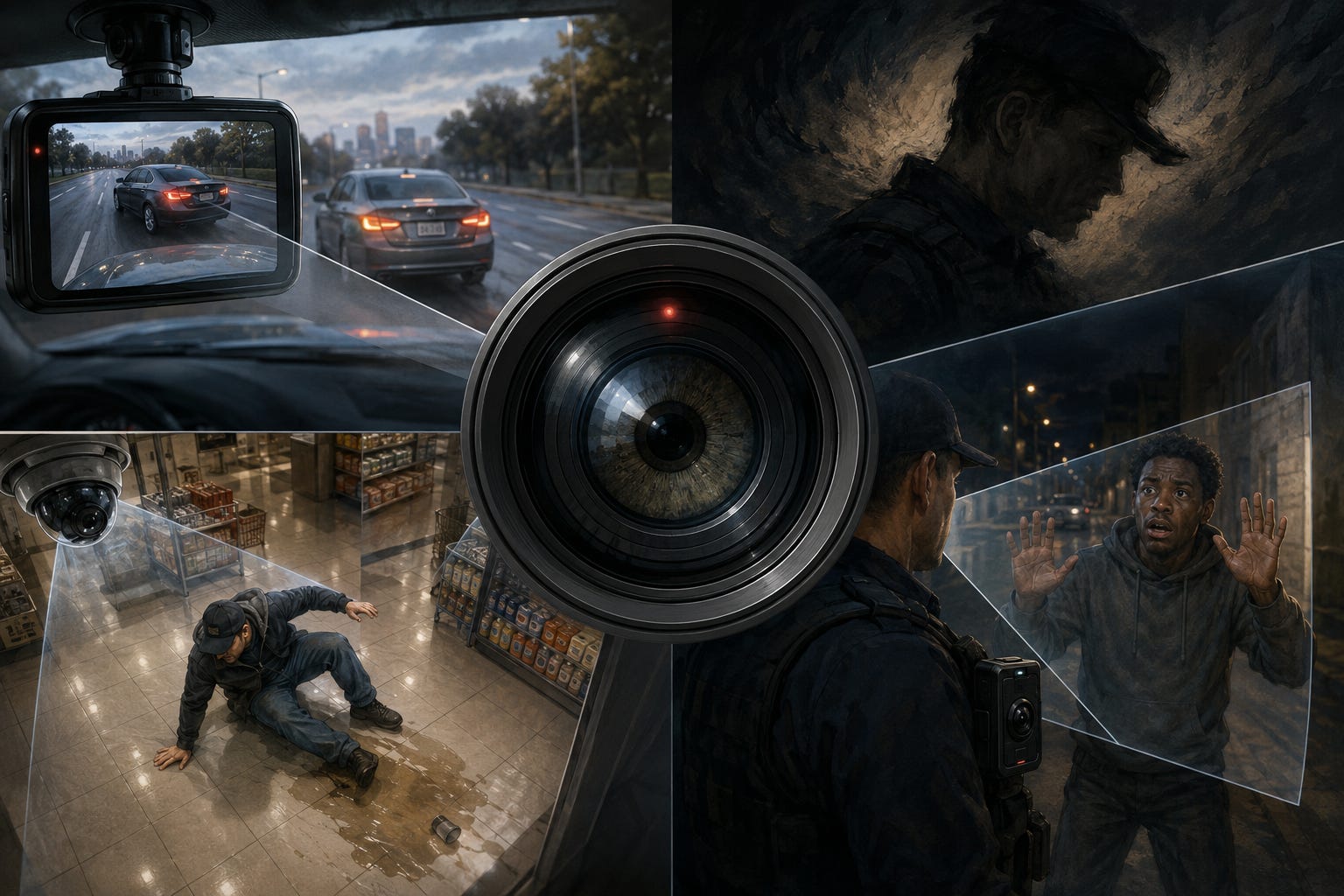
The camera ended the sport before the sport even realized it was over. That’s the story people keep missing when they talk about surveillance, dashcams, bodycams, Ring doorbells, ALPR, as though they’re primarily a story about catching bad cops or catching criminals. They’re actually a story about ending games. Multiple games, running in parallel, that different people didn’t realize they were all playing simultaneously until the unblinking eye showed up and closed the table on everyone at once.
The swoop, the squat, and the slip
For decades there was a foolproof move on American roads. Cut in front of a target, brake hard for no reason, the driver behind rear-ends you, and traffic law almost always presumes the rear driver at fault. Pack the car with passengers. Everybody files whiplash. Nobody can disprove soft tissue injury. It worked because the alternative to believing the fraudster was a “he-said, she-said” that always resolved the same predictable way.
Dashcams ended that game overnight, not by making the fraud less profitable in theory, but by making the specific move visible: the aggressive lane change, the brake-check with nothing ahead, the seat-switch after impact to hide who was driving. The fraudsters weren’t stopped by a new law. They were stopped by a camera that happened to be running the whole time and had never once been playing along.
The slip-and-fall version is the same trick on foot. Pour your own liquid, check that nobody’s looking, lower yourself down slowly, and sue. Commercial CCTV ended that one too, for the same reason: the fraud required a moment nobody could see. Once somebody could always see, the fraud had nowhere left to hide the tell.
Citizens believed something too
It wasn’t only fraudsters running a game. Ordinary citizens, in ordinary encounters with police, sometimes ran their own version. A complaint that an officer used a slur, or shoved someone who was standing still, or lied about resisting, used to live or die on credibility alone, a citizen’s word against an officer’s, adjudicated by whoever the listener already trusted more.
Body cameras ended that particular sport too, and did it fast. Citizen complaints against officers dropped by wide margins almost immediately after departments rolled cameras out, the Rialto trial is the famous early case, and a large share of behavioral misconduct complaints get resolved in the officer’s favor once the footage is actually pulled. Whatever was happening before, exaggeration, misremembering, outright fabrication, in either direction, the camera ended most of it at once. Total recording doesn’t ask who was lying. It just removes the space lying used to live in.
Except the eye isn’t neutral, it’s mounted somewhere
Here’s the part that complicates the tidy “cameras are just the truth” story, and it’s worth sitting with rather than rushing past. A body camera is strapped to an officer’s chest. That means the footage is a first-person point of view shot from inside the officer’s body, looking out. The viewer sees the suspect’s raised fists, hears the suspect’s screaming, watches a hand move toward a waistband. The viewer does not see the officer’s face, the officer’s posture, the officer’s own fear or hesitation or overreaction, because the camera physically cannot see the thing it’s attached to.
That’s not a data problem. That’s a placement problem. The footage is genuinely unedited and genuinely real, and it is still, structurally, one person’s eyes and nobody else’s. Legal scholarship on this is explicit about the mechanism: judges and juries watching bodycam footage are primed to identify with the officer’s perspective because that’s the only perspective physically available in the frame. Scott v. Harris, the Supreme Court case that lets judges throw out a plaintiff’s version of events when video contradicts it outright, assumes the video is a neutral referee. It’s closer to a neutral referee who’s only ever standing in one team’s dugout.
So the camera didn’t just end two sports and leave both sides equally exposed. It ended the citizen’s sport almost completely, the fabricated complaint, the exaggerated injury, the “he attacked me for no reason” claim that used to survive on credibility alone. It left the officer’s side of the table with a structural home-field advantage baked directly into the hardware. Not because anyone designed it maliciously. Because nobody thought hard enough about where the eye would sit before they mounted it.
What total transparency actually produces
The honest conclusion isn’t that cameras are good or bad, biased or neutral, a win for cops or a win for citizens. It’s that “the truth will set everyone free equally” was never how this was going to work, because truth isn’t disembodied, it’s always recorded from somewhere, by something, mounted on somebody’s chest or bolted to somebody’s dashboard or hanging over somebody’s doorbell, and that specific placement decides whose fear gets narrated and whose stays invisible.
Total transparency ended the fraudster’s sport. It ended a lot of the citizen’s sport too. It just didn’t do those two things by an equal amount, and pretending otherwise, treating every camera as a neutral witness rather than a specific eye with a specific vantage point, is its own kind of naivety, the belief that recording something is the same thing as seeing it whole.