
The Footnote Miracle
Five thousand strangers ambushed a grieving man in the wilderness—and the real miracle wasn’t the bread, it was that he didn’t turn the boat around

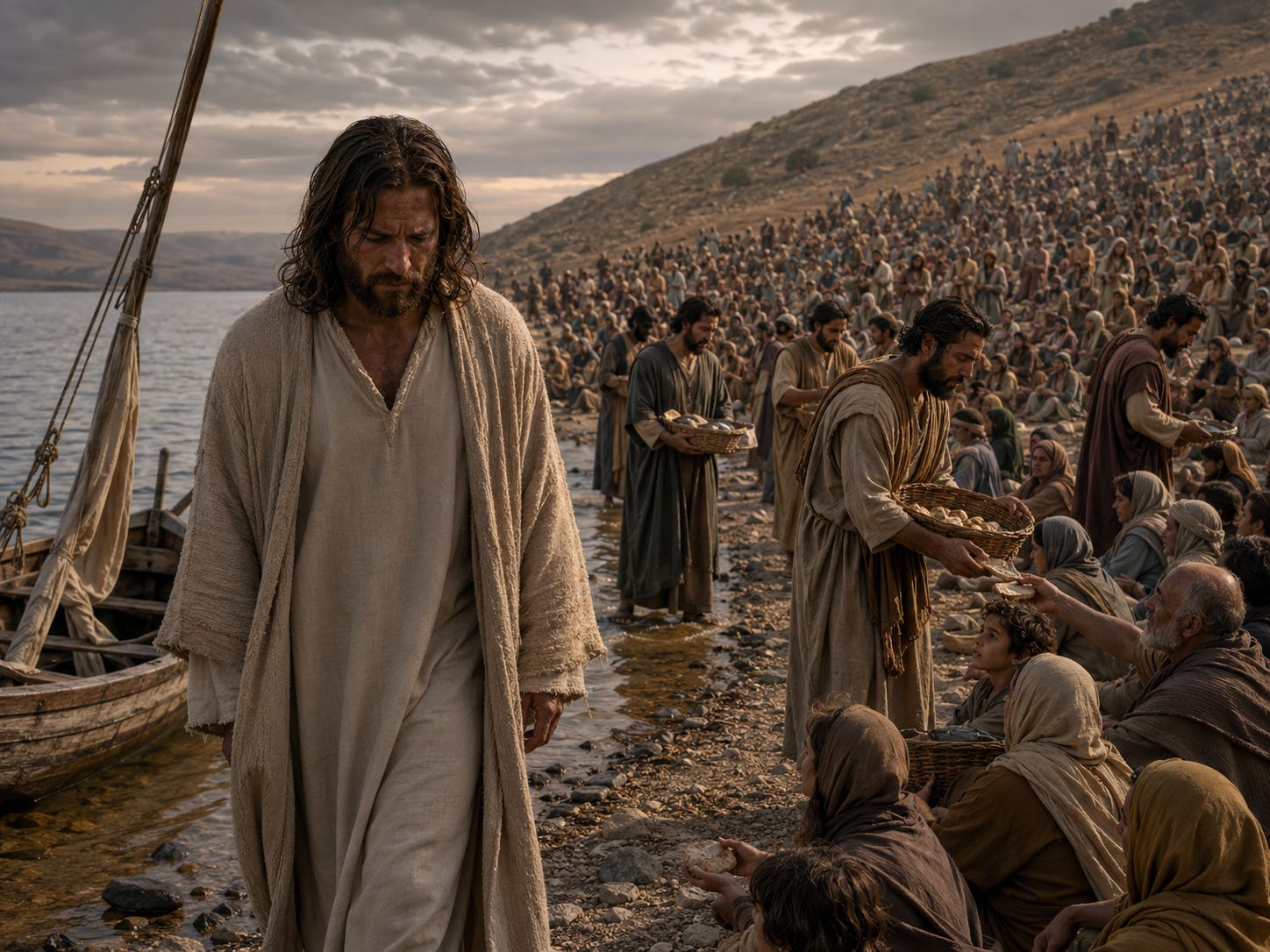
When Jesus heard of the death of John the Baptist,
he withdrew in a boat to a deserted place by himself.
The crowds heard of this and followed him on foot from their towns.
When he disembarked and saw the vast crowd,
his heart was moved with pity for them, and he cured their sick.
When it was evening, the disciples approached him and said,
“This is a deserted place and it is already late;
dismiss the crowds so that they can go to the villages
and buy food for themselves.”
Jesus said to them, “There is no need for them to go away;
give them some food yourselves.”
But they said to him,
“Five loaves and two fish are all we have here.”
Then he said, “Bring them here to me,”
and he ordered the crowds to sit down on the grass.
Taking the five loaves and the two fish, and looking up to heaven,
he said the blessing, broke the loaves,
and gave them to the disciples,
who in turn gave them to the crowds.
They all ate and were satisfied,
and they picked up the fragments left over—
twelve wicker baskets full.
Those who ate were about five thousand men,
not counting women and children.
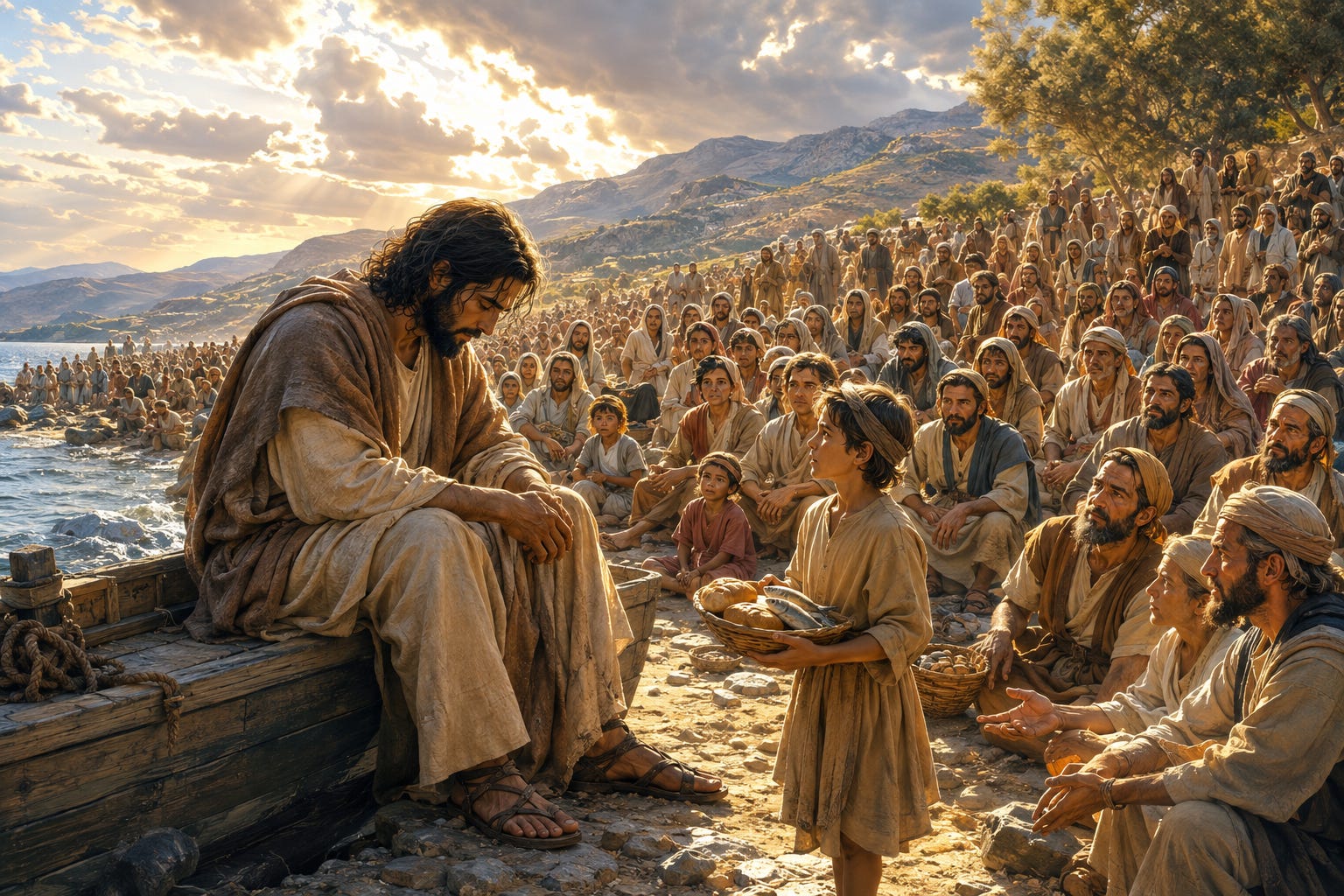
Jesus gets word that his cousin has been executed. Herod had John the Baptist beheaded on a party favor, a dancing girl’s whim turned into a severed head on a platter, and Jesus does the single most human thing in the entire gospel. He gets in a boat and goes to a lonely place, by himself, to grieve.
He doesn’t make it.
Five thousand men, plus women and children the text doesn’t even bother counting, fifteen or twenty thousand people easily, chase him down on foot around the shoreline and are standing there waiting when he lands. He didn’t invite them. He wasn’t holding a rally. He was trying to disappear, and a crowd that size found him anyway and sat down expecting something from him. They’re unwelcome stalkers who ambushed a man mid-grief.
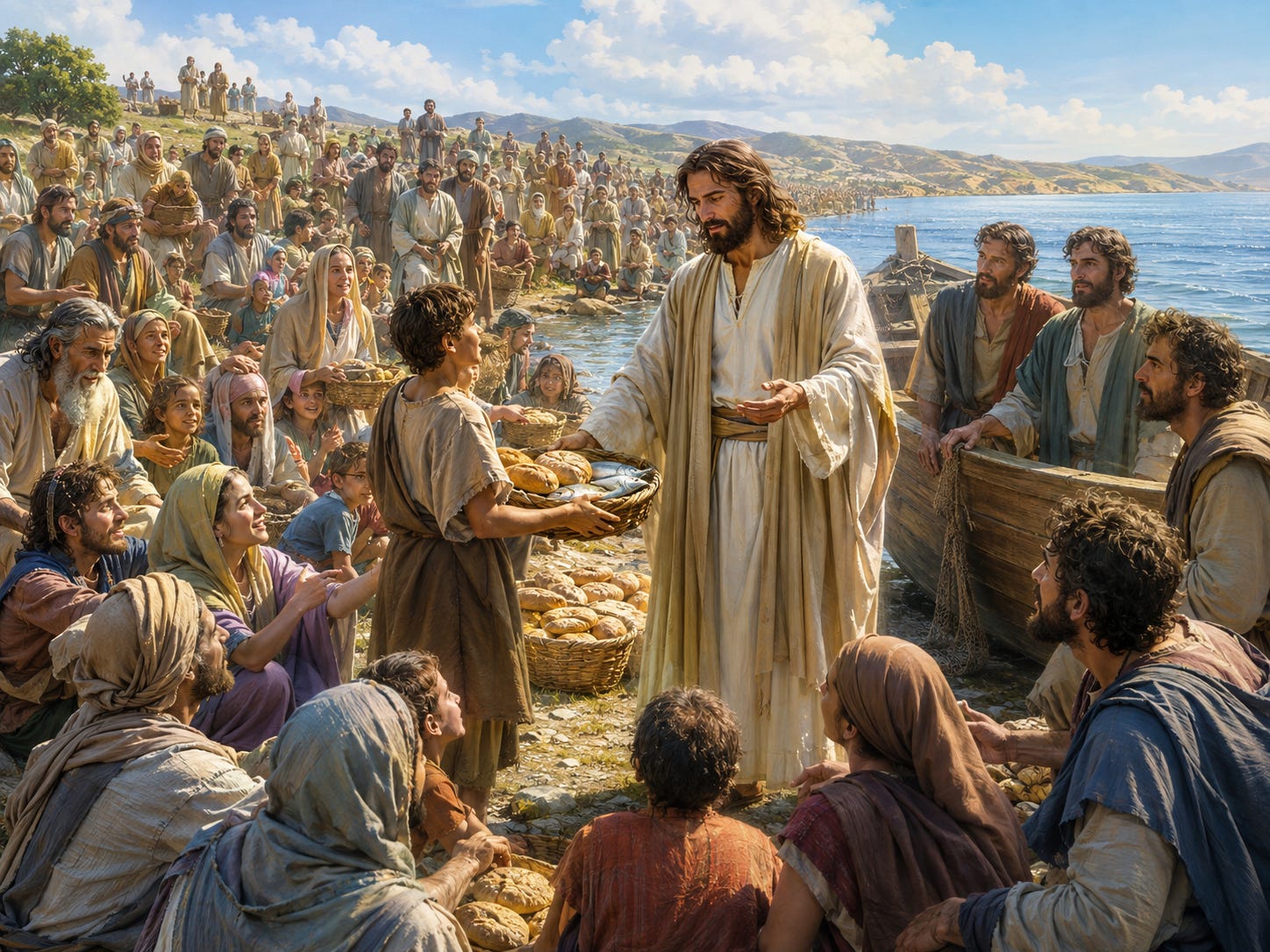
Matthew says he “had compassion on them.” The actual Greek is splagchnizomai, and it doesn’t mean warmth, it means his guts were wrenched, because the ancients located love and pity in the bowels, not the heart. That’s not a gentle word. That’s a physical gut-punch landing on a man who just buried his cousin’s memory in a boat ride. I’ve got a friend, Mark, who describes exactly this feeling: his guts get moved and his face says oh, hell, I have to do this now. Not warmth flooding in. An obligation landing in the stomach like a fist, and he rises to it anyway. That’s a truer read of splagchnizomai than any stained-glass window ever gave us. Jesus isn’t beaming down love. He’s absorbing a gut-punch and doing the job regardless.
And here’s the part that never makes it into a homily: nobody in that crowd was starving. Hungry, sure, the way anyone gets hungry after a long day outdoors, but they had villages within walking distance and money to spend in them. The disciples’ actual suggestion, send them into town to buy their own supper, was the fiscally reasonable one. It’s a conference organizer’s problem, not a famine. You’ve got a few thousand people who are going to be here past dinnertime, it’s a courtesy to make sure there’s a boxed lunch. Jesus says no, feed them here, and that’s not logistics, that’s him refusing to let a solvable inconvenience become the excuse to send grieving, needy, opportunistic people back out into the world alone.
Here’s the detail that actually undoes every “clever trick” reading of this story: nobody in that crowd watched bread multiply in front of their eyes. Nobody saw the mechanism. Five loaves and two fish went out from a boy’s hands into a stack of baskets, the baskets went out into the crowd, and people just got handed food, the way you get handed a plate at any large gathering. The only people who ever had proof a miracle happened were the ones left holding twelve full baskets of leftovers afterward, food that should not have existed. That’s not a magic trick performed for an audience. A magic trick needs spectators watching the sleight of hand happen. This one has no audience for the actual miracle at all, only forensic evidence of it after the fact.
None of it was top-down, either. Jesus blesses the loaves and hands them to the twelve, and it’s the twelve who walk out and do the actual distributing to thousands of people. That’s the whole shape of his ministry, not an exception. He sends the apostles out ahead of him with the power to heal and cast out demons in his own name and tells them plainly they’ll do what he does and more. Jesus is the lighter. The apostles are the fuse. The crowd is the dynamite. He performs one miracle that day, in twelve men’s hands, distributed outward into thousands of hands after that.
Compare that to Nazareth, his own hometown, the people who watched him grow up in a carpenter’s shop. Mark says he could do no mighty work there, only laid his hands on a few sick people and healed them, and he marveled at their unbelief. Same man, same power, and in front of the people who knew him best since he was a boy he’s nearly impotent. This wilderness crowd walked miles on foot around a lake to catch a man actively fleeing them, because they already believed there was something worth chasing. His own neighbors are the one crowd in the gospels who showed up wet.
Underneath all of it sits an obligation older than the miracle itself, one the text never explains because everyone hearing it already knew the rule: you feed the stranger who shows up at your door, invited or not. It’s the same hospitality code that has Abraham slaughtering a calf for three strangers in Genesis eighteen, the same code Jesus invokes later telling his own disciples to shake the dust off their feet against any village that won’t take them in. He didn’t invent that obligation. He was a product of it, the same as everyone in that crowd who watched a boy hand over his own lunch and understood, without being told, what came next.
And almost nobody turned around afterward to say thank you. That’s the oldest pattern in the whole gospel, ten lepers healed, one comes back. A crowd fed on a hillside, most of them walking off full and already forgetting whose hands that bread passed through. I know this exact ingratitude firsthand. Fifteen years as a sous chef at Miriam’s Kitchen, a homeless services organization here in DC, and nobody who walked through that door for dinner ever thought about who’d been up since five sourcing the food, cutting away what had gone soft, making something a sous chef would actually be willing to plate. People came in expecting to be fed. That expectation is the entitlement. The real miracle, the case manager quietly working a housing intake or a doctor’s appointment into the evening while somebody eats, is the part nobody notices, because the meal was never supposed to be the story. It’s what happens because hungry people don’t disappear on their own, and somewhere behind every plate is somebody doing the harder, invisible work that the meal only exists to make possible.
The miracle isn’t the bread multiplying in anyone’s hands. It’s upstream of that, in a heart that had every reason, that particular week, to have nothing left to give. A man buries his cousin, gets ambushed by thousands of strangers before he’s even had the privacy to finish grieving, and instead of sending them away, he lights a fuse that runs through twelve men and out into thousands of hands until there’s more bread left over than he started with. The bread is a footnote. Grief didn’t win. He showed up anyway, and so did everyone he lit up.
Flowers to Daniel Mikkelsen of Logical Bible Study and to Jeff Cavins, whose daily readings on Hallow this morning are what set this whole train of thought in motion.