
The Gold Standard
Every complaint about Donald Trump is a complaint about ostentatiousness that nobody is allowed to aim at anyone else

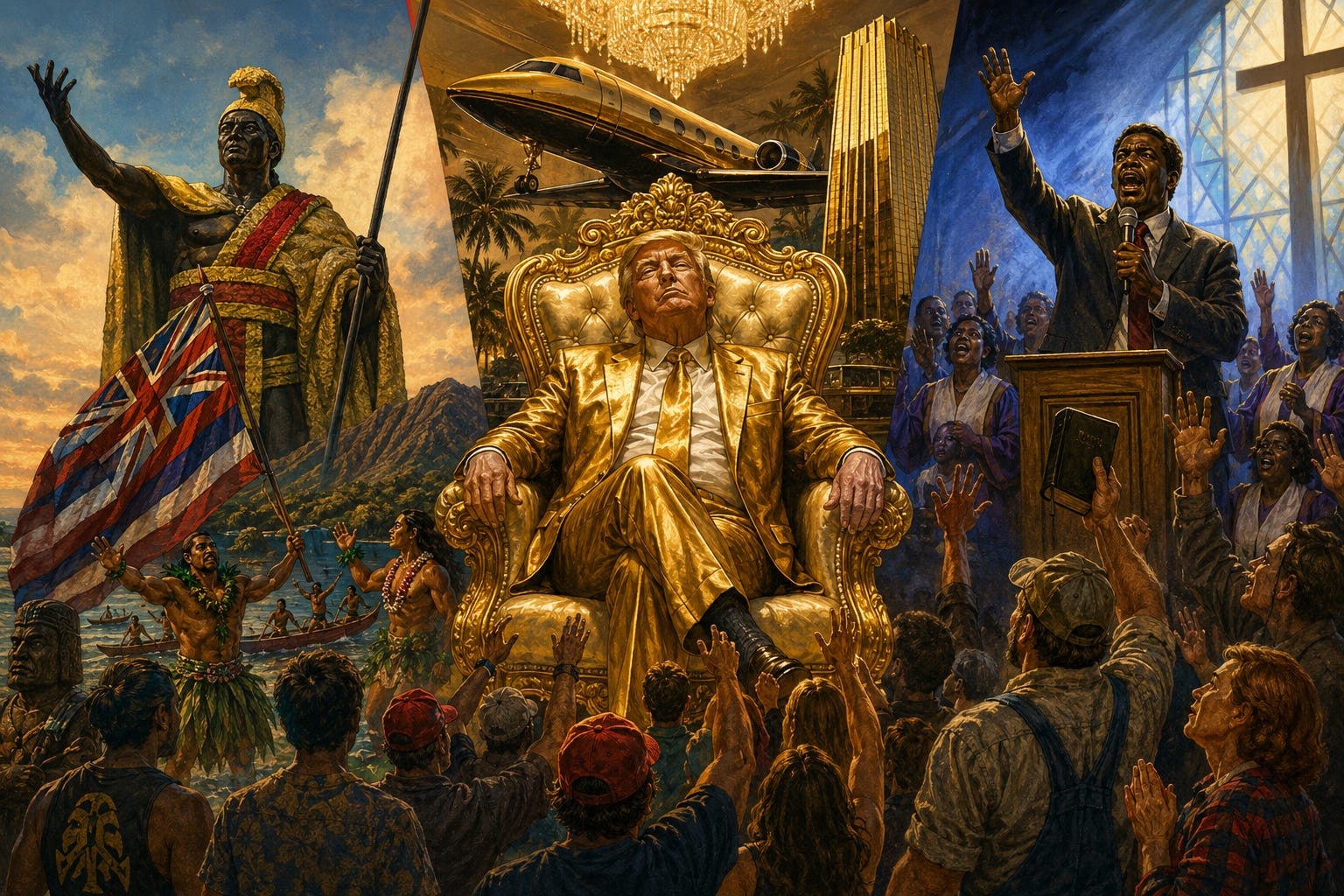
Donald Trump is not America's first ostentatious president. He is America's first ostentatious president who didn't have the decency to be ostentatious on behalf of people the taste-making class had already decided to find charming.
That's the whole thing. That's the entire argument. Everything else is footnotes.
---
There is a gentleman's agreement at the heart of American public life and it has nothing to do with party or policy. It is a code of conduct so deeply embedded that the people who enforce it can't actually name it—they can only feel when it's being violated. The code goes something like this: you may be powerful, you may be rich, you may be influential, but you will perform a certain modesty about all of it. You will wear the right clothes without calling attention to them. You will live in the right house set far enough back from the road that nobody has to look at it. You will summer somewhere with a short Saxon name—Greenwich, Kennebunk, Nantucket. You will not put your name on buildings. You will not gold-plate things. You will treat the offices you hold as vocations rather than jobs, which means you will wear the costume and observe the liturgy and pretend that the power is incidental to the service rather than the entire point.
Every president before Trump observed this agreement to at least a functional degree. Even the ones who came from nothing performed the dignity of the office as though they'd been born to it, because that performance was the job. Not the legislation. Not the foreign policy. The comportment. Presidential is not an adjective that describes what you do. It's an adjective that describes how you hold yourself while you do it.
Donald Trump does not hold himself that way and has never held himself that way and has made it abundantly clear that he finds the expectation absurd. His name is on everything. His plane says TRUMP on the side in letters you can read from the tarmac. His residence is a Florida palazzo with more gold leaf than the Palace of Versailles. His rallies are revival meetings crossed with roasts crossed with something that in any other context would be called a tent crusade. He rewards loyalty and punishes betrayal with the frank transactional clarity of a man who never learned that you're supposed to pretend that's not how power works.
And the people who hate him—really hate him, the kind of hate that requires a therapist and a good Burgundy—cannot tell you clearly why. They say democracy. They say norms. They say he's dangerous, he's a fascist, he's unfit. And some of that is true and some of it is projection and all of it is beside the point. Because the thing they actually cannot stand, the thing that produces the specific quality of revulsion in their voices when they say his name, is that he will not observe the agreement. He is ostentatious. He is loud. He is proud. He will not be quiet about any of it.
Here is where it gets interesting.
---
I grew up in Honolulu in the 1970s, when Hawaiiana was something you avoided if you could. The hula was for tourists at the Kodak Hula Show. The chants and the canoes and the warrior culture were being curated in museums by rich old ladies and university anthropologists who found it all tremendously interesting in the way that rich old ladies and university anthropologists find things tremendously interesting—from a careful appreciative distance that never once threatened to give any land back.
Then the Hawaiian Renaissance hit and suddenly intermediate school boys were wearing t-shirts featuring cartoonishly muscular warrior kings in elaborate feathered regalia and nobody thought anything of it except that it was extremely cool and extremely Hawaiian and an expression of pride in a culture that deserved to be proud.
That pride was charming. That ostentatiousness—because that's what it was, muscular golden warrior kings on every available surface—was beautiful and authentic and a connection to the ancestors. The same energy that gets called tacky when it comes out of Mar-a-Lago got called a renaissance when it came out of Kalihi.
I am not saying the Hawaiian cultural revival was equivalent to gold-plating a toilet. I am saying that the determining variable for whether ostentatiousness reads as vulgar or as vital has never been the ostentatiousness itself. It has always been whose ostentatiousness it is and whether the people making the judgment have already decided to find that community charming or threatening.
---
Think about the big tent preacher working a crowd of ten thousand people into absolute ecstasy—call and response, the spirit moving, people on their feet, the preacher in a suit that cost more than your car telling everybody that God wants them to be prosperous and that their faith will be rewarded with abundance in this life not just the next. If that preacher is Black the secular liberal finds it electrifying. Authentic. Rooted in a tradition of survival and resistance and community that sustained people through horrors that the secular liberal cannot imagine. Beautiful.
If that preacher is white the secular liberal calls it skydaddy. Prosperity gospel grift. Provincial embarrassment. The same supernatural claim, the same crowd psychology, the same expensive suit, the same promise of divine reward—and the reception is completely inverted based entirely on which community is doing it.
The working class white evangelical who actually believes, who actually prays, who structures their entire life around a relationship with Jesus Christ—they get the same condescension that gets called appreciation when it's aimed at someone else's grandmother burning sage or someone else's community doing ceremony or someone else's ancestors whose spiritual practices survived colonization and therefore carry the specific gravity of survival.
It's not about the content of the belief. It's about whether the belief belongs to someone the taste-making class has decided to find interesting.
---
There is a concept in therapy called displacement. You come home and you kick the dog because your boss humiliated you in a meeting and you cannot kick your boss. The dog is safe. The dog won't fire you. The dog won't remove you from the will or stop inviting you to the right parties. The dog absorbs the violence that has nowhere else to go.
René Girard—the French literary critic and anthropologist who became one of the more important Catholic intellectuals of the twentieth century—built an entire theory of human civilization around a related mechanism he called the scapegoat. Communities that are full of internal tension and resentment and mimetic rivalry—which is all communities, always—periodically need to discharge that violence somewhere. They find a designated victim, load all the community's sins and resentments onto that victim, and destroy them. The community feels better. The violence is discharged. The scapegoat is usually guilty of something, which is what makes the mechanism work—you need the charge to be at least partially plausible—but the charge is never really the point. The point is the discharge.
Donald Trump is the most effective scapegoat in American political history and he is effective precisely because he is actually guilty of the specific offense that is making everyone crazy. He is ostentatious. He will not observe the agreement. And because he is white and male and rich and powerful and the one category of person that the current social operating system has designated as a fully acceptable target, he can absorb an essentially unlimited quantity of displaced resentment from people who have that resentment aimed at targets they cannot touch.
You cannot say out loud that you find loud ostentatious expressions of group pride exhausting regardless of which group is doing the expressing. You cannot say that the aesthetic of maximalist self-announcement—the gold, the motorcade, the name on the building—bothers you when it comes from communities that have been told their pride is political resistance. You cannot say that the revival meeting energy makes you uncomfortable when it's a Black church or a Pentecostal congregation in Appalachia that you've been told to find authentic. You cannot direct your class anxiety and your status resentment and your exhaustion with performative pride at the people who are actually generating those feelings in you because those people are protected by a social contract that would destroy you for saying it.
But you can say it about Trump from now until the sun burns out and everyone will nod and pour you more wine.
---
Someone said to me recently that Donald Trump is less Bill Clinton's successor than his completion—that if Clinton was America's first Black president in the Toni Morrison sense, Trump is America's third, because he behaves with the specific combination of energies that the American establishment finds most threatening when it comes from anyone other than a white billionaire with a golden escalator.
The ostentatious private jet. The name on everything. The big tent preacher rally energy. The prosperity gospel aesthetic—I alone can fix it, your faith will be rewarded, the deal is coming, trust me. The strongman loyalty culture where betrayal is punished and devotion is rewarded with access and protection. The complete indifference to the gentleman's agreement and its demands of performed modesty.
All of that, in a different body, in a different context, would be called authentic leadership. Would be called cultural pride. Would be called you don't understand our community and our traditions and what this means to us.
In Donald Trump it gets called fascism.
The argument is not that Trump is good. The argument is that the specific texture of the hatred aimed at him—the revulsion, the class contempt barely disguised as constitutional anxiety—is being applied with a consistency problem so large you could drive a motorcade of a hundred Mercedes S-Classes through it.
The tall poppy gets the shears regardless of which garden it grows in. The agreement is the agreement. You will be quiet about what you have and what you are and what you believe and how proud you are of all of it.
Donald Trump will not be quiet. Neither will a lot of other people the establishment has decided it's not allowed to say that about.
That's the problem. That's always been the problem.
The gold is just the most honest part.
---
Chris Abraham writes at chrisabraham.com and on Substack. He is an SEO consultant, essayist, and recovering everything else, based in Arlington, Virginia.