
The K-Shaped Country
Why Nobody on Either Side Will Admit the Map Is Gone

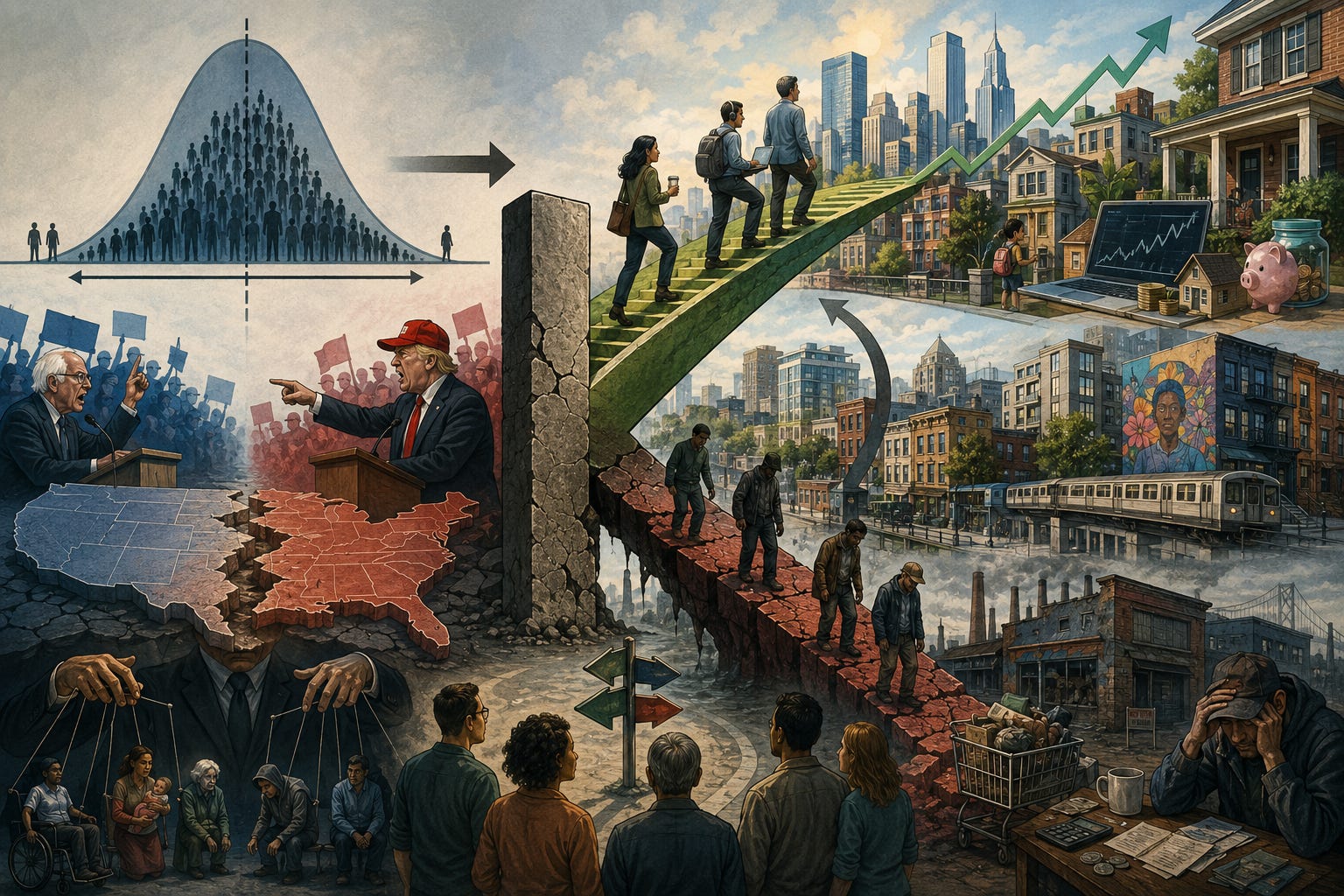
There’s a picture of America that the left and the right both still operate from, and it’s wrong. It’s been wrong for about fifteen years. Both sides keep drawing their battle lines on a map that no longer matches the terrain, and they keep losing for reasons they refuse to examine—because examining them would require admitting the map is gone.
The old picture was a bell curve. The middle class was the fat part—the highest concentration of people, the center of gravity of the whole country. Politics was simple arithmetic: find the median voter, speak to the median experience, win. The working class was large, the wealthy were small, and the poor were the tail. You could draw a straight line from economic grievance to electoral majority. The numbers worked.
That picture is dead.
What replaced it is called a K-shaped economy, and if you want to understand why every populist campaign—left or right—keeps running into a wall it can’t explain, this is the wall.
What K-Shaped Actually Means
When COVID hit and the economy convulsed, economists started using the term K-shaped recovery to describe what was happening. A normal recovery looks like a V or a U—everything falls, everything comes back together. A K-shaped recovery splits. One arm goes up. The other goes down. The people on the upper arm did better than they’d ever done. The people on the lower arm got worse. And the middle—the fat part of the old bell curve—got divided between the two arms and largely ceased to exist as a unified class.
But this wasn’t just a COVID phenomenon. COVID accelerated something that had been building for two decades. The middle class didn’t evaporate. It bifurcated. Half caught affluenza—the professional class, the remote-work class, the asset-owning class, the people whose net worth went up during a pandemic because they owned a house in a market that exploded and had a 401k that recovered in eight months. The other half caught the opposite—call it poorluenza—the people whose jobs were physical, local, non-exportable, and either disappeared or stagnated while everything they needed to buy got more expensive.
Here’s what the numbers actually show: the upper-middle class now represents 31% of all U.S. families, up from just 10% in 1979. For the first time in American history, more families are above the core middle-class threshold than below it. The old bell curve didn’t hollow out—it boomed upward on one side and collapsed on the other.
And critically—this is the part that breaks both parties’ models—the upper arm of the K is not small. It’s not the top one percent. It’s not a rounding error. It’s a genuinely large slice of the country that is, in every experiential sense, doing fine. Their retirement accounts are intact. Their kids are in decent schools. They own or rent at market rate, pay full price for everything, don’t qualify for any assistance, and have no generational wealth pulling them up—but they’re making it. In a high-cost city like New York, that band runs roughly $120,000 to $300,000 household income. In Arlington, Virginia, it looks similar. These people are not oligarchs. They are not going to Davos. But they are not the aggrieved majority that either Bernie Sanders or Donald Trump keeps describing, and they vote accordingly.
Why This Breaks the Populist Math
Populism—real populism, the word-has-people-in-it kind, from the Latin populus—runs on the arithmetic of the majority. The many versus the few. It works when the many actually share a material condition that the few are exploiting. When the bell curve was intact, that math was approximately correct. The median voter was economically anxious, culturally legible, and reachable through a message about economic fairness.
The K breaks that math in a specific way. It doesn’t eliminate the 80%. It fractures it. The lower arm of the K is real, large, and genuinely aggrieved. But the upper arm—the people who caught affluenza instead of poorluenza—is also large, also part of the 80%, and is not living the grievance the populist campaign is selling. You can’t win on class resentment when a substantial chunk of the class you’re describing is actually pretty comfortable and knows it.
“Voting against their own interests” is the tell. It’s the most condescending sentence in American politics, and both sides use it. What it actually means is: they didn’t vote the way I would have voted for them. It assumes that the speaker has correctly identified the voter’s interests better than the voter has. And the only way to enforce that assumption—to get people to override what they actually want in favor of what you’ve decided is good for them—is authoritarianism. There’s no democratic version of that. A soft despot is still a despot. A despot who reads is still a despot.
The K-shaped economy made this problem structural. The people on the upper arm aren’t voting against their interests. They’re voting their balance sheet. And their balance sheet is fine.
The Vanguard’s Staffing Problem
There’s a related problem on the left specifically, which is that the progressive vanguard long ago quietly retired the actual working class and replaced them with a client base selected for permanent dependency.
The original pitch of left populism was the proletariat—the mass of working people who, organized and conscious of their shared condition, would demand and ultimately take power. That’s a majority. That’s arithmetic. That works.
What happened instead is that the professional-managerial vanguard looked at the actual working class—the 80%, the people with numbers and therefore potential leverage—and got nervous. A genuinely empowered majority doesn’t need a vanguard. Doesn’t need managers. Doesn’t need credentialed translators to convert their suffering into policy. They just vote their interests and the entire apparatus becomes redundant overnight.
So instead you get the permanent triage. The working class got swapped out for a client base carefully selected because it will never consolidate enough power to challenge the managers: the most vulnerable, the most marginal, the most fragmented. People whose condition requires constant expert administration. The tell is Münchhausen by proxy—you don’t keep the child sick because you hate the child. You keep the child sick because a healthy child walks away and you lose your identity, your purpose, your reason for existing. The cure is the threat.
Meanwhile the actual K-shaped upper arm—the functional middle that is neither destitute nor wealthy, that pays full freight and asks for nothing and just wants the machine to work—has no natural home in this arrangement. The left’s client coalition doesn’t include them. The right’s donor class doesn’t represent them. Populism on both sides keeps describing a bell curve that no longer exists.
What This Means for New York Specifically
Take Zohran Mamdani’s New York as a case study, because it crystallizes everything.
Mamdani is running a genuinely left-populist campaign in a city that has been systematically emptied of the people that campaign is nominally for. Brooklyn didn’t gentrify itself—it displaced every Puerto Rican, Haitian, and Latin American family that was there first, priced them out borough by borough, neighborhood by neighborhood, across two decades of rising rents and falling affordability. The same thing happened to Capitol Hill in Washington. The same thing is happening across every major American city. The vanguard moved in. The clients got pushed to the exurbs.
Here’s the timing problem: the border tightened, so the new wave of low-income immigrants that previously needed the housing assistance the city provides is slowing. The people who were already displaced are gone. The ones who remain in the five boroughs increasingly occupy that $120k–$300k functional-middle band. If Mamdani’s free programs come online by 2027 as promised, they may arrive in a city that has already completed its displacement—a city where the people who needed those programs most no longer live there to use them.
What you end up with is a socialist program that functions as the most effective gentrification engine in New York history. The city becomes affordable—but affordable for people making $150,000 to $300,000 a year, which in New York is genuinely middle class. The poor got moved. The programs arrive for the people who didn’t need them as badly. And it will have a socialist’s name on it.
You can’t win an affluenza fight with a poorluenza message. The math doesn’t work anymore. Half the middle class is on the wrong side of the K to hear it.
Remediation: What Would Actually Work
If the bell curve is gone and the K is the new reality, then the political playbook has to change. Here’s what that looks like:
Stop running against the upper arm. The comfortable 30–40% of the former middle class are not villains. They are not the ruling class. They caught a lucky break in the bifurcation and they know it and they feel weird about it and they are not going to vote to punish themselves for surviving. A coalition that treats them as class enemies will lose. A coalition that treats them as potential allies—people who have a stake in a stable, functional society and don’t particularly want to live in a country that’s visibly falling apart at the bottom—might not.
Run on the K itself. Nobody has named the split directly and honestly in terms a normal person recognizes. “K-shaped economy” is wonk language. But “half the middle class made it and half didn’t and the people who made it are afraid of becoming the people who didn’t” is something everyone understands. That’s the message. That’s the actual shared anxiety that crosses the K.
Stop pretending the vanguard serves the proletariat. The left specifically needs to reckon with the Münchhausen problem. A political movement that has confused its clients with its constituents—and has structured itself to keep those clients dependent because a healthy client is an existential threat—is not a left movement. It’s a management consultancy with better branding.
Accept that every politician is 20%. Trump is a rich man’s son. Sanders is a rich man’s senator. Fetterman is a rich man’s son. The 20% always governs. The question is who they’re accountable to. Accountability is a function of who can replace them. A genuinely organized majority can replace anyone. A fragmented client base cannot replace anyone. That’s the whole game.
FAQ
Isn’t the K-shaped economy just a COVID thing?
No. COVID accelerated a bifurcation that had been building since at least the 2008 financial crisis. The asset-owning class recovered from 2008 in roughly two years. The wage-earning class took a decade. COVID repeated the pattern at double speed. The K was already there; the pandemic just made it visible.
Doesn’t this just mean the rich are getting richer?
Not exactly. The top 1% and the top 10% are different animals. The K-shaped split happened inside what used to be called the middle class—between the professional-asset-owning half and the wage-dependent half. The billionaire class is a separate phenomenon sitting above all of this and distorting every statistical average you try to use to describe it, which is why you have to strip the outliers out to see what’s actually happening to normal people.
Isn’t $120,000–$300,000 still a lot of money?
In most of America, yes. In New York City, Washington DC, San Francisco, Boston, or Seattle, it is the price of participation—of renting a two-bedroom, paying for childcare, saving anything for retirement, and not qualifying for any assistance. The cost of being a full participant in the market economy in a major American city has risen faster than wages for this entire band. They feel squeezed because they are squeezed. They’re just squeezed from above, not from below.
What does this mean for populism?
Populism still works—but only if it correctly identifies who the people are in the current map, not the old one. The people are not a unified aggrieved majority anymore. They’re a fractured majority with one arm doing okay and one arm not. A populism that speaks only to the lower arm will ceiling out. A populism that speaks to the anxiety shared across the K—the fear of falling, the sense that the system is rigged against everyone who isn’t already at the top of the top—might actually get somewhere.
Glossary
K-shaped economy: An economic recovery or condition in which different segments of the population diverge sharply—one group recovering or thriving while another continues to decline—producing a shape resembling the letter K when charted over time.
Affluenza: Informal term for the condition of the upper arm of the K—people who, through asset ownership, professional-class employment, or fortunate timing, emerged from economic disruption better off than before. Not the same as wealthy. Just not hurting.
Poorluenza: The opposite condition—people on the lower arm of the K whose wages stagnated, whose jobs disappeared or became precarious, and who experienced inflation as an assault on a budget that was already tight.
Bell curve (political): The old model of income distribution in which the middle class was the largest single group, making it both the median voter and the natural target of any majority coalition. Largely obsolete as a description of the current United States.
Vanguard: In Marxist theory, the educated leadership class that guides the working class toward political consciousness. In practice, the professional-managerial class that administers progressive politics and has largely substituted a dependent client base for the working-class constituency the theory requires.
Münchhausen by proxy (political): A condition in which a political movement maintains its identity, funding, and reason for existence by keeping its constituents dependent rather than empowered. The cure—a genuinely organized, self-sufficient majority—is an existential threat to the caretaker.
Functional middle: The band of households that pay full freight for everything, receive no subsidies or assistance, own no significant assets beyond a retirement account, and are one serious financial shock away from the lower arm of the K. In major American cities, this runs roughly $120,000–$300,000 household income. In the rest of the country, lower.
Voting against your own interests: The most condescending sentence in American politics. What it means in practice: the speaker has decided they know the voter’s interests better than the voter does. See also: vanguard, Münchhausen by proxy.