
The Making an Example Of
Deterrence was never supposed to be universal. That’s what makes it work.

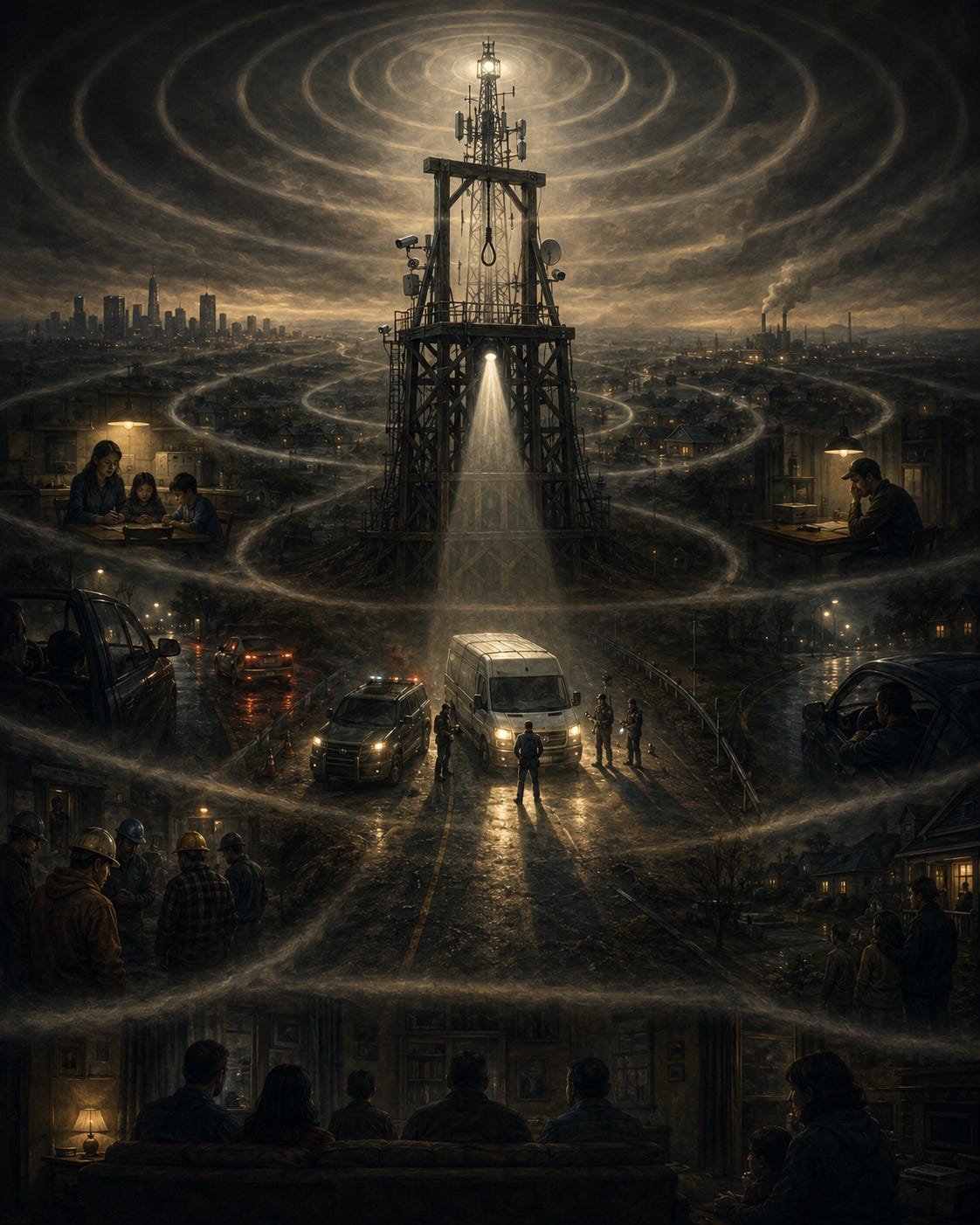
Nobody enforces a rule against everybody. Nobody ever has. The trick, as old as any state that’s ever existed, is that you don’t need to. You need one or two visible, vivid, unmistakable cases, and the story of what happened to them does the rest of the enforcement for you, traveling further and cheaper than any patrol officer, any inspector, any agent ever could. That’s not a flaw in how deterrence works. It’s the entire mechanism.
The scaffold didn’t need to hold everyone
Public executions weren’t practical crime control by volume. They were never going to catch every thief in the kingdom. What they did instead was make sure that everyone who couldn’t attend still heard about it, in vivid enough detail that they could picture themselves there. Foucault’s whole point about the spectacle of punishment is that the state stopped needing to enforce against every single violation once it got good enough at making a small number of enforcements terrifying and memorable. The scaffold was a broadcast tower, not a dragnet.
Criminology has a cleaner name for the same idea now: general deterrence, the theory that punishing one offender sends a message to everyone who hears about it, distinct from specific deterrence, which is just about stopping that one person from doing it again. The research on this is actually pickier than the folk version, severity alone barely moves the needle if people don’t believe they’ll get caught, certainty matters more than harshness, but the core insight survives: a punishment doesn’t need to be applied at scale to function at scale. It needs to travel.
You don’t need volume, you need visibility
This is where the intuition people reach for backwards. “If this were really systemic, there’d be way more cases” sounds like a reasonable check on a claim, and sometimes it is. But if the actual mechanism at work is deterrence-through-example rather than blanket enforcement, then a small number of highly visible cases is exactly what the theory predicts, not evidence against it. The theory doesn’t need every violation punished. It needs enough of them punished, loudly enough, that everyone extrapolates the rest for free.
Mexico’s own accounting of deaths tied to ICE custody and enforcement operations, at last count, seventeen Mexican nationals, only a handful of whom, Lorenzo among them, ever became a name most people recognize. The other names didn’t travel the same distance. That’s not proof the mechanism is smaller than people fear. It’s what the mechanism looks like when it’s working exactly as designed, a small number of cases doing the broadcasting so the state doesn’t have to enforce against everyone individually.
Whether it was him, or whether it just had to be someone
There’s a sharper test hiding underneath all this, worth asking about any case that ends up carrying the weight of a whole population’s fear: did it matter that it was specifically this person, or would any sufficiently visible person have done the same work. A personal vendetta terminates in the person it’s aimed at. An exemplary punishment uses the person as a delivery mechanism, and would have used someone else just as readily if the cameras and the timing had lined up differently.
I don’t know which one Lorenzo was, and neither does anyone reading this. But the question itself is the useful part. If the case mattered because of who he specifically was, that points toward something narrower, an individual failure, a single bad decision by a single agent on a single day. If the case mattered mostly because someone in that position, driving that kind of van, with that kind of record, was always going to become the name eventually, that points toward the exemplary function instead, a mechanism that doesn’t need any particular person, just a sufficiently visible one, on a sufficiently regular basis.
The line between deterrence and misconduct
None of this is a defense of any particular use of force, and it’s worth being precise about where the theory stops functioning as description and starts functioning as excuse. Legitimate general deterrence operates through lawful, proportionate consequences, consistently and transparently applied, a conviction, a sentence, a documented enforcement action that happens to become widely known. It is a different thing entirely from excessive force, false arrest, or deliberate indifference dressed up after the fact as “sending a message.” The theory explains why a state doesn’t need universal enforcement to shape behavior. It does not, on its own, justify whatever specific action produced the visible case. Those are separate questions, and collapsing them, either by excusing brutality as “necessary deterrence” or by dismissing all deterrence as inherently brutal, gets the mechanism wrong in both directions. Fear can be causally effective without being morally clean, and identifying the mechanism a system runs on is not the same thing as applauding it. None of this requires liking the scaffold, or the broadcast, or whoever built it.
Why the story needs a name, not a headcount
What makes an example stick isn’t the raw number of people it happened to. It’s whether the case has the specific features that make it travel: a name, a face, a family that speaks publicly, a government willing to escalate it diplomatically, a detail vivid enough to lodge in a stranger’s memory, driving a van full of coworkers, thirty-five years without a single infraction, a wife saying I can’t believe you shot her. Cases without those features happen just as often, sometimes more often, and simply don’t become the story anyone tells. That’s not a conspiracy. It’s just how narrative travels versus how enforcement actually gets distributed, two different curves that only sometimes overlap.
This is old enough that it predates every current headline. It’s why one public flogging outlasted a thousand private ones in the memory of a village. It’s why a single viral video does more to change behavior nationwide than ten thousand unremarked encounters that ended exactly the same way. The individual case is never really about the individual, not for the state doing the enforcing and, uncomfortably, not always for the public doing the remembering either. It’s about everyone who wasn’t there, extrapolating from a story instead of an experience, exactly the way the mechanism was built to make them do.
As an event, a case like this happens once, on one day, to one person. As infrastructure, it doesn’t stay contained to that day at all. It moves into other people’s decisions long after the fact, into a family’s calculation about which route to drive, a sentence passed down as a warning at a kitchen table, a hesitation nobody can quite explain that traces back to a name they heard once and never forgot. The state acts a single time. The name it leaves behind keeps working long after the state has moved on to the next thing.