
The Sporting Fallacy
Why "it was good while it lasted" beats "no way, piggy" every single time.

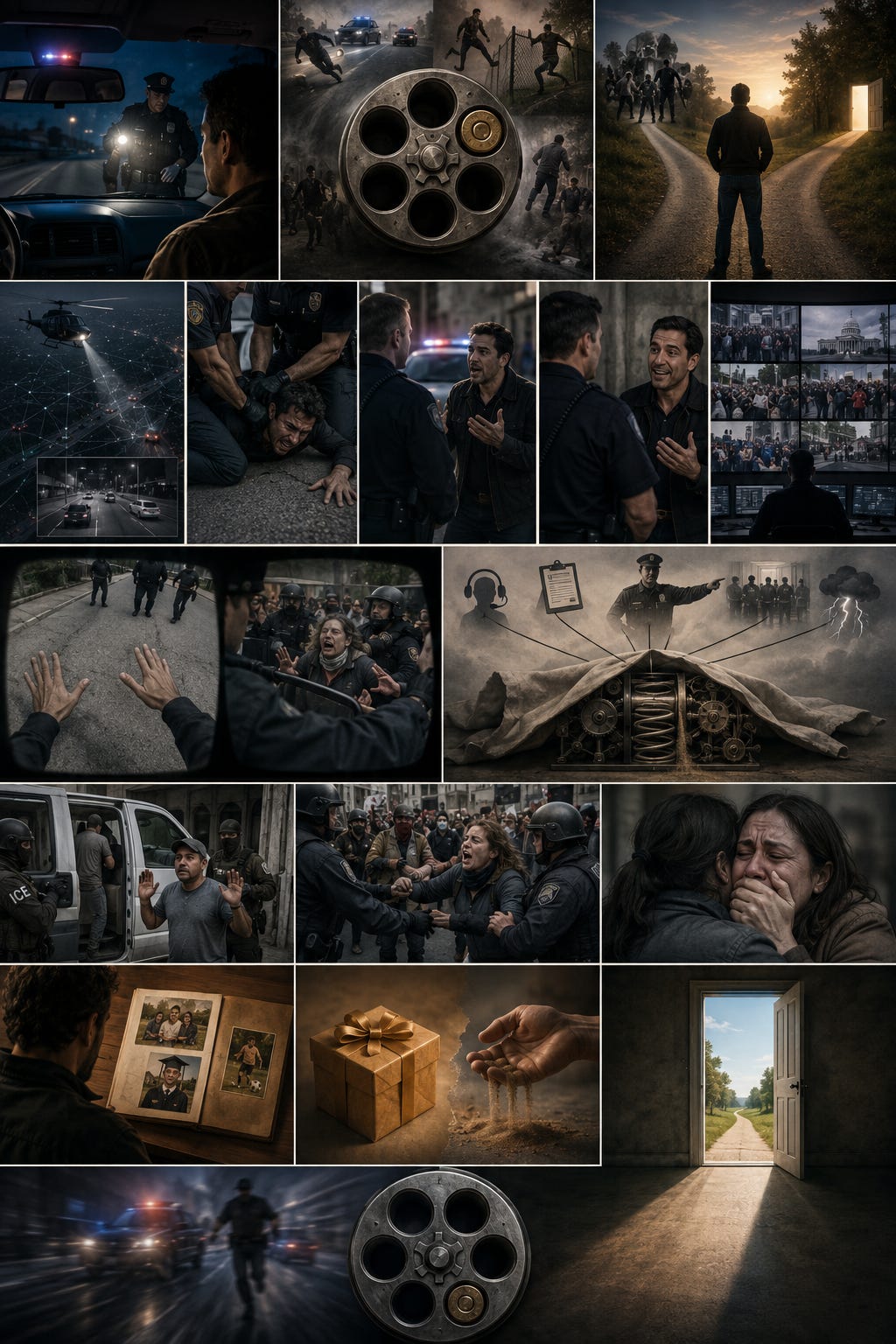
There is no game. That's the whole essay. People keep encountering the state, a cop, an ICE agent, a judge, a prosecutor, believing there's a sporting chance buried somewhere in the exchange, some clever move, some fast car, some right combination of words, that lets them win outright. There isn't. There never was. The only move that reliably works is the unglamorous one: comply, be efficient, be convivial, get out. Everything else is a spin of the cylinder, and the cylinder doesn't care how you got there.
I've spent my whole life being the guy who says "well, it was good while it lasted." Thirty-five years of a clean record isn't a fortress to me, it's a run. A good one. But a run. Other people experience the same thirty-five years as an entitlement, a thing that's owed to them now, a debt the universe has to keep paying out. I think that's the actual fork in the road that determines who survives an encounter and who doesn't: the people who think a happy life is a gift are the ones who can walk away from a bad hand. The people who think it's an entitlement are the ones who gamble everything rather than accept the hand is over.
Where the sporting idea comes from
Nobody invents the belief that evasion is winnable on their own. It's inherited. Decades of car chases that end with the hero screeching into an alley, lights off, heart pounding, safe. Foot chases where the guy hops the fence and disappears into the crowd. Cheech and Chong bailing out of a van in the chaos and scattering into the trees, laughing. Fiction has never once shown you what actually happens after the credits roll, because what actually happens is boring, or it's fatal, and neither makes a satisfying third act.
So when the moment comes, the brain doesn't consult the data. It consults the genre. Federal researchers surveying people who fled from police found that sixty-four percent believed they would get away. Not a fringe delusion. The median belief. That's the sporting fallacy's actual footprint, not rare, not stupid, just universal and wrong.
The DUI panic, scaled up
Here's the mechanism, and it isn't really about cops at all. It's about guilty knowledge plus existential stakes. Someone who's had three drinks knows exactly what the officer is going to find if this goes normally, and knows exactly what it costs: license, job, maybe the marriage, maybe the kids' custody arrangement. The fear isn't really about the DUI charge. It's about the cascade behind it. That fear, not intoxication, not the substance itself, is what hijacks the prefrontal cortex, tunnels the vision down to the open lane in the windshield, and convinces someone with a point-three percent chance of actually getting away that this is the one time it'll work.
Now take that same mechanism and scale the stakes. A person who's been in this country for thirty-five years, has three American citizen sons he put through college, has never had so much as a criminal record, gets pulled over by federal agents. He knows what they're looking for. He knows what's on the other side of full compliance: not a fine, not a night in jail, but the end of everything he built. The panic isn't irrational. It's the DUI mechanism with the dial turned as far as it goes, because the thing waiting behind compliance isn't inconvenience, it's total loss. Whatever was happening in his head in that van, hero, farce, blind panic with no script at all, it was running on the exact same wiring that makes ordinary sober people do insane things at ordinary traffic stops. He wasn't reckless. He was a data point on a curve that's fully predictable once you understand what he stood to lose.
Four things that don't work, and one that only works after
Speed. Ubiquitous cameras, ALPR, helicopter thermal ended this game entirely. There used to be a real chance a good driver could disappear. Now you can't outrun a database. The jig-jag down the exit, the lights-off wait in a side neighborhood, that's a strategy from an era that's over, and the people still running it are playing a game with no win condition left.
Resistance. Fighting doesn't get you free, it gets you Graham v. Connor, the standard that judges an officer's force by objective reasonableness in the moment, not by hindsight. Struggle hard enough and you might fall and crack your skull on the pavement. Grab for a weapon and you've crossed from ambiguous to unambiguous, the one signal that almost universally triggers an immediate, intentional, lethal response.
Argument. This is the quieter version of the same fallacy, verbal instead of physical. "I didn't do anything." "I want a woman officer." "I have mental illness." "Do you know who I am." Every one of these is a real concept, but they're courtroom concepts, they operate on due process and evidence weeks later, not on an officer's next-ten-seconds decision. A beat cop, a judge, a prosecutor has heard every version of this a thousand times from a thousand people who felt exactly as unique as you do right now. That's not callousness. It's pattern recognition doing exactly what it evolved to do. You only get to be a singular, beloved child of God to the people who actually love you. The system was never built to see you that way, and no amount of charm converts one register into the other in real time.
Charm. Same problem, warmer packaging. It doesn't work in the moment for the same reason argument doesn't. And critically: it does nothing at all for the dead. There is no win available to someone who's already gone, only better or worse outcomes for the people left standing.
The one thing that does work, but only after the fact: the news cycle. Public narrative, sustained outrage, political pressure, these can force accountability, change policy, win a lawsuit, retroactively vindicate a name. But that's leverage on the institution from the outside, working on a timeline of weeks or years. It has never once, not one time, saved the person in the encounter itself.
The camera doesn't take sides, but it isn't blind either
Ubiquitous recording ended more than one sporting fantasy at once. It killed the "swoop and squat" insurance scammer's staged crash. It killed the slip-and-fall grifter's foolproof payday. Citizen complaints against police dropped sharply the moment body cameras rolled out, because a lot of complaints, it turns out, were their own kind of sporting move. Total transparency doesn't pick a side. It just ends every performance simultaneously.
Except it isn't perfectly blind. A body camera is mounted on the officer's chest, which means the footage is a first-person shot of the citizen's flailing arms, screaming, advancing threat, and it can't see the officer's own face, own fear, own overreaction. The eye exists somewhere. Where it's strapped changes whose fear the jury feels. Cameras closed the citizen's casino almost entirely. They left the house odds on the other side mostly intact.
Pop goes the weasel
The revolver in this essay's title metaphor is true randomness, six chambers, one bullet, no bias, once you've decided to spin it. But there's a second mechanism running underneath every encounter that isn't random at all, it's just invisible. Whether a given stop "pops" often has nothing to do with the person being stopped and everything to do with things they can't see: how many calls that shift, whether a sergeant said make an example of somebody this week, whether this particular officer is at the end of his leash on a bad day. It feels like a dice roll from the outside. It's actually a wound spring, tightened by pressures that predate the encounter entirely. Nobody chooses to be the example. The system just periodically needs one, the way it has since long before America existed, a public, visible severity that lets the state stop enforcing against everyone by terrifying everyone with what happened to someone.
X, Y, Z
Lorenzo. Renee. Alex. Three separate tests of the same fallacy in three different contexts, not one story told three times.
Lorenzo Salgado Araujo was pulled over by ICE agents in Houston who, DHS later admitted, weren't even looking for him, they were searching for two different men entirely. Whatever happened in that van, whether he thought he could get his work crew to safety, whether it was closer to a farce, whether it was pure animal panic with no plan behind it at all, he may not have even understood what was happening to him well enough to be running any script. He wasn't playing a game. He may not have known there was one being played around him.
Renee and Alex come from a different terrain entirely, the protest encounter rather than the solo traffic stop, a crowd dynamic instead of one vehicle and one agent. Different actors, different stakes, same underlying assumption: that defiance carried a survivable cost, that pulling back was always still an option.
Renee's wife said the thing that belongs at the center of all three: I can't believe you shot her. That's the sound of someone who believed, right up until the moment she was proven wrong, that there was a game being played with rules, and that following them, whatever "following them" meant to her, would be enough.
The gift, not the entitlement
I have aphantasia and severely deficient autobiographical memory. I don't get to replay my own past as a felt experience, I mostly just know that it happened. I wonder sometimes if that's part of why I can say "it was good while it lasted" without much of a fight in me. Thirty-five years doesn't loop behind my eyes as a movie I'm mid-scene in. It's closer to a ledger entry. Easier to let go of a number than a feeling.
But I don't think that's required to reach the same place. I think it's just a belief, available to anyone: a happy life is a gift, not an entitlement. If you think it's owed to you, its ending feels like theft, and theft is worth fighting, worth gambling everything to reverse. If you think it was never owed, its ending, even a cruel and premature one, isn't a rupture of the natural order. It's just the gift running out sooner and uglier than you'd have chosen. Not deserved. Never was.
Compliance isn't submission. It's recognizing there was never a game to win in the first place, only a cylinder, spinning whether you engage with it or not, and a door out that was open the entire time, the whole while you were looking for another way.