

The most successful international development program in the world may be the one nobody invented.
It has no headquarters in Washington, Geneva, Paris or New York. It has no president, no board of governors, no annual donor conference, no five-year plan and no mission statement. Nobody flies business class to a resort hotel to discuss stakeholder engagement. There are no consultants producing a 140-page report explaining what the recipients need before the recipients are allowed to receive it.
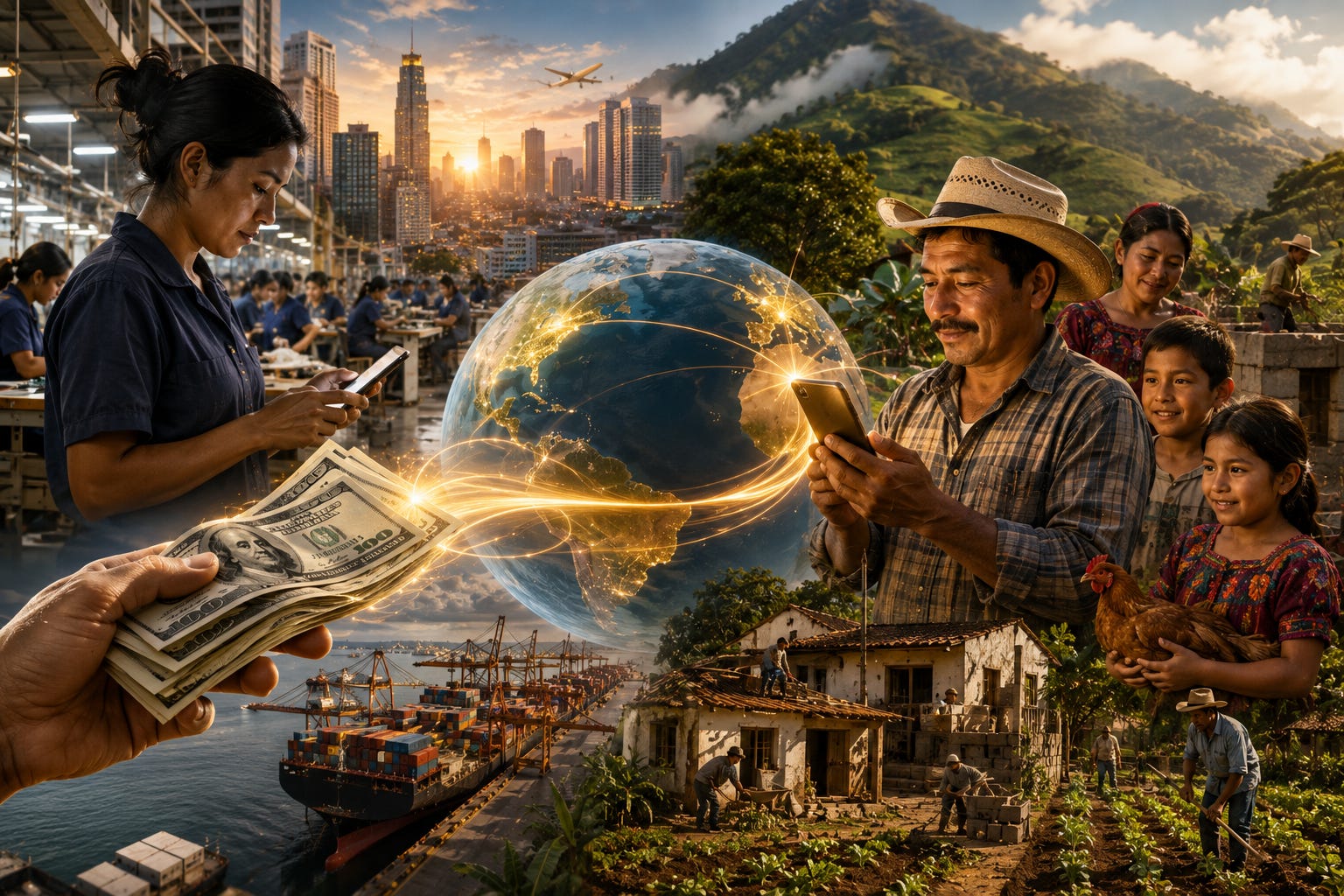
It is a roofer in Virginia sending $500 to Guatemala.
It is a nurse in London sending pounds to Nigeria. It is an Indian engineer in California sending dollars to his parents. It is a Pakistani cabdriver in Chicago, a Filipino caregiver in Toronto, a Bangladeshi restaurant worker in Queens, a Moroccan in France, a Salvadoran in Maryland. It is somebody getting paid in a rich economy and sending part of the money to somebody he knows personally in a poorer one.
We call these transfers remittances, which may be one of the dullest words ever invented for one of the largest voluntary transfers of wealth in human history.
The World Bank estimated that officially recorded remittances to low- and middle-income countries reached $685 billion in 2024. The real number is larger because money traveling through informal channels does not necessarily appear in the official totals. India alone was expected to receive $129 billion, Mexico $68 billion, China $48 billion, the Philippines $40 billion and Pakistan $33 billion. In Tajikistan, remittances were estimated at 45 percent of GDP. In Tonga they were 38 percent. In Nicaragua and Lebanon, 27 percent.
Then comes the number that should rearrange the furniture in every conversation about international development: according to the World Bank, remittances to low- and middle-income countries have grown larger than foreign direct investment and official development assistance combined. During the decade leading into 2024, remittances increased by 57 percent while foreign direct investment declined by 41 percent.
The world's poor did not wait for us to solve development.
Their relatives got jobs.
Mamá needs $400
There is an important difference between institutional development money and a remittance that has nothing to do with whether the people working at the World Bank, IMF, USAID or an international NGO are good people. I assume most of them are trying to accomplish exactly what their institutions say they are trying to accomplish.
The difference is informational.
If I want to improve the life of a family in rural Guatemala from an office in Washington, I first need to determine what the family needs. I need data. I need criteria. I need a program. I need a mechanism for distributing the money. I need accountability. I need to determine whether the program worked. Somewhere in this process there will eventually be a person whose roof leaks.
The woman's son already knows the roof leaks.
Mamá needs $400.
Send $400.
That is the entire needs assessment.
Remittances have an extraordinary informational advantage because the sender and recipient generally know one another. The migrant does not need to commission a poverty survey to discover that Dad needs medicine, his sister needs school fees, the roof needs repairing or somebody needs $2,000 to buy equipment for a tiny business. The family has information that no development institution could acquire at comparable cost because they live inside the problem.
The IMF itself describes remittances as unusually targeted toward recipient needs and notes that research has repeatedly associated them with poverty reduction. World Bank research has found that remittances help households smooth consumption during shocks, ease working-capital constraints for farms and small businesses, and increase spending on education, health, entrepreneurship and property.
This is development without the development industry standing between the money and the person.
No debt, no austerity, no application
A World Bank loan and $500 sent home by your daughter are not substitutes. Governments need infrastructure. Countries sometimes need financing on a scale that families obviously cannot provide. Nobody is building a national electrical grid because Uncle José sent money from Houston.
But at the level of the household, remittances possess features institutional finance cannot reproduce.
There is no repayment schedule.
There is no interest rate.
There is no structural adjustment program.
There is no requirement that the recipient privatize the electric company, reform the pension system, cut a subsidy, change the tax code or satisfy a lender before the next tranche arrives.
There is not even necessarily a requirement that the money be spent wisely.
That last part matters more than it appears.
Development institutions understandably want to make sure development money is used for development. A brother sending money to his sister trusts his sister to decide what development means this month. Maybe it is tuition. Maybe it is antibiotics. Maybe it is concrete. Maybe it is a refrigerator. Maybe it is repaying an ugly local debt. Maybe it is a motorcycle that makes a job possible. Maybe it is chickens.
The recipient possesses the money and therefore possesses the decision.
That is not merely economic assistance. It is autonomy.
Cash changes who you have to ask
Money is power in the most boring and immediate sense of the word. It expands the number of things you can do without asking somebody else.
If you live close to subsistence, your choices can be controlled by whoever controls access to work, food, credit, land, transportation or government assistance. That person may be a perfectly decent employer or official. He may also be a landlord, political boss, local oligarch, corrupt official, predatory moneylender, abusive relative, cartel, landowner or whoever happens to control the narrow economic passage through which you must travel.
Then your daughter starts sending dollars every month.
Nothing magical happens. You are not suddenly rich. The government does not disappear. The local strongman does not evaporate in a puff of smoke.
But perhaps you no longer need his loan.
Perhaps your child can attend a different school. Perhaps you can pay transportation to a city where the jobs are better. Perhaps you can survive long enough to tell an employer to go to hell. Perhaps you can buy fertilizer instead of owing part of the harvest to the person who financed it. Perhaps you can repair your house without asking a politician for a favor. Perhaps you can accumulate enough cash to become the person who owns the tiny store instead of the person who buys on credit from it.
That is why I think remittances are politically more interesting than we usually admit.
The World Bank describes strong evidence that they reduce poverty, and the IMF has found that remittances can help households maintain consumption particularly during periods of fiscal consolidation. That sounds bloodless until you translate it into ordinary life.
When the government tightens its belt, your cousin in New Jersey does not necessarily tighten yours.
The migrant monetizes the village
There is another form of remittance that we often fail to recognize because the money never crosses an international border.
A young person leaves a subsistence village and gets a factory job in a manufacturing center. Maybe she assembles electronics. Maybe she makes clothing. Maybe she works in food processing or automotive parts. Her parents have spent much of their lives producing things they consume themselves or trading inside a local economy with very little cash.
Then money starts coming home.
This changes more than the family's consumption. It monetizes choices that previously did not exist.
Cash buys fertilizer, tools, animals and building materials. It makes it possible to pay somebody else for labor. It creates customers for the little shop. It gives somebody a reason to start a transportation service. It pays school fees. It produces savings. It may eventually become land.
You can criticize global supply chains until everyone involved is blue in the face, and plenty of criticism is deserved. Factory labor can be brutal. Workers can be exploited. Communities can lose their youngest and strongest people. A village that once depended on a landlord may become dependent on a factory 400 miles away.
But dependence has changed shape, and sometimes the new dependence gives the worker more bargaining power than the old one.
The ability to leave is itself an economic asset.
Hermano bought the farm
My favorite example lives in my building.
I call him Hermano. He is Guatemalan, works construction, drives an old Toyota Tundra, smokes too much, drinks too much and remains convinced that I need to accompany him to Guatemala so that somebody can find me una novia. I remain unconvinced about the final proposal.
If you look only at his American balance sheet, you could construct a very persuasive story about deprivation. He rents here. He works with his body. He does not possess the visible portfolio of assets Americans associate with arrival.
Then you look south.
Hermano bought a farm in Guatemala with the money he earned here. He built the family compound. His extended family lives on it. The farm did not precede the migration as some ancestral estate he occasionally helps maintain. The migration produced the farm.
In America he can look like a working-class immigrant in an old truck.
In Guatemala he is the lord of the manor.
The mistake is assuming that the apartment in America represents his wealth. It may represent his overhead.
The wealth went somewhere else.
That is remittance economics in one human being. Labor performed in a high-wage economy becomes capital in a lower-cost one. The difference between what his work can command here and what those dollars can purchase there becomes land, buildings and security for people he loves.
No NGO bought Hermano's farm.
No development bank bought Hermano's farm.
Hermano bought the fucking farm.
This is soft power nobody has to administer
There is another consequence of all this money moving around the world that receives remarkably little popular attention.
Remittances connect households in poorer countries directly to the economic health of richer ones.
If your son works in America and sends dollars, you now have an interest in his continued ability to work in America. You have an interest in the dollar retaining purchasing power. Your local bank and money-transfer businesses have an interest in systems capable of moving dollars. Merchants become accustomed to receiving money ultimately sourced from the American economy.
The dollar travels home even when the worker does not.
Nobody needs to have designed this as an American soft-power strategy for it to function as one. Hundreds of millions of family relationships can accomplish what a propaganda campaign cannot: they make the prosperity of the United States materially relevant to households that may never contain a person who has visited it.
The migrant does not simply send dollars.
He exports demand for dollars.
The same thing happens with euros, pounds and currencies earned in other wealthy labor markets, but the scale and international role of the dollar make the American case particularly interesting.
Unlike a conventional aid program, this influence is radically decentralized. There is no single faucet to shut. Formal transfers can be regulated, taxed or made difficult, but people have been moving money across borders for considerably longer than Western Union has existed. Cash, informal transfer networks, digital payment systems and increasingly cryptocurrencies and stablecoins give people additional ways to move value when formal rails become expensive or restrictive.
The international financial system keeps becoming harder to monopolize because the technology keeps becoming easier to carry in your pocket.
The recipients are allowed to waste it
One of the reasons remittances offend the managerial imagination is precisely what makes them powerful.
The recipient is allowed to screw up.
She can make a terrible investment. He can buy the wrong truck. They can lend money to the idiot cousin. Somebody can spend too much on a wedding. Somebody can open a shop that fails after eleven months.
This is normally regarded as a weakness.
I think it is adulthood.
We do not require affluent Americans to demonstrate optimal capital allocation before letting them possess money. We allow them to buy boats they never use, kitchen renovations nobody needed, cryptocurrency at the top, ugly handbags and Pelotons that become clothing racks.
Then we become extremely concerned about whether a poor person in Nicaragua will allocate $500 according to the optimal development model.
Give him the money.
It is his brother's money anyway.
Remittances are not magic
There are costs. Sending money remains surprisingly expensive. World Bank data put the global weighted average cost of sending $200 at about 4.9 percent in early 2025, still well above the United Nations Sustainable Development Goal target of 3 percent.
Heavy dependence on remittances can also produce distortions. A community can become reliant on income generated somewhere else. Young workers leave. Families receiving foreign income may pull ahead of neighbors without relatives abroad. Large inflows can affect exchange rates and labor markets. Remittances are excellent at helping households and considerably less capable of building sewer systems, reforming courts or running a central bank.
None of that makes the phenomenon smaller.
It makes it real.
The World Bank itself describes the aggregate growth effects of remittances as more complicated than their household effects. The poverty-reduction evidence is strong; the question of how that translates into national economic growth contains countervailing forces.
Fine.
I am interested in the household first.
Because nations do not eat dinner.
People do.
Development from below
International development has spent decades asking how rich countries can transfer enough knowledge, capital and institutional capacity into poor countries to accelerate their development.
Migrants discovered another method.
Move the worker.
Let the worker plug into the richer economy. Let him earn a wage that would have been impossible or improbable at home. Then let some portion of that wage travel backward through the family.
The migrant becomes his own tiny multinational corporation.
Production happens in Virginia. Capital accumulation happens in Guatemala. Management is distributed between family members who already know one another. The investment committee may consist of somebody's mother yelling through WhatsApp that the west wall still leaks.
It is messy, inefficient, frequently sentimental, occasionally stupid and almost impossible to centrally control.
That is precisely why I love it.
We have spent generations designing institutions to lift the global South from above while millions of ordinary people quietly built an enormous development system from below.
They migrated.
They worked.
They sent money home.
They bought medicine and tuition and fertilizer and concrete and motorcycles and chickens and land. They built houses. They supported children. They kept parents alive. They opened shops. They accumulated assets. They transformed American dollars and European euros into decisions that somebody else no longer got to make for them.
The World Bank can measure it. The IMF can study it. Governments can regulate it. Economists can argue about its macroeconomic effects.
But nobody owns it.
Somebody's daughter gets paid on Friday.
Mamá needs $400.
Send $400.