
Two Sets of Books
How the climate movement learned to keep one ledger for the public and another for the back office

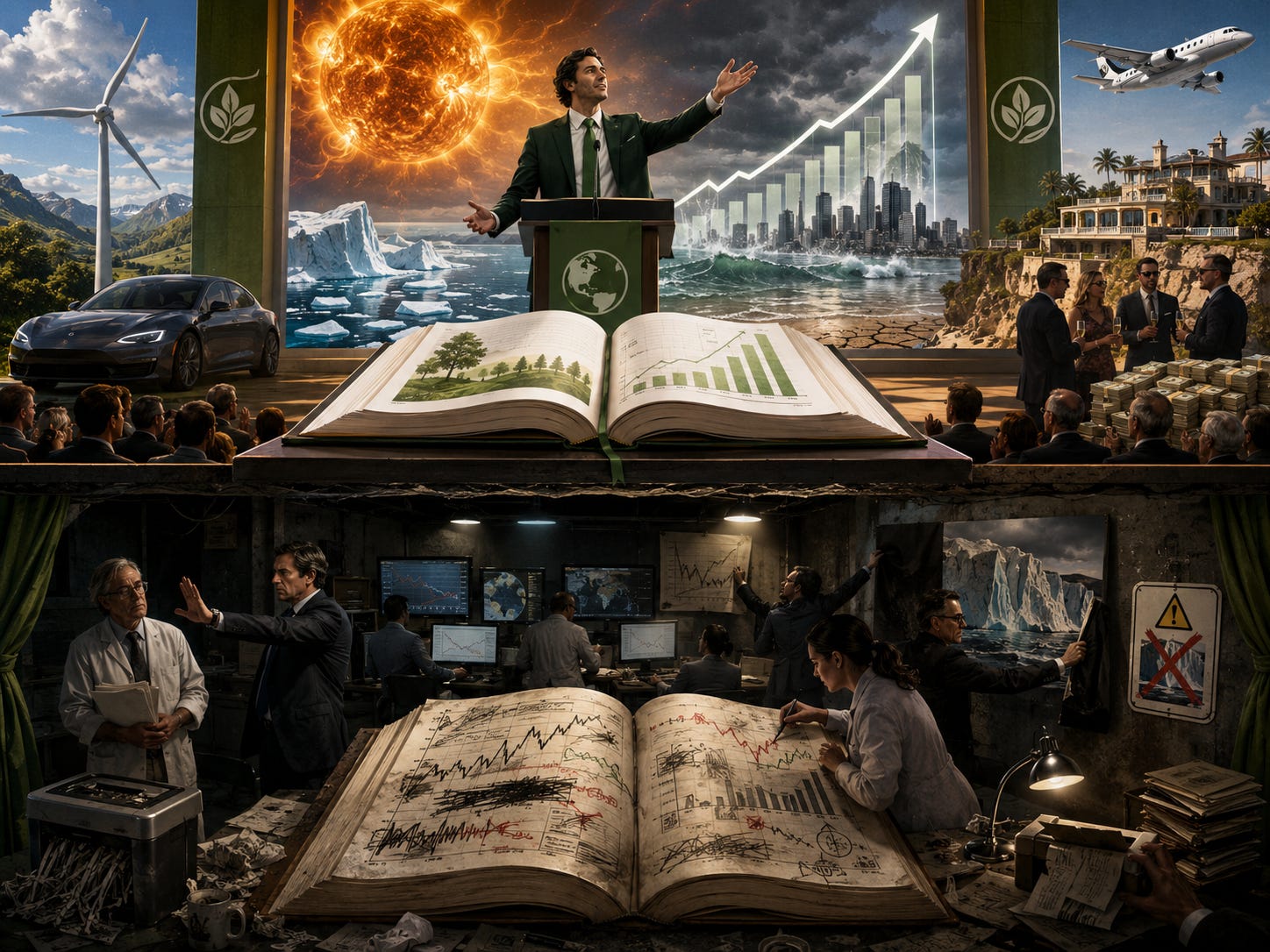
Twenty years ago this month, Al Gore stood in front of a movie screen and told the world it had roughly ten years before Earth’s ecosystems crossed a point of no return. The film was An Inconvenient Truth. It won an Oscar. Gore won a Nobel. The ten-year deadline came and went in 2016 without incident, and Gore has since been spotted at a Hollywood sustainability gala invoking The Day After Tomorrow—a sci-fi disaster film he apparently confused during the keynote with a 1983 nuclear war thriller—to warn that a new ice age could arrive within 25 years. Same prophet. New apocalypse. No accountability. No refund of the awards.
I didn’t believe him then. I don’t believe him now. And I want to explain why in a way that doesn’t require you to be a scientist, a policy analyst, or a person who has ever once enjoyed being lectured to at a dinner party by someone who owns a Harley and sells wine in New Haven.
The Wine Guy
About ten years ago I was at a friend’s wedding, talking to exactly that kind of person. Smart enough to have talking points. Confident enough to deploy them at a reception. He knew I was skeptical of the climate narrative and he came at me with the whole toolkit—consensus, urgency, the children, the future, the science.
I told him I didn’t believe in climate change as it was being sold to me.
He paused. Then he said something I’ve never forgotten: “It’s not that you don’t believe in it. It’s just that you don’t care.”
I’ve been turning that over for a decade. And here’s where I’ve landed: he was right, but not in the way he meant it. I don’t care about a manufactured emergency built on a dataset that was cooked in the back office of a university I actually attended. I don’t care about the performed urgency of people whose revealed preferences—their private jets, their oceanfront mansions, their Sydney-to-Fort-Lauderdale commutes—make plain they don’t believe it either. Caring about a lie isn’t a virtue. It’s just credulity with better PR.
But the wine guy put his finger on the real question, which isn’t whether the climate changes. Of course the climate changes. It has always changed. It changed before humans existed, before industrialization, before the combustion engine, before the first cow farted. The question is whether the specific crisis narrative being sold to you is accurate—or whether someone is running two sets of books.
The Ledger They Show You
The public ledger of the climate movement is a clean document. Global temperatures are rising. Human activity contributes to greenhouse gas concentrations. The trend line goes up. Coastal cities will flood. Glaciers will vanish. Polar bears will perish. Act now or face catastrophe.
That’s the set of books you’re meant to see. It’s the Al Gore presentation. It’s the IPCC summary for policymakers. It’s the graph on the conference room screen at Davos, presented by someone who flew in on a Gulfstream IV.
Now let’s look at what’s actually in the back office.
Gore predicted in An Inconvenient Truth that Africa’s Mt. Kilimanjaro would have no snow on it by 2016. In 2026, there is snow, large glaciers, and ice caps on Kilimanjaro. No apology from Gore. Nor any return of his awards. Climate DepotWashington Examiner
Gore predicted Glacier National Park would be “the park formerly known as Glacier” after all ice melted away. The U.S. Geological Survey predicted all glaciers would be gone by 2020. Signs were placed throughout the park warning visitors of impending glacial collapse. The signs had to be removed in 2020 when it became clear the glaciers remained. Climate Depot
And before anyone tries the obvious parry—that the numbers look better because we've done an amazing job, that this is what success looks like—consider what happened in the same period. The world produced more new car owners, more air travelers, more tourists, more fast-fashion consumers, more central-air households, more billionaires, and more millionaires than at any point in human history, inside a population moving toward nine billion that is industrializing faster and deeper than ever. Economists call this the Jevons Paradox: efficiency gains don't reduce consumption, they expand access, which expands appetite, which expands total demand. The global vehicle fleet now exceeds 1.6 billion. Energy-related CO₂ hit record highs in 2024 and 2025. The machine got cleaner per unit. We just built exponentially more units. That's not success. That's better bookkeeping on a larger operation.
Gore stated the Arctic Ocean could lose all of its summer ice by 2013—seven years after the film’s release. He forecast global sea levels could rise as much as 20 feet “in the near future,” complete with visualizations of New York City and Miami underwater. Breitbart
Gore was dubbed potentially the world’s first “carbon billionaire” by the New York Times back in 2009. He was worth less than $2 million when he left the vice presidency in 2001. He has breezily dismissed the inherent conflict of interest in being simultaneously the Visionary Saint of Climate Change and a businessman who turns doomcasting into profit. The public ledger doesn’t have a line item for that. HotAir
Twenty years after his warnings proved false, Gore is still making climate doom predictions—this time invoking The Day After Tomorrow for a Hollywood audience, conspicuously omitting that the “tipping point” deadline he declared in 2006 came and went a full decade ago. David Icke
The predictions failed. The prophet got richer. The ledger stayed closed.
The Man They Had to Destroy
Here’s where it gets instructive.
Roger Pielke Jr. is a climate researcher whose work has been cited by all three working groups of the United Nations IPCC. He is not a denier. Both he and Tom Steyer agree that greenhouse gases warm the climate. Pielke’s published work is peer-reviewed, award-winning, and sits comfortably within the mainstream of climate science. reason
His sin was saying it’s not the apocalypse.
Specifically, Pielke’s research found that while economic costs from extreme weather events were rising, the impacts were not caused by bigger storms but by “what we build, where we build, how much wealth we have in harm’s way.” We’re not getting more violent weather. We’re building more expensive things in the path of the same weather we’ve always had. reason
Steyer funded the Center for American Progress to run hit piece after hit piece describing Pielke’s work as “fantastical falsehoods” and calling him a “disinformer” who “ignores the data on climate science.” The funding arrangement only became known when WikiLeaks exposed an email from ThinkProgress to Steyer: “Thanks for your support of this work…it’s fair to say, without Climate Progress, Pielke would still be writing on climate change.” reasonreason
They were proud of it. They were proud of stopping a scientist from doing science.
The University of Colorado, where Pielke worked for 24 years, closed his research center, canceled his classes, and moved his office into a closet. The Obama White House issued a 3,000-word memo attacking his congressional testimony. He was the only academic any president had ever personally targeted in this way. reason
This is not how you respond to a crank. This is how you respond to someone who has the receipts and is about to show them to people. You don’t need to destroy researchers who are wrong. You need to destroy researchers who are right about the wrong thing.
Two sets of books requires an enforcement mechanism. Pielke was it.
The Novelist Who Read the Footnotes
Michael Crichton read the same literature the climate scientists were reading and arrived at different conclusions. So he did something unusual: he wrote a novel—State of Fear, 2004—that embedded the actual data, the actual citations, the actual IPCC documents inside a thriller narrative. Despite being fiction, the book contains graphs, footnotes, two appendices, and a 20-page bibliography. He wasn’t asking you to trust him. He was showing you the receipts and asking you to check them yourself. epfl
In September 2005, Crichton testified before the United States Senate Committee on Environment and Public Works. He argued for independent verification of research used for public policy and criticized the “hockey stick” study for reasons later confirmed by the Wegman Commission. His core argument wasn’t that climate doesn’t change. It was that science requires independent verification, and the climate establishment had built a system specifically designed to prevent it. Michael Crichton
His testimony was not a wholesale denial of climate change, but a sophisticated challenge to the certainty with which it was often presented and the policy implications derived from that certainty. Discovermagz
The response was exactly what you’d expect from an organization running two sets of books. NASA’s Jim Hansen, cited in Crichton’s novel, sent a preemptive email attack on Crichton the eve of his Congressional testimony. The climate science community mobilized. Crichton was dismissed as a novelist playing scientist—even though he held an MD from Harvard and had spent years in the primary literature. colorado
He died in 2008. The Climategate emails dropped in 2009. He never got to say I told you so, but the emails said it for him.
Climategate and the Back Office
I went to UEA—the University of East Anglia. The Climatic Research Unit was there. I was there when the climate program was young and the CRU was establishing itself as the central node of global temperature reconstruction. The unit that would eventually become the single most important keeper of the temperature record that underpins the entire climate narrative.
In November 2009, right before the Copenhagen climate summit, thousands of emails from the CRU were leaked. What was in them was not fabrication from whole cloth. It was worse, in a way—it was the people who controlled the dataset talking candidly among themselves about what to do with data that didn’t cooperate.
Phrases like “hide the decline.” Discussions about how to handle the Medieval Warm Period, which inconveniently showed temperatures comparable to today’s without any human industrial activity to explain them. Coordination to resist FOIA requests for the underlying raw data. Pressure on journal editors not to publish dissenting work.
This is what two sets of books looks like from the inside. The public ledger shows the clean trend line. The back office shows the arguments about what to do with the data points that don’t fit it.
The official investigations largely exonerated the researchers of deliberate fraud. But they didn’t—couldn’t—address the deeper problem: the people adjusting the dataset, deciding what gets included, smoothing what gets smoothed, are the same people whose careers, funding, and institutional status depend on a particular answer coming out. That’s not science. That’s an audit performed by the auditee.
DC vs. AC, or: The World Is Not Flat
Here’s the physical reality that the public ledger systematically hides.
The climate is not a flat baseline that humans have disturbed. It is an oscillating, layered, cyclical system running on overlapping frequencies simultaneously—Milankovitch orbital cycles operating on 100,000-year timescales, solar output variations, oceanic circulation patterns, volcanic forcing events, the 11-year sunspot cycle layered on longer Gleissberg cycles, coronal mass ejections that can strip atmosphere and alter surface conditions with no warning whatsoever.
The climate is AC. The narrative requires you to believe it’s DC.
If you treat an AC signal as a DC baseline, every wave looks like a deviation. Every crest looks like damage. You can build an entire emergency response apparatus around what is actually just the waveform doing what waveforms do.
Ask a ham radio operator. These are people who live with solar variability as an operational reality. When a solar storm hits, their bands go dead in real time. They track sunspot cycles not as an academic exercise but because it determines whether the radio works today. The sun is not a stable lamp. It is a thermonuclear reactor with cycles within cycles within cycles, producing a constantly fluctuating energy output that bathes this planet every second of every day.
The climate models that get presented to the public treat solar input as essentially a constant with minor variance. Ham operators know from direct experience that this is fiction.
The Carrington Event of 1859 was a direct coronal mass ejection hit that melted telegraph wires and set telegraph paper on fire. If it hit today, we’re talking about a civilization-level infrastructure collapse—satellites gone, grid gone, solid-state electronics across the planet potentially fried. That’s not a human-caused climate event. That’s just Tuesday on a cosmological timescale.
Meanwhile, Hawaii—where I grew up—has the same shoreline it had when I was a child. The alarmists say sea levels are catastrophically rising. I say: same beach, same water line, same tides. What’s actually happening to some coastlines is erosion—a completely different physical process driven by wave action, development patterns, removal of native coastal vegetation, and concrete infrastructure built too close to a dynamic shoreline. They’re running erosion through the climate ledger. Different line item. Different cause. Different solution. But the same set of books.
The Enforcement Mechanism
Every criminal organization running two sets of books needs an enforcement mechanism. You need people who make sure nobody talks about the back office.
For the climate movement, the enforcement is social and institutional rather than physical, but it is no less effective. Anyone who disagrees is labeled a “climate denier”—a term engineered to carry the moral weight of Holocaust denial without the burden of making an actual argument. You don’t have to engage the data. You just apply the label. The label does the work. reason
Pielke got the label, got defunded, got moved to a closet. Crichton got the label, got attacked by NASA on the eve of his Senate testimony, got dismissed as a fiction writer who should stay in his lane—despite his Harvard MD and 20-page bibliography. The CRU resisted FOIA requests for the raw temperature data that the entire edifice rests on. The University of Colorado closed a 24-year research program rather than defend it.
There are now two generations substantially smaller and less mentally healthy because of climate change hysteria. People declined to have children, or limited themselves to one, to prevent their kids from living through an apocalypse that the people selling it don’t actually believe is coming. HotAir
That’s the human cost of running two sets of books. Not just bad policy. Actual people making irreversible life decisions based on a narrative that the people producing it contradict with every flight they book, every coastal mansion they buy, every private terminal selfie they post.
The Columbus Trick
Al Gore is Christopher Columbus telling the natives that if they don’t release him, he will blot out the moon.
Columbus knew the eclipse was coming. He had the almanac. He didn’t cause it, he didn’t control it, but he harvested the credibility of a real astronomical event to run a negotiation he couldn’t win on honest terms.
The climate has always changed. That’s the eclipse. It’s real. Gore didn’t cause it, doesn’t control it—but he had the almanac, and he used it. The predictions were always moonshots, designed to be far enough in the future that accountability was someone else’s problem. By the time the deadline arrived, the prophet had moved on to the next deadline.
The wine guy told me I just didn’t care. He was right that caring is the social requirement—the price of admission to a certain kind of room, a certain kind of conversation, a certain kind of status. You signal that you care and you get to stay at the table.
But I’ve seen the back office. I’ve read Crichton’s footnotes. I attended the university where the emails came from. I grew up on the same Hawaiian beaches that were supposed to be underwater by now. I’ve watched the glacier signs get taken down. I’ve tracked the carbon billionaire’s net worth. I’ve noted who flies private to tell other people to drive electric.
The front ledger is very clean. The back ledger is a mess.
I don’t not care. I just read both sets of books.
APPENDIX: THE RECEIPTS
Specific predictions from An Inconvenient Truth (2006) and their outcomes
Mt. Kilimanjaro: Gore predicted no snow by 2016. In 2026, snow, glaciers, and ice caps remain on the mountain. No correction, no apology. Washington Examiner
Arctic sea ice: Gore stated the Arctic Ocean could lose all summer ice by 2013. Summer ice remains. Breitbart
Sea level rise: Gore forecast sea levels rising as much as 20 feet “in the near future,” with visualizations of New York City and Miami underwater. Current measured rise: a few inches over the century, consistent with pre-industrial trend rates. Breitbart
Glacier National Park: Federal agencies predicted all glaciers gone by 2020. Warning signs were placed throughout the park, then removed in 2020 when the glaciers remained. Climate Depot
Hurricane frequency: Gore connected Katrina to global warming and predicted more frequent intense storms. Pielke’s IPCC-cited research found no observed changes in hurricane frequency or intensity beyond natural variability. reason
The tipping point: Gore declared Earth’s ecosystems would reach a point of no return in approximately ten years. That deadline passed in 2016 without the predicted consequences. Breitbart
On Roger Pielke Jr.
Climate researcher, University of Colorado (24 years). IPCC-cited. Not a denier. Targeted by Steyer-funded Center for American Progress after his research found hurricane damage increases were driven by development patterns, not storm intensification. His research center was closed, his classes canceled. reason
On Michael Crichton
MD, Harvard Medical School. Author of State of Fear (2004). The novel contains graphs, footnotes, two appendices, and a 20-page bibliography. Testified before the Senate Environment and Public Works Committee in September 2005, arguing for independent verification of climate research and criticizing the hockey stick study—a critique later confirmed by the Wegman Commission. Died November 2008. Climategate emails: November 2009. epflMichael Crichton
On Climategate
University of East Anglia Climatic Research Unit. Emails leaked November 2009, weeks before Copenhagen summit. Contents included internal discussion of handling inconvenient data trends, resistance to FOIA requests for raw data, and pressure on journals to exclude dissenting research. Official investigations found no deliberate fraud. They did not address the structural conflict of interest in having the dataset controlled exclusively by the researchers with the most to lose from its revision.
On Gore’s net worth
Less than $2 million upon leaving the vice presidency in 2001. Described by the New York Times in 2009 as potentially the world’s first “carbon billionaire.” Current estimates: hundreds of millions. Business interests include green energy investment vehicles that benefit directly from the policy outcomes his advocacy produces. HotAir
Primary sources for further reading
Michael Crichton, State of Fear (2004)—read the appendices, not just the novel.
Crichton’s Senate testimony, September 28, 2005—available at michaelcrichton.com.
The Climategate emails—archived and searchable.
Roger Pielke Jr.’s Substack, The Honest Broker—the man they tried to silence is still writing.
Bjorn Lomborg, The Skeptical Environmentalist—the cost-benefit analysis the movement refuses to engage.
The raw UAH satellite temperature dataset versus the adjusted surface station record—compare them yourself.
The front ledger is very clean. Always is.
APPENDIX II: THE JEVONS PARADOX, OR WHY EFFICIENCY IS NOT VICTORY
A field guide to the argument they will make and why it doesn’t hold
What It Is
In 1865, a British economist named William Stanley Jevons published a book called The Coal Question. His central observation was counterintuitive and has never stopped being true: when a resource becomes more efficient to use, total consumption of that resource goes up, not down. More efficient steam engines didn’t reduce coal consumption in Victorian England. They made coal-powered production cheaper, which expanded the industries that ran on coal, which consumed more coal than the inefficient engines ever had.
Jevons called it a paradox because it inverts the intuition that efficiency equals conservation. It doesn’t. Efficiency equals access. Access equals scale. Scale equals more total consumption, not less.
This has been confirmed across nearly every resource and technology studied since 1865. More fuel-efficient cars led to more driving. More efficient lighting led to more lit spaces running longer hours. More efficient agriculture led to more land under cultivation. More efficient shipping led to more goods shipped. The pattern is so consistent and so well-documented that it has acquired multiple names in different fields—the Jevons Paradox in economics, the Rebound Effect in energy research, the Scale Effect in environmental science—but they are all describing the same phenomenon.
The machine gets better. We build more machines.
Why It Matters for the Climate Argument
The standard “we’ve done an amazing job” defense of the climate movement’s record rests entirely on ratio improvements—emissions per unit of GDP, carbon intensity per kilowatt-hour, fuel efficiency per vehicle mile traveled. These numbers have genuinely improved in many sectors in many countries. That is real.
What is also real is that the denominators—the units of GDP, the kilowatt-hours, the vehicle miles traveled—have all grown faster than the efficiency gains. The ratio looks better. The absolute number keeps climbing.
Global energy-related CO₂ emissions hit record highs in 2024 and 2025. This happened while solar and wind capacity was expanding faster than at any point in history, while electric vehicle sales were breaking records, while efficiency standards were tightening across major economies. The clean energy buildout is real. The emissions record is also real. Both things are true because the Jevons Paradox is real.
The Kaya Identity
Japanese energy economist Yoichi Kaya formalized the math in 1990. His identity breaks total carbon emissions into four multiplied factors:
Emissions = Population × (GDP per person) × (Energy per unit of GDP) × (Carbon per unit of energy)
Climate policy focuses almost entirely on the last two terms—making the economy less energy-intensive and making energy less carbon-intensive. These efforts are genuine and have produced measurable results.
But the first two terms—population and per-capita GDP—have been growing simultaneously, and growing fast. More people. Richer people. The Kaya Identity means those gains in the third and fourth terms have to outrun the compounding growth of the first two just to hold emissions flat, let alone reduce them. So far they haven’t. Hence the record highs.
The climate movement’s public ledger shows you the third and fourth terms. The back office contains the first two.
The Scale of What We’re Talking About
This is not a marginal rounding error. Consider what the world has produced since An Inconvenient Truth was released in 2006:
The global vehicle fleet has grown from roughly 800 million to over 1.6 billion—essentially doubling. Every new car owner in India, China, Brazil, Indonesia, and Nigeria represents a first-time entry into the personal transportation economy, with decades of fuel consumption ahead of them.
International air passengers went from roughly 2.1 billion annual trips in 2006 to over 4.5 billion before COVID, recovering past that afterward. Aviation is one of the most carbon-intensive activities per hour that a human being can undertake, and the industry has roughly doubled in twenty years.
Global tourism overall—the full ecosystem of hotels, restaurants, ground transport, and infrastructure that serves travelers—has expanded at similar rates. The tourist is not a trivial figure in the consumption ledger. A week of international travel can represent more carbon than months of ordinary domestic life.
Residential air conditioning may be the single largest pending driver of global electricity demand. Wealthy countries already have near-universal penetration. The developing world is catching up fast. The International Energy Agency has projected that air conditioners will consume more electricity globally than the entire current electricity consumption of the United States and Europe combined by 2050—and that’s under optimistic efficiency scenarios.
Fast fashion has industrialized disposability. The average garment is now worn approximately seven times before disposal. Global textile production has more than doubled since 2000. The water, dye chemicals, synthetic fiber production, and shipping involved in clothing a planet of nine billion people at throwaway prices represents a consumption category that barely registered as a concern in 2006.
The global billionaire population has more than quadrupled since the early 2000s. This matters not just symbolically but materially—the carbon footprint of a private jet owner, a mega-yacht operator, a person maintaining four or five large properties across multiple continents is orders of magnitude above the per-capita average. The proliferation of extreme wealth is a consumption phenomenon, not just an inequality phenomenon.
The Rebound Effect in Practice
Energy researchers use “rebound effect” to describe the percentage by which efficiency gains are offset by increased consumption. A 100% rebound means the efficiency gain is completely canceled. Studies across transportation, lighting, heating, and manufacturing consistently find rebound effects between 10% and 100%—and in some cases, “super-rebound” or “backfire” effects that exceed 100%, meaning efficiency improvements cause net consumption increases.
LED lighting is the cleanest example. LEDs use roughly 75% less electricity than incandescent bulbs. Global electricity consumption for lighting has not decreased. It has increased, because cheaper, more efficient light means more surfaces are lit, for more hours, in more places that previously went dark. Las Vegas got more neon. Warehouses stayed lit around the clock. Developing cities installed streetlights for the first time. The efficiency gain was real. The conservation effect was not.
The same pattern runs through automotive fuel efficiency, industrial process improvement, agricultural yield optimization, and data center energy management. Every time we make something cheaper to run, we run more of it.
What This Means for the “Success” Claim
The claim that current numbers represent success requires you to believe one of three things:
First, that the efficiency gains are so large that they have genuinely overcome the Jevons Paradox and the Kaya math—that we have bent the curve in absolute terms, not just relative ones. The record CO₂ readings in 2024 and 2025 make this difficult to argue.
Second, that the counterfactual baseline—what emissions would have been without any intervention—is so much worse that current levels represent meaningful relative success. This is possible but unfalsifiable, and conveniently immune to any empirical test.
Third, that success is being defined as something other than reduced absolute emissions—reduced intensity, improved technology, expanded clean capacity, changed trajectories. All of which may be true and none of which is what the original apocalyptic predictions were about. Gore’s Manhattan-underwater visualization was not a relative-intensity claim. It was an absolute physical prediction. Judging it by relative-intensity metrics is changing the scoreboard after the game.
The Bottom Line
Jevons figured this out in 1865 watching coal and steam engines. The mechanism has not changed. When you make something more efficient, you expand access to it. When you expand access to it, more people use more of it. When more people use more of it, total consumption rises.
We made energy more efficient. We made cars more efficient. We made appliances more efficient. We made manufacturing more efficient. And then nine billion people, billions of them newly middle-class, newly mobile, newly air-conditioned, and newly connected to global supply chains, bought all of it.
The paradox isn’t a gotcha. It’s just math. The efficiency was real. The scale was also real. And scale won.
The front ledger shows you the efficiency. The back office has the scale numbers.
Both sets of books are real. Only one of them is getting shown at the conference.
no we THAT was hard-hitting!
There is quite a bit of well written meaningful workmanship making its way through the substack-o-sphere. This is one component thereof.
Fantastic, again you constructed a giant cathedral inside a tiny bottle.