
Whose Broth Is It, Anyway?
America was always Emerson's smelting pot. It just got misread as a stockpot for a hundred and twenty years.

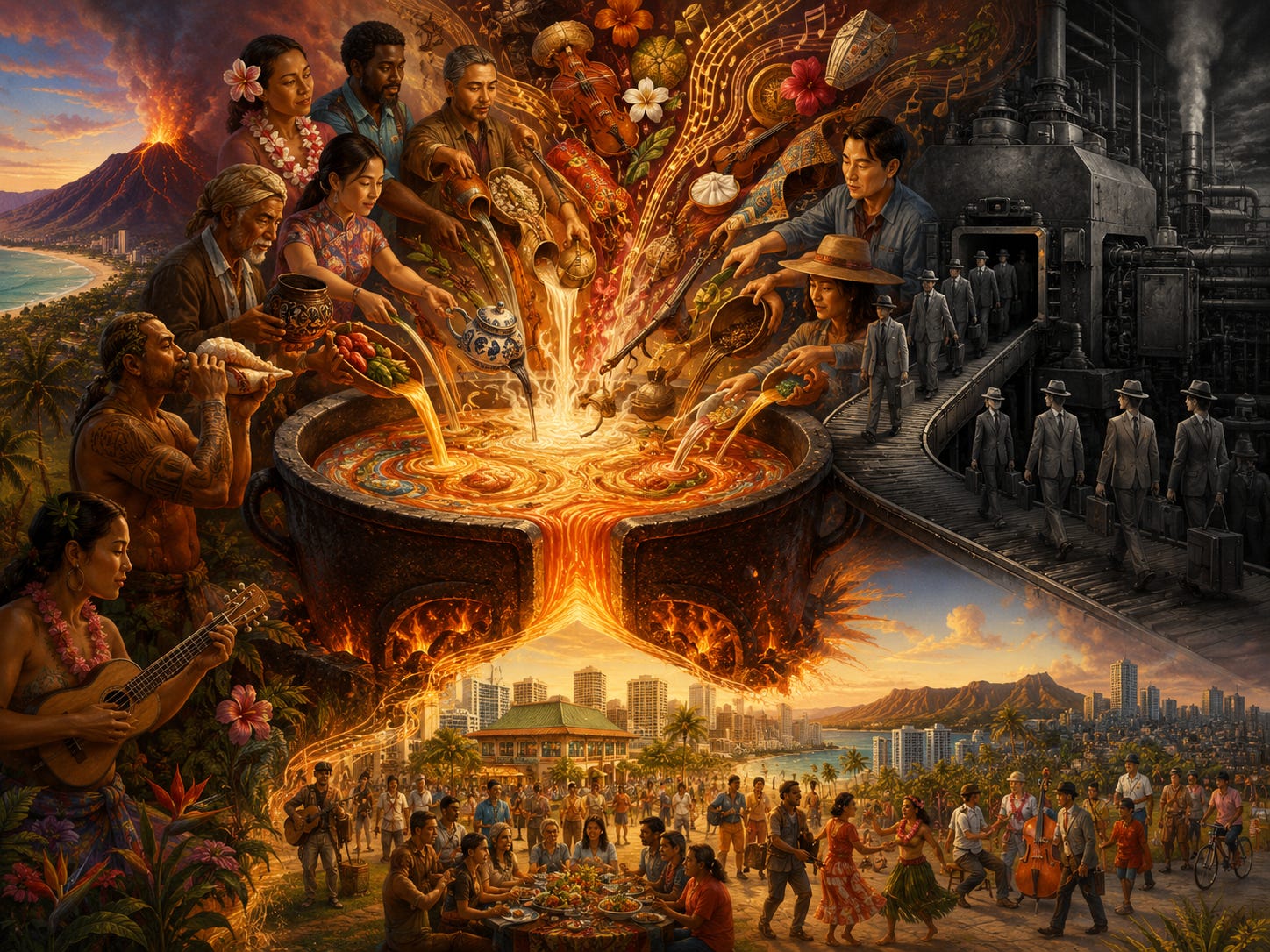
I got into it on Facebook recently with a friend over what “melting pot” actually means. He’d posted a list of what he thinks America is and should be—meritocracy, free markets, Constitution as written, sovereign nation, free speech, governed by the states. Good list. I agreed with most of it. First item: a melting pot of cultures. Second item: colorblind.
I told him I agreed with both, but I didn’t think we meant the same thing by either one.
Here’s what I wrote back:
“I think some people didn’t know that the melting pot meant, ‘you’re welcome as long as you completely assimilate to the dominant culture, even you, former slaves.’ I think Mr. Snuffleupagus should have been more clear about what ‘melting pot’ meant. Melting pot, to me, is that the entire pot ends up tasting like all the flavors. Not melting pot as in a soupçon of curry and a soupçon of chili. A melting pot of cultures means that the taste of the melting pot alloys differently according to the new introduced cultures—and not only as a ‘melt into the Judeo-Christian western-European, English-speaking America through assimilation.’ I don’t feel like that was ever the promise anyone made. Or assumed. They should have been way more explicit.”
That’s the whole argument. Everything else is unpacking it.
The problem starts with the word pot. Everyone hears pot and pictures a kitchen. A stockpot. A mulligan stew—which is what hobos made during the Depression by throwing whatever they could scavenge into a shared vessel over a campfire. The carrots stay carrots. The potatoes stay potatoes. Everything softens, everything flavors the broth a little, but you can still fish out the individual ingredients and identify them. That’s the food version. That’s what most Americans picture when they hear melting pot, and it’s the wrong picture entirely.
The people who originated the concept were not standing in a kitchen. They were standing in a forge.
Ralph Waldo Emerson wrote about America as a smelting pot in his private journal in 1845—sixty years before the phrase melting pot entered the culture, unpublished until 1912, which is why nobody knows it. Smelting is not cooking. Smelting is the process of applying extreme heat to ore to burn away everything that isn’t the metal—to extract from raw material something that was latent in it but couldn’t exist without the furnace. What comes out of a smelt is not what went in with the impurities removed. It’s a transformation at the molecular level. The material that emerges has a different melting point, different tensile strength, different conductivity, different properties in every measurable way than the ore that went in.
When a Jewish immigrant playwright named the concept for mass American consumption in his 1908 Broadway hit, he was thinking the same way Emerson was. He chose the metallurgical image deliberately. Put iron in. Put carbon in. What comes out is steel. Steel is not iron that learned to behave. Steel is a substance that didn’t exist before, with properties neither input had, and you cannot look at it and find the original iron anymore. You cannot un-smelt it. You cannot recover the inputs. The transformation is permanent, total, and irreversible—and it produces something with entirely different properties than anything that went into the furnace.
That’s what the melting pot actually means if you take the metaphor seriously. America as the crucible. Not the destination. Not the mold. The crucible. What comes out is genuinely new—not the dominant culture with seasoning added, not the immigrant with the accent trained out, but something that has everyone’s properties distributed through it and isn’t any of the originals anymore.
The food metaphor gave white America an escape hatch the metallurgical metaphor doesn’t offer. If it’s a stew, the ingredients are still in there—identifiable, recoverable, fishable-out. The pot can be steered toward a flavor profile someone prefers. Someone can decide too much curry is overwhelming the broth and adjust accordingly. But if it’s a smelt, none of that reassurance is available. What goes into the furnace does not come back out as what it was. The atoms rearrange. America was always Emerson’s smelting pot. It just got domesticated into a stockpot for a hundred and twenty years because stockpots are less frightening.
The most honest physical expression of what the mainstream American melting pot has actually meant in practice is what Henry Ford built on a stage for his English School graduation ceremony. Immigrant factory workers walked off a replica ship in their native costumes, stepped into a giant prop pot—an actual physical pot, built specifically for this purpose—and emerged from the other side in identical suits waving American flags. That happened. Someone designed and constructed that prop. That’s the version that won: you arrive as yourself and you leave as us. The pot is already done. The flavor is already set. Your job is to conform to it.
Not a smelt. A costume change.
This is not a conservative problem. This is a white American problem, which means it lives on both sides of every political argument white Americans have been having with each other for a hundred years.
The conservative version is at least coherent. Here are the norms. Here is the culture. Here is what functional participation in this society requires. Meet those standards and you’re welcome. There’s an honest transactional logic to it even if you find the terms objectionable. What you see is what you get.
The liberal version is the same transaction with the paperwork obscured. The diversity hire has to have gone to the right schools. Has to know which fork to use. Has to make white liberals feel cosmopolitan rather than challenged. Has to perform the right kind of otherness—exotic enough to be interesting, domesticated enough to be safe. The melanin is decorative. The culture underneath has to be fully legible. You don’t have to become white. You just have to become the kind of person white liberals can have at a dinner party without anyone feeling weird. And if that sounds achievable, notice what it actually requires: fluency in the dominant culture as the price of admission. Codeswitching as the cover charge. Tom Wolfe saw the entire structure in 1970 and called it Radical Chic. The cuisine at the fundraiser has gotten more interesting since then. The structure hasn’t moved.
Both versions share the same hidden premise. The pot’s flavor is already set. New arrivals are welcome to add color without changing the taste.
Colorblind, as actually practiced by white Americans of every political persuasion, operates from the same premise. On the surface it sounds like the enlightened position—judge people as individuals, don’t sort by race, let merit determine everything. The problem is that colorblind in practice means: I have decided not to see your race, which conveniently means I also don’t have to see your specific history, your specific culture, your specific set of inputs into the pot. I get to evaluate you as a deracinated individual against a standard I’ve already set, which happens to be shaped like me. That’s not colorblind. That’s assimilation with the assimilation part left unstated.
I grew up in Honolulu. Haole kid—white minority, St. Louis School for Boys, a city where Japanese, Filipino, Native Hawaiian, Portuguese, Chinese, and white people all occupied the same space without any single group setting the cultural default. What kept the daily peace wasn’t ideology. Nobody was running a multicultural seminar. Nobody was performing a position about it. People went to the beach. People went to work. By the time locals hit their twenties, they knew that being mean to haoles ended in prison. That’s a fence built from consequences. It worked.
What I didn’t have growing up in Honolulu was exposure to the specific mainland binary—white grievance and Black grievance calling and responding to each other, each organized around a story of what was owed and taken, each requiring the other to exist. That software never got installed in me. When I moved to the mainland and encountered the full performance of it, it read as alien. Not offensive. Just—what is this? Why are these people like this?
Because Hawaii already ran the actual experiment. Not the managed, narrated, institutionally supervised version. The real one. The pot ran long enough and hot enough with enough different inputs and what came out wasn’t the dominant culture with seasoning added. Pidgin is not broken English. It’s a language with its own grammar, its own logic, its own internal consistency, that emerged from the specific collision of peoples in that specific place. The food is different. The music is different. The social texture is different. Nobody voted on any of it. It just happened, because that’s what happens when you keep adding things to a pot that stays on the heat. The broth changes. The broth was always going to change.
And here’s the thing I’ll say that most people in this argument won’t: I want my haole culture to dominate the flavor. I like the taste of it. I think the Judeo-Christian western-European framework produced things genuinely worth keeping—rule of law, individual rights, free markets, the whole inheritance. That’s a real preference and having it doesn’t make me a monster. But I know it’s a preference, not a description of what the smelting process actually produces. And I know that even a fully monoracial, monocultural society doesn’t deliver on the preference’s own terms.
Sweden in the 1980s—before meaningful immigration, before anyone could blame the dysfunction on outsiders—had punk kids and skinheads and football hooligans and people drinking themselves sideways in the Miljonprogrammet housing blocks outside Stockholm. An unsolved prime minister assassination. Its own homegrown raggare—a rural working-class subculture built around 1950s American cars, considered threatening and embarrassing by respectable Swedes decades before the first Somali family arrived. Every society generates its own dysfunction from the same soil conditions: concentrated poverty, disconnected suburbs, alienated youth, broken economic mobility, generational transmission of damage. The dysfunction doesn’t care what the seed stock looks like. Appalachia is very white. It does not speak Midwestern newscaster English.
The melting pot argument in both its conservative and liberal forms has always functioned as a distraction from that. It is much easier to argue about who is contaminating the broth than to look honestly at what the heat itself does to people when economic conditions get bad enough and the pot stops being a place of transformation and becomes a place of pressure.
Pele doesn’t negotiate. The lava covers what was there, cools, and becomes new land—and the Big Island is physically larger because of it. You can stand at the edge and explain to the lava what you’d prefer to keep. The lava is not taking questions. That’s not destruction. That’s the smelting process at geological scale. What comes out is new ground that didn’t exist before, with properties the old landscape didn’t have.
America was always the forge, not the stockpot. Emerson knew it in 1845. The process has been running whether anyone consented to it or not—jazz, hip-hop, pidgin, the specific mongrel American English full of loanwords nobody voted on, the national character recognizable worldwide that isn’t English or Irish or African or Chinese or anything else that went into the furnace.
Mr. Snuffleupagus should have said so out loud. So should everyone since who has used the phrase while meaning its opposite. The least we can do now is say what we actually mean—which is that most of us, if we’re honest, wanted the mold. The costume change. The Ford graduation ceremony.
The smelting pot was always what we were going to get.