

I. The Stadium and the Silence
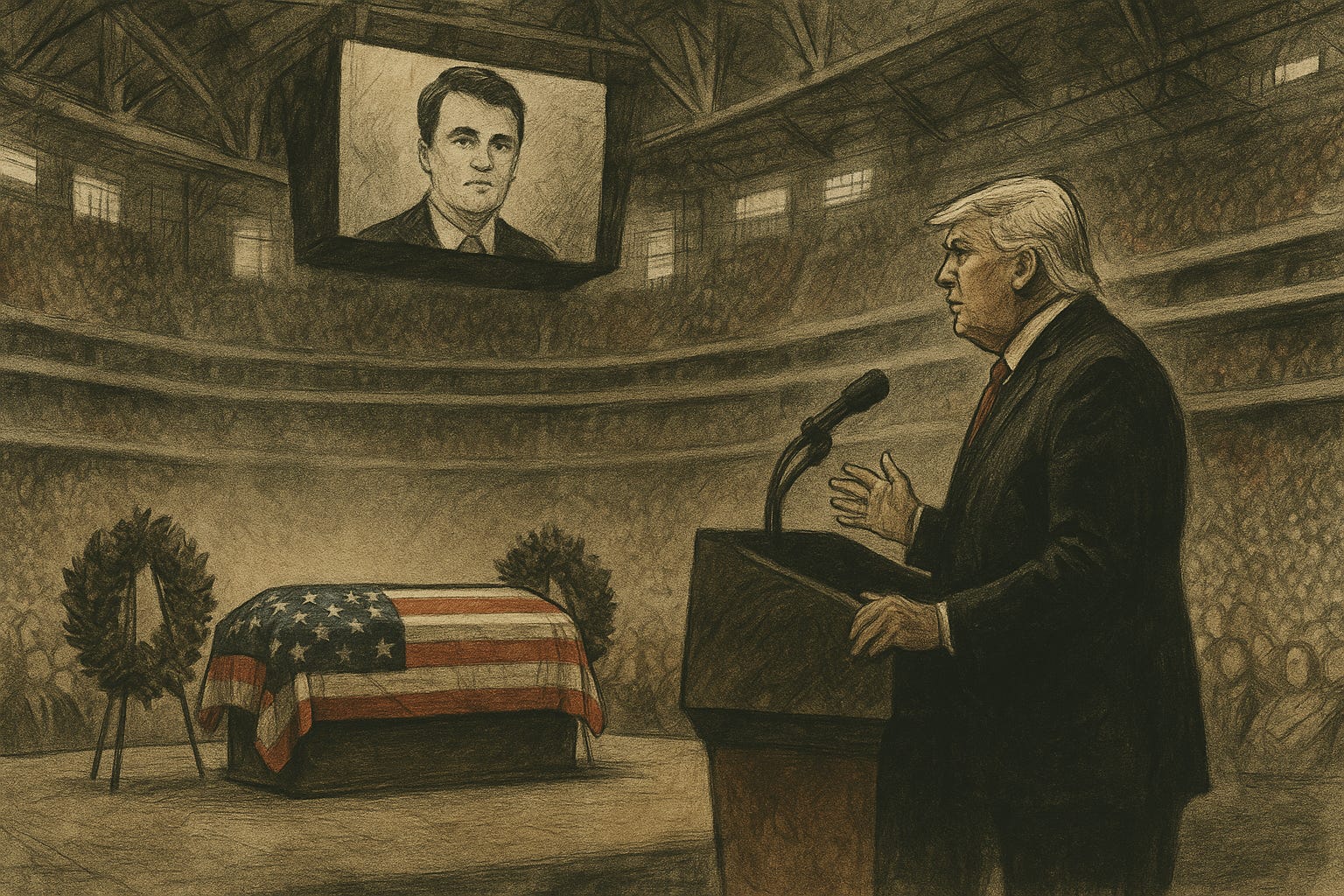
On a hot September afternoon, as the Arizona sun baked the parking lots around State Farm Stadium, tens of thousands gathered in a spectacle that was half sporting event, half national vigil. Inside, under the retractable roof, the coffin of Charlie Kirk lay draped in an American flag. Screens showed his image—boyish grin, comb-over, suit just a little too big—as if this were one of the Turning Point USA conferences he had once orchestrated. But this was not a pep rally. It was a funeral.
Donald Trump, now returned to the White House, took the podium first. His words were not conciliatory. He did not reach across the aisle. He promised vengeance. “We will not allow radical left lunatics to destroy America,” he thundered, his voice bouncing off the rafters. JD Vance, his vice president, called Kirk “a martyr to the cause of truth.” Cardinal Dolan compared him—astonishingly, controversially—to St. Paul. Erika Kirk, weeping but composed, pledged her husband’s voice would remain alive through her.
Outside, protesters clashed with police. Across social media, hashtags veered between lament and glee. At the same moment, in London, tens of thousands of far-right activists marched with placards of Kirk’s face. In Rome, Matteo Salvini declared, “I cried for Charlie. Now everything changes.” In Washington, flags flew at half-staff—though not for Melissa Hortman, a murdered Democrat.
In an America already polarized, Kirk’s killing became a Sarajevo moment. Gavrilo Princip’s bullet killed Archduke Franz Ferdinand in 1914, and within weeks Europe had plunged into a war no one had wanted but all had prepared for. Kirk’s assassination in 2025 felt eerily similar: a single shot in Utah, and within days the entire world was speaking as though politics had become a battlefield.
II. The Ladder of Escalation
This was not unforeseeable. In a prior essay I called “Hate Speech, Free Speech, and the Ladder of Escalation,” I argued that when speech is choked, when dissent is punished by employers or mobs, when the only outlet for hostility is silence, society primes itself for violence.
The ladder begins with ugly words. A tweet, a protest, an insult hurled in the quad. Instead of tolerating it, institutions increasingly punish it. People lose jobs. Students are expelled. Public shame campaigns follow. The message is clear: some opinions are not just wrong but unutterable.
Yet what happens to sentiments that cannot be spoken? They do not vanish. They metastasize. They find darker channels. And eventually, some fraction of those silenced will act, not speak.
This is not an abstract theory. It is nuclear physics.
III. The Implosion Trigger
Every schoolchild knows that nuclear bombs are not detonated by magic but by conventional explosives. The irony is that something as small as TNT can unleash something as devastating as a mushroom cloud.
The most common design is the implosion method. Around a core of plutonium—the “pit”—engineers place carefully shaped charges of high explosive. These are not random sticks of dynamite but “explosive lenses,” sculpted so that when they detonate, they send shockwaves inward, perfectly symmetrical, compressing the pit.
At normal density, plutonium is subcritical. It cannot sustain a chain reaction. But compress it with exquisite precision, and suddenly it crosses a threshold. Neutrons multiply. A runaway fission reaction begins. A city vanishes.
Words function the same way. An insult on its own is subcritical. But surround it with outrage, amplification, and perfect timing, and it becomes explosive. Outrage influencers are explosive lenses. Retweet storms are detonation wires. Media amplification is compression. Together, they can take a society that was merely brittle and drive it past criticality.
Private citizens are the blasting caps. A comedian’s joke, a professor’s misphrased lecture, a tweet from a teenager—small charges, but precisely placed, they set off the implosion.
Charlie Kirk’s assassination was not only a political murder. It was the implosion of a speech environment that had been primed for years.
IV. The Case Study: A Week in September
The shooting happened at Utah Valley University. Kirk was on stage, mid-debate. The suspect, Tyler Robinson, fired from a concealed perch. Cameras rolled. Within minutes the footage spread globally.
Day One: CNN reported Kirk was dead. Trump blamed the “radical left” before any facts were known.
Day Two: Vigils sprang up in Arizona, London, Malta. At one, supporters raised crucifixes and called Kirk a martyr. At another, European far-right leaders hailed him as proof of global convergence.
Day Three: Trump ordered flags at half-staff. ABC News reported he would posthumously award Kirk the Presidential Medal of Freedom.
Day Four: Social media fractured. Stephen King tweeted—and later apologized—that Kirk had advocated stoning gays. Comedy Central pulled a South Park episode mocking him. Coldplay dedicated a song, awkwardly, to “love and healing.”
Day Five: Fox News announced a Kirk tribute. Wired and Reuters reported calls for vengeance online. The Guardian noted JD Vance endorsed a doxxing campaign against Kirk critics.
Day Six: Armed men appeared at a memorial in Arizona. Erika Kirk spoke through tears. Trump doubled down on designating Antifa a terrorist group.
Day Seven: The frenzy spread globally—Elon Musk called Democrats “the party of murder.” European Parliament refused a moment of silence; a French MEP received death threats. The Pope himself prayed for Kirk.
The sequence was not spontaneous. It was implosion.
V. Words as Lenses, Institutions as Containment
This is the paradox: words must be tolerated not because they are harmless but because they are dangerous. Suppressing them does not defuse them; it concentrates them.
When employers fire staff for jokes, when universities cancel speakers, when mobs swarm a tweet, we are not preventing explosions. We are arranging the lenses. We are preparing the pit for criticality.
Institutions could serve as moderators. They could absorb insults, tolerate dissent, and model resilience. Instead, many have become amplifiers of outrage. Versailles was not just an end to World War I—it was a seed for World War II. Every punitive cancellation is a mini-Versailles. Every martyr is an Archduke.
VI. Theology, Mercy, and Sternness
Here is where theology matters. In John’s Gospel, Christ tells the adulterous woman: “Neither do I condemn you. Go, and sin no more.” Mercy does not mean indulgence. Sternness does not mean cruelty.
Our culture understands neither. We either indulge endlessly or punish mercilessly. What is lost is the paradoxical combination: stern mercy. To forgive the sinner while naming the sin. To protect the speaker while rebuking the speech.
This paradox is the only way to prevent implosion. Without it, we oscillate between permissiveness and vengeance, between laughter and bullets.
VII. Protecting the Square
What is to be done? Not censorship. Not vengeance. Not canonization. What is needed is protection of the civic square.
That means:
Legal restraint: Brandenburg already sets the bar—speech is only punishable if it incites imminent lawless action. That standard must hold.
Institutional resilience: Universities, corporations, and media must resist the urge to punish every transgression.
Cultural toughness: Citizens must learn to hear ugly words without collapsing.
Merciful exactness: Defend the right to speak, rebuke the content if necessary, but do not suppress it.
The alternative is torches.
VIII. Conclusion: The Hard Descent
A ladder is easy to climb, hard to descend. Outrage builds effortlessly; restraint is exhausting. Sarajevo proved it. Versailles proved it. Kirk’s funeral proved it again.
The nuclear analogy is not hyperbole. A society is a plutonium pit, always near critical mass. Words are the charges around it. The choice is whether we arrange them to implode us, or disperse them harmlessly into the air.
Charlie Kirk’s death was a tragedy, but the greater tragedy would be if his killing becomes the detonator for a republic that can no longer tell the difference between speech and war.
FAQ
Why compare speech to nuclear detonations?
Because like fissile material, societies are brittle. Words themselves are not critical, but when amplified with precision, they compress us into violence.
Isn’t hate speech violence?
No. Violence is violence. Speech may wound, but the distinction is vital. If we collapse the categories, we justify real violence against words.
Why defend ugly rhetoric?
Because without defense, suppression becomes the only tool, and suppression breeds violence. Better to defend speech and refute it than to muzzle it.
How does theology matter here?
Because only a framework of mercy and sternness can hold both freedom and responsibility together. Secular liberalism tends to collapse into indulgence or vengeance.
What’s meant by “protect the square”?
The civic space—physical and digital—where all speech can coexist without violence. Without it, politics becomes war.
Glossary
Brandenburg Doctrine: U.S. Supreme Court standard holding speech punishable only if it incites imminent lawless action.
Cancel Culture: Informal, extralegal punishment of speech by social or economic exclusion.
Explosive Lenses (metaphor): Social media outrage patterns that compress discourse into violence.
Implosion Trigger: The dynamic by which words ignite violence, as conventional explosives ignite nuclear fission.
Ladder of Escalation: The stepwise process from speech to ostracism to violence.
Versailles Analogy: Punishment of one side breeds resentment and the next war.
“Go and sin no more”: Gospel phrase embodying the paradox of mercy with sternness.
tl;dr
The source provides excerpts from an essay titled "Hate Speech, Free Speech, and the Implosion Trigger," which analyzes the assassination of conservative figure Charlie Kirk in 2025 as a pivotal moment demonstrating the fragility of political discourse. The author employs a nuclear analogy, comparing the suppression and amplification of offensive speech to the implosion method used to detonate an atomic bomb, arguing that attempts to silence unpopular views act as "explosive lenses" that concentrate resentment and lead to real-world violence. The text details the volatile global reaction to Kirk's death, including political vengeance promised by Donald Trump and mass far-right demonstrations, while asserting that institutions must adopt a strategy of "stern mercy"—defending the right to speak while rebuking hateful content—to prevent the political climate from reaching criticality. Ultimately, the document advocates for strict adherence to the Brandenburg Doctrine and fostering cultural resilience against offense to protect the civic square.


