
Words Without Anchors
How “Democracy” and “Fascism” Both Became Smuggling Operations, and Why Antifa Will Tell You That to Your Face

It started with an AI avatar named Atheist Adam telling me that any democracy worth the name has to be anti-fascist. Sounds clean. Sounds like something you’d nod along to before finishing your coffee. Then you ask what either word means anymore, and the whole thing falls apart in your hands.
Here’s the punchline before the essay earns it: I went looking for who’s lying about democracy, and the answer is everybody, including the people who’d tell you they’re not lying, because they’ve got a “real” definition tucked behind the fake one they hand out to normies. The State Department has one. Antifa has another. Neither one is the dictionary definition, and both of them know it.
The export version
Western democracy promotion didn’t stay a Cold War procedural project, elections, rule of law, peaceful transfer of power. It became what amounts to a civil rights algorithm: establish a progressive social norm, identify a traditional or religious target, label the target hate or regression, deploy “democracy promotion” to purge it. The algorithm needs an enemy to run. Liberation from constraint isn’t a thing you can enjoy quietly, it requires something to push against, so when the supply of obvious enemies runs low, the definition expands to manufacture more. That’s concept creep, and it’s not a vibe, it’s a documented mechanism.
Identity groups, women, queer people, religious minorities, become geopolitical litmus tests, not because Western institutions are uniquely obsessed with their wellbeing but because traditional non-Western societies are most distinct from the West exactly on these axes. Forcing the debate there creates an unbeatable wedge: resist the social package, get flagged inhuman or fascist, skip the harder conversations about sovereignty or economics entirely. It’s a humanitarian rescue mission with the serial numbers filed off a soft power operation.
The Algerian election of 1991 and the Egyptian election of 2012 are the tell. Real ballots, real majorities, wrong winners. If democracy means self-determination, those were democratic outcomes. The West’s discomfort with the results reveals the actual export was never the voting mechanism, it was a specific cultural payload riding inside it.
The mirror at home
Run the same shibboleth analysis domestically and you get a perfectly symmetrical structure. “Our democracy” functions as a password for the progressive status quo, a lawful conservative election outcome still gets called anti-democratic by the institutions that lost. Meanwhile “fascism” has been hollowed of its actual 20th century content, state control of the economy, totalitarian dictatorship, the elimination of corporate independence, and repurposed as a synonym for anyone who wants a secure border or doubts secular progressivism. Each side picked its own word to defend (the left took “democracy,” the right took “republic”) and built an absolute, civilization-ending villain out of the other side’s preferred term. Nobody invented this independently. Both sides converged on the identical move.
Push the fascism label far enough and you get a genuine mathematical paradox: border enforcement, religious conservatism, nationalism, and skepticism of globalist institutions all qualify, which means most of human history and most of the present global population gets classified fascist, leaving a tiny corner of acceptable progressive opinion as the only non-fascist position left standing. That’s not rhetoric, that’s the literal shape of the definition once you trace where it’s been stretched to.
Fascism, unbundled
There’s a clean before-and-after here. Call it v1944: jackboots, Panzers, extermination camps, a specific historical horror with a specific historical shape. Call the redefinition post-Zinn: landlord, cop, border agent, Law and Order itself recoded as the enemy. Older audiences, the ones a meme like this is often aimed at, never updated to the second definition. They hear fascist and picture the Wehrmacht. The rhetoric misfires on its own intended targets because the word means two incompatible things depending on who’s saying it and when they came of age.
And Antifa’s actual lineage doesn’t help the case for precision. It traces to 1930s Antifaschistische Aktion, not a leaderless emergent good-versus-evil coalition but a specifically communist project where fascism was Comintern-defined as capitalism in crisis, the bourgeoisie funding reaction to crush the working class. Under that framework anti-fascism and anti-capitalism are the same sentence, Nazis were the convenient current enemy, not the actual target. The men who stormed Normandy and fought across the Pacific were capitalists almost without exception, zero Marxist content, fighting for their families and their economic way of life. Modern Antifa borrows the moral authority of that generation while opposing everything they actually believed in. That’s not an insult, it’s just the lineage.
The confession
Here’s the part that should stop you cold, because it’s not me making the accusation, it’s what a Marxist, anarchist, or Maoist will tell you themselves if you ask directly: mainstream democracy is a fraudulent shield. They call it Bourgeois Democracy or Capitalist Democracy, an illusion where voting Democrat or Republican every four years makes normies feel powerful while the wealthy actually run everything, a moral cover for imperial wars and crushed dissent, all while claiming to defend the very thing it’s strangling.
But they don’t abandon the word. They claim the real one. Their definition is economic to the bone: you cannot call a country a democracy if its citizens spend eight to twelve hours a day inside a workplace dictatorship where a boss commands their labor and pockets the surplus. True democracy, in this frame, means the public collectively owns and votes on the factories and the wealth. The Dictatorship of the Proletariat sounds totalitarian to Western ears, but in Marxist theory it just means the majority using state power to suppress the minority, which they’ll tell you is the most majoritarian democracy there is.
And they’ll admit, if pushed, that they use the word as bait. It’s called the Popular Front strategy, and it works because ordinary liberals will never sign up for a violent collectivist revolution, but they will absolutely march to “defend democracy from fascism.” Once they’re marching, the hook goes in: you like democracy? Great, then why don’t we have democracy in our economy, why do billionaires run your life? The palatable word pulls people toward the radical payload they’d never have agreed to up front.
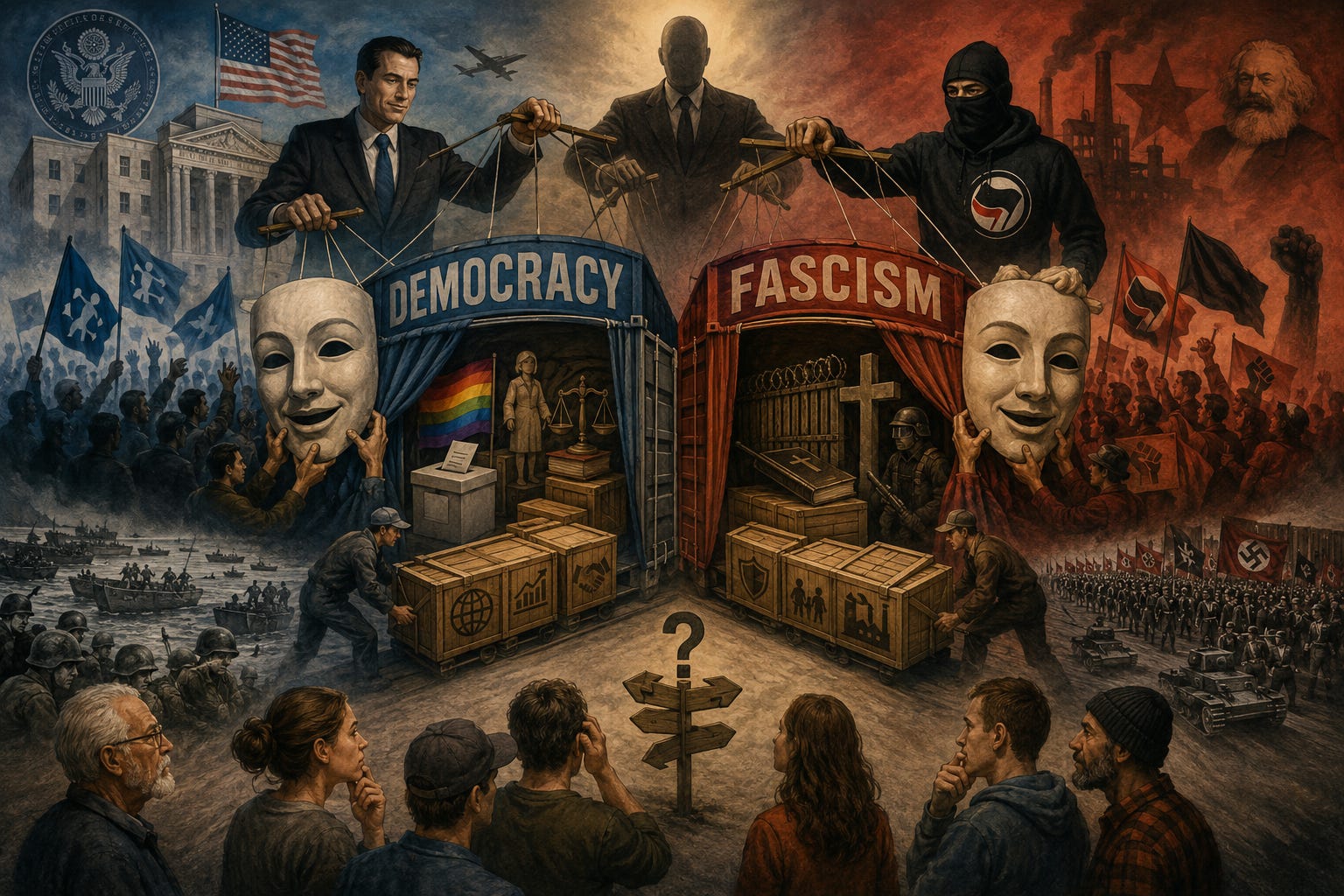
That is the entire essay in one move. The State Department runs this exact playbook in reverse, dressing a specific cultural and economic order in the language of self-determination so nobody has to debate the substance directly. Antifa runs it forward, dressing economic collectivism in the language of defending democracy so nobody has to debate the substance directly. Different cargo, identical smuggling method, and both sides will tell you, separately and proudly, that the other guy’s version is the fraud.
Why this can’t be negotiated
Concept creep isn’t free. It cries wolf, when literal neo-Nazis and ordinary populist voters get called fascist with equal intensity, the word stops warning anyone of anything real. It drives people out of the persuadable center, because nobody listens to a critique from an institution that’s already decided their beliefs make them evil. And it makes compromise structurally impossible, you don’t negotiate a tax rate or an infrastructure bill with a fascist, you defeat one. Once both major words in the room mean the other tribe is an illegitimate enemy rather than a fellow citizen with different priorities, you’re not doing politics anymore. You’re doing a religious war with secular vocabulary.
Even the messenger gives the game away. An AI avatar named Atheist Adam delivers “democracy must be anti-fascist” without blinking, because secularism, anti-fascism, and progressive democracy have fused so completely that nobody clocks the bundling anymore, not even the bot saying it. Concept creep finished its work generations ago. It didn’t just expand what fascist means, it welded an entire worldview into a single login name and called it common sense.
Where that leaves the word
Democracy was a procedure once: elections, rule of law, peaceful transfer of power, nothing more glamorous than that. Both poles of the current argument have abandoned the procedure and kept the brand, because the brand still polls well and the procedure doesn’t get anyone what they actually want. When literally every faction’s version of democracy is a vehicle smuggling something else past the gate, the word stops describing a system of government and starts functioning as a flag people wave while moving cargo nobody examined closely enough to ask for.
Appendix A: Glossary
Procedural democracy — Elections, rule of law, peaceful transfer of power. No required social or cultural content.
Liberal/substantive democracy — Procedural democracy bundled with a specific progressive social package (secularism, individual autonomy, specific civil rights frameworks).
Concept creep — The documented process by which a precise, severe term gets broadened until it covers far milder phenomena, eventually losing its descriptive power entirely.
Bourgeois democracy — The radical left’s term for mainstream Western liberal democracy, understood as a capitalist PR shield.
Substantive economic democracy — The radical left’s actual definition: collective ownership and democratic control of the means of production, not voting mechanics.
Popular Front strategy — Using a palatable mainstream cause (defending democracy) as a recruitment gateway toward a more radical, less popular goal (collectivism).
Counter-hegemony — Gramscian term for capturing cultural institutions (media, academia, entertainment) rather than just the state, as the real terrain of revolutionary struggle.
Prefiguration — Living the desired future system in the present, e.g. running an occupied space without police, money, or hierarchy.
Horizontalism — Rejection of leaders and representatives in favor of flat, consensus-based decision making.
Diversity of tactics — The internal-left norm that peaceful protest, lobbying, and property destruction are all valid, mutually non-judged tools toward the same end.
Democratic backsliding — Institutional shorthand for any elected government, however legitimately chosen, that enacts policy outside the global progressive consensus.
Critical Theory — Frankfurt School framework treating all traditional relationships (boss/worker, priest/parishioner, citizen/state) as oppressor/victim dynamics requiring permanent dismantling, not preservation or reform.
Appendix B: FAQ
Isn’t this just “both sides” centrism?
No. The point isn’t that both sides are equally right or wrong on policy, it’s that both sides have independently emptied the same two words of stable meaning and refilled them with their preferred payload. That’s a descriptive claim about rhetoric, not a moral equivalence claim about substance.
Doesn’t pointing this out just help the side currently winning the linguistic war?
Possibly, in the short term. But a word that means “whatever my side wants plus an insult for yours” stops being useful to anyone long after the news cycle moves on. Precision isn’t partisan.
Is Antifa actually this organized and self-aware?
The ideological lineage and vocabulary are real, documented, and traceable to specific 20th century theorists (Gramsci, Marcuse, the Frankfurt School). Whether any individual activist articulates it this cleanly varies, same as any movement.
What about the people using these words sincerely, without any of this strategic intent?
Most people using either word have no idea they’re standing inside someone else’s smuggling operation. That’s exactly the problem. The bait doesn’t require the recruit to know they’ve been hooked.
Appendix C: Timeline
1930s — Antifaschistische Aktion forms in Germany as an explicitly communist project against right-wing nationalist regimes.
1945 — V1944 fascism: the historical reference point of jackboots, Panzers, extermination, fixed in the minds of the generation that fought it.
1960s — Cultural shift (post-Howard Zinn historiography) begins recoding fascism toward landlord, cop, border enforcement, institutional authority generally.
1991 — Algerian elections produce an Islamist majority; Western-backed democratic opening yields a non-liberal outcome.
2001–present — Post-9/11 democracy promotion accelerates as explicit US foreign policy doctrine via State Department and USAID channels.
2012 — Egyptian elections repeat the Algerian pattern.
2020s — “Our democracy” and “fascism” solidify as mirrored partisan shibboleths in US domestic discourse.
2026 — An AI-generated TikTok persona named Atheist Adam delivers the fully fused version of the argument without apparent awareness of doing so.